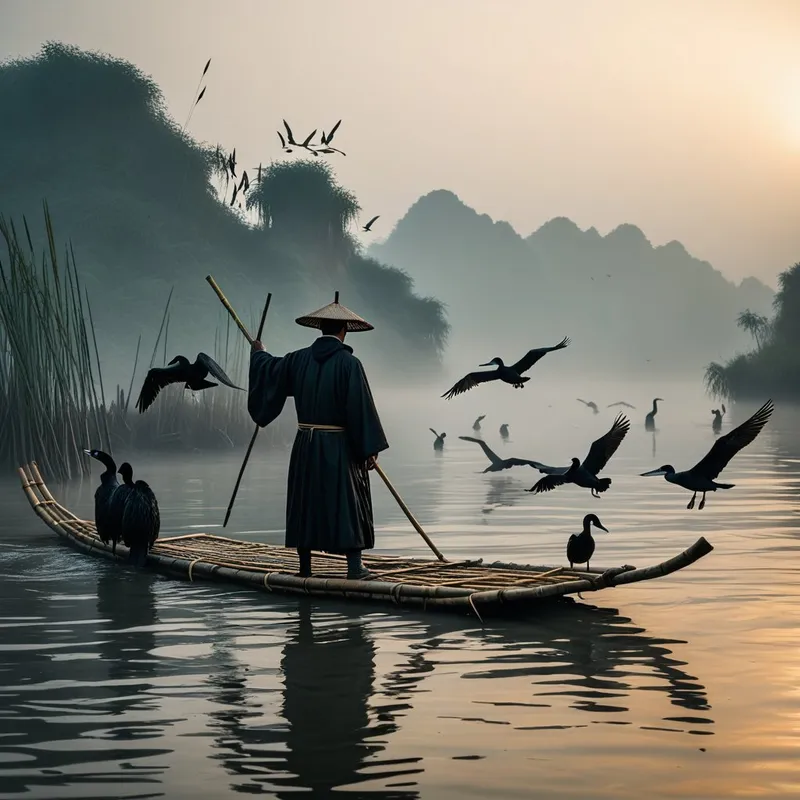
Cormorant Fishermen Myth Meaning & Symbolism
An ancient tale of a fisherman who forms a sacred pact with wild cormorants, learning their language to survive and finding his soul in the deep river.
The Tale of Cormorant Fishermen
Listen. The story does not begin on the water, but in the silence that follows a great hunger.
In a time when the river was a god and the sky its grey cloak, there lived a man named Lao Jiang. His village was starving. The rains had been cruel, then absent; the fish had fled to depths unknown, as if the river itself had turned its back. Lao Jiang, whose father and grandfather had been fishermen, pushed his bamboo raft onto the water each day, returning each dusk with empty nets and a heavier heart. Despair, cold and slick, began to coil in his gut.
One evening, as the last light bled into the mountains, he saw them. A flock of cormorants, black as polished obsidian, moved through a distant channel. They dove, vanished into the murk, and surfaced, their slender throats bulging with silver. They feasted while his children whimpered with empty bellies. A bitter thought arose: he would trap them, eat them, this thieving flock. He readied his net.
But as he watched, a strange reverence stayed his hand. Their movements were not chaotic, but a silent, fluid dance—a perfect conversation with the hidden world beneath the surface. He saw an elder bird, larger, with a wise, unblinking eye, watching him from a rock. In that gaze was no fear, only a deep, alien knowing. Lao Jiang did not cast his net. Instead, he sat on his raft, and he watched until the moon rose.
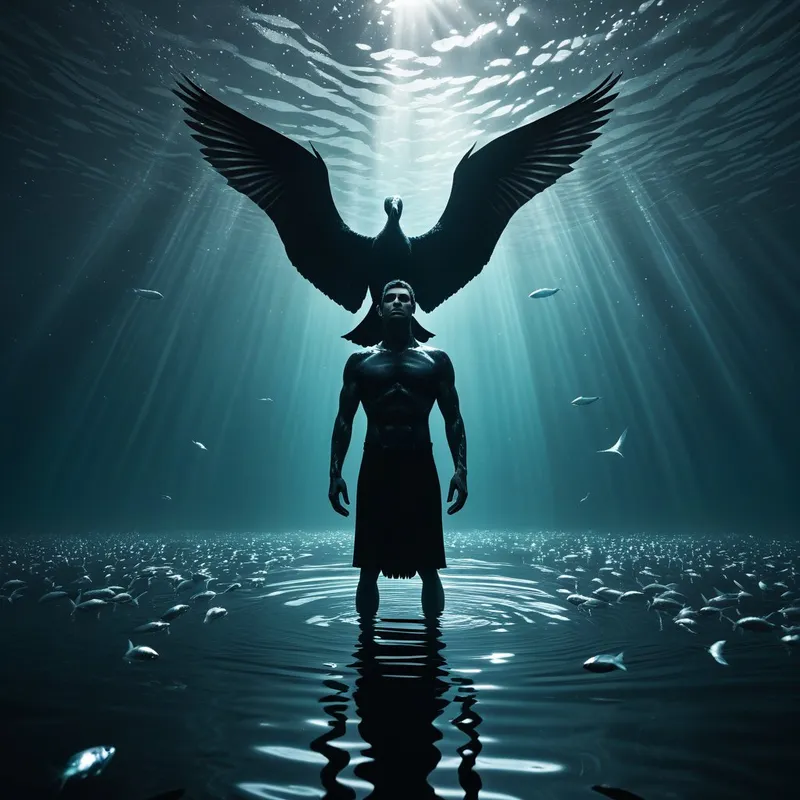
For three days and nights, he followed them, not as a hunter, but as a student. He mimicked their silent drift, learned the ripples that signaled a shoal. On the fourth dawn, exhausted and near delirium, he did not return to shore. When the cormorants dove, he dove with them, his lungs burning, his eyes open to the cold, green gloom. In that breathless descent, a vision came: not of catching, but of joining.
He surfaced gasping. The elder cormorant floated nearby, its head cocked. From a place deeper than thought, a sound escaped Lao Jiang’s throat—a guttural, clicking call, an imperfect mimicry of the bird’s own language. The cormorant stared. Then, it dipped its head, dove, and surfaced moments later. It paddled to the raft and dropped a fat, struggling carp at Lao Jiang’s feet.
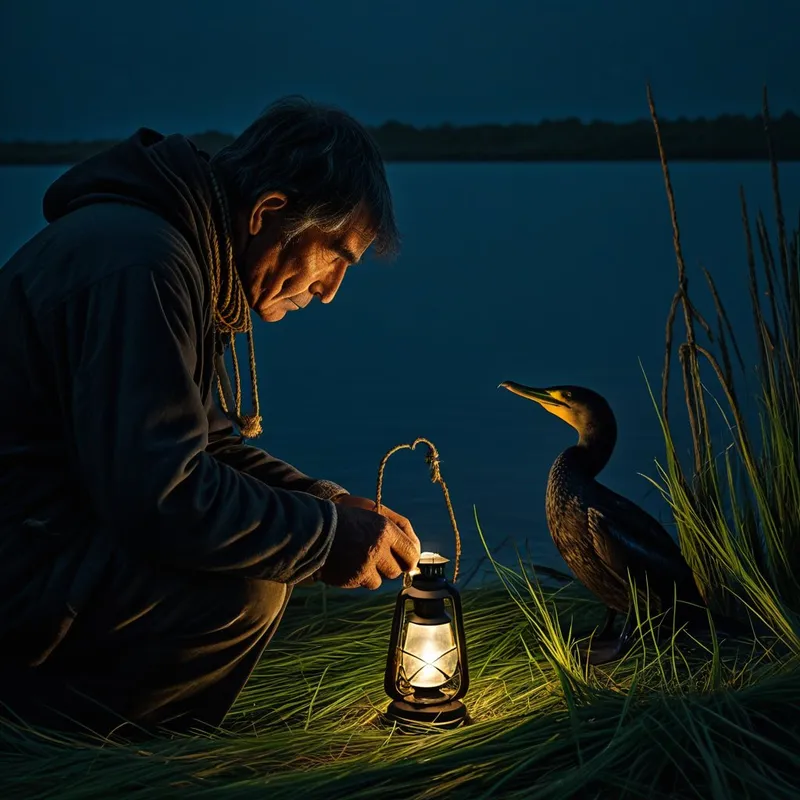
This was the pact, sealed not in words, but in mutual need. Lao Jiang learned to tie a gentle cord around the birds’ throats, not to choke, but to prevent them from swallowing the largest fish—a shared harvest. In return, he offered protection from other predators, a safe roost, and the first of the catch for their young. He became the bridge. The flock became his net. The river, once a barren foe, became a丰饶 (fēng ráo)—a place of abundant communion. He was no longer just a fisherman. He was the one who listens to the water’s black birds.
Cultural Origins & Context
This is not a myth of emperors or celestial battles, but a folk narrative born from the mudbanks and reedy shores of China’s great river systems, particularly the Yangtze and the Li River. For over a millennium, the practice of cormorant fishing was a tangible, economic reality. The myth of its origin served a vital societal function: it transformed a clever fishing technique into a sacred covenant.
Told by fishermen to their children on quiet nights, the story was a moral and ecological charter. It explained not how to control the birds, but why one had the right to. It framed the relationship as one of earned trust and reciprocal sacrifice, rather than domination. The fisherman-hero is not a mighty warrior, but a desperate man who achieves wisdom through humility, observation, and mimicry. This grounded the practice in values of harmony (hé xié) and respect for the natural world’s intelligence, a core tenet of both Daoist and ancient animist beliefs that permeated rural life. The myth ensured the technique was passed down not just as a skill, but as an ethos.
Symbolic Architecture
At its heart, this is a myth of the symbiosis between consciousness (the fisherman) and instinct (the cormorant). The fisherman, Lao Jiang, represents the human ego in a state of crisis—starving, isolated, and ineffective. His traditional tools (nets) have failed. The river, the unconscious, holds the bounty, but he cannot access it directly.
The cormorants are the emissaries of the instinctual psyche. They are creatures of two worlds: air (spirit, consciousness) and water (the unconscious, emotion, the depths). They dive fearlessly into the dark and bring up nourishment. They symbolize those raw, untamed parts of our own nature—intuition, primal skill, adaptive intelligence—that we often view as alien or “other.”
The pact is the central alchemical symbol: the conscious mind does not conquer the instinct, but learns its language and enters into a respectful agreement.
The gentle cord is profoundly important. It is not a shackle of oppression, but a limitation agreed upon for a shared goal. It represents the necessary tension between wild nature and cultural structure, between letting instinct run utterly free and directing its power toward a conscious purpose. The fish is the prize, the psychic energy or creative life force (qì) that is harvested from the depths through this collaboration.

The Dreamer's Resonance
When this myth stirs in the modern dreamer, it often signals a profound psychological transition. To dream of cormorants, or of diving birds, or of forming a pact with an animal, suggests the ego is in a state of “hunger”—perhaps creatively barren, emotionally dry, or lacking in vital energy. The old ways of “netting” solutions through sheer force of will are no longer working.
The somatic feeling may be one of frustration, followed by a peculiar, watchful stillness. The dreamer may find themselves in the dream observing an animal with intense focus, or attempting to make a sound that is not human. This is the psyche rehearsing the first step of the myth: the surrender of aggressive control and the turn toward attentive listening to the inner, instinctual self.
A dream of a cord or leash being applied gently, without cruelty, can indicate the nascent formation of a new inner agreement. The dream-ego is learning to “tie the cord”—to create a conscious relationship with a powerful, previously autonomous complex or drive, not to suppress it, but to collaborate with it and redirect its energy.
Alchemical Translation
The journey of Lao Jiang is a precise map of individuation. It begins with the nigredo, the blackening: the famine, the despair, the failure of the conscious attitude. This necessary darkness forces a crisis.
The albedo, the whitening, is the moment of purification and insight. It is Lao Jiang’s decision not to kill, but to watch; his delirious dive into the river (the unconscious); and his first, clumsy attempt at the cormorant’s call. This is the ego humbling itself, making itself permeable to the non-ego.
The transmutation occurs in the relationship. The Self is not the fisherman or the cormorant, but the functional, living system they create together—the raft, the birds, the man, and the flowing river.
The rubedo, the reddening or culmination, is the sustained practice. It is the daily ritual of partnership that yields sustenance and meaning. The fisherman becomes a sage not because he masters the birds, but because he becomes a fluent participant in a dialogue that is larger than himself. For the modern individual, this translates to identifying those “cormorant” aspects within—perhaps a fierce independence that needs to be channeled into teamwork, or a deep emotional intuition that needs to be brought into dialogue with logic. It is the art of building a psychic ecology where consciousness and instinct are not at war, but in a sacred, productive, and endlessly renewing pact. The bounty is no longer just survival, but a soul fed from its own deepest waters.
Associated Symbols
Explore related symbols from the CaleaDream lexicon: