Condor as World-Bridge Myth Meaning & Symbolism
An ancient Andean myth where the Condor spans the three worlds, bridging heaven, earth, and the underworld to restore cosmic balance.
The Tale of Condor as World-Bridge
Listen. The world was sick. A great silence had fallen between the realms. Hanan Pacha, the world above, hung in the sky like a distant, cold mirror. Kay Pacha, our world, was heavy, its rivers sluggish, its people speaking to the soil but hearing no reply. And below, in the deep belly of the earth, Uku Pacha seethed with forgotten whispers, its waters undrinkable, its truths buried.
The Paqos gathered on the bare stone, feeling the fracture in their bones. No rain came from above. No vision rose from below. The cord was cut. The worlds had turned their backs on one another, and in the stillness, a slow death was spreading.
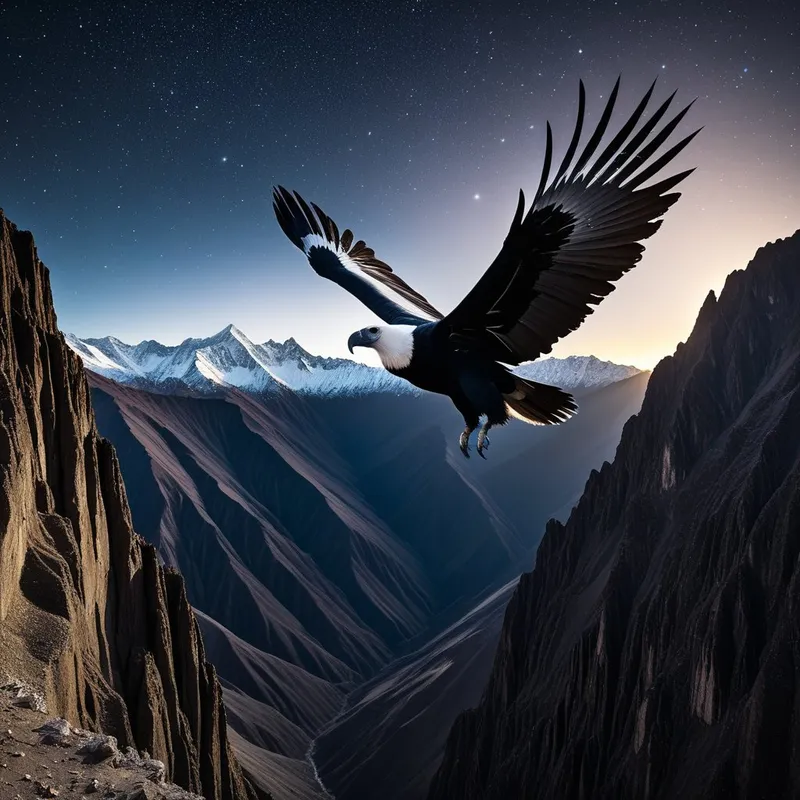
Then, from the highest peak where the air is thin and time itself grows faint, a shadow fell. It was Mallku, the Condor. Not as a mere bird, but as a concept given wings. His feathers were the black of the void between stars and the white of the highest snows. His eyes held the patience of the mountains.
He did not speak in words, but in an intention that vibrated through the stone. The task was impossible: to span the unspannable, to be the bridge where no bridge could be built. He launched himself from the pinnacle of Kay Pacha. With a beat of his wings that sounded like a tearing cloak, he ascended. He flew not just upward, but into—into the fabric of Hanan Pacha. His wingtips brushed the sun’s chariot, his breath mingled with the ice of the Milky Way. He drew down a thread of light, a filament of pure intention.
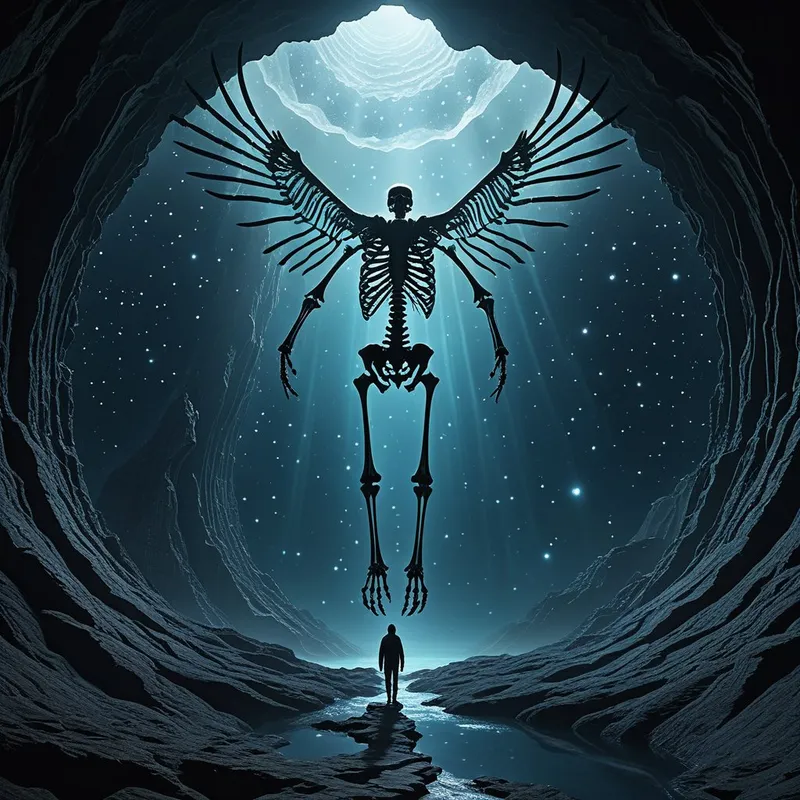
Then, the great turn. The descent. But not a fall—a purposeful plunge into the depths. He dove toward a sacred cave mouth, a portal to Uku Pacha. The warm, moist breath of the earth rose to meet him. He did not fear the dark. His talons, which had touched the celestial, now grasped the roots of the world, drawing up a thread of dark, fertile power.
And there he hung, in the eternal moment. His head in the stars, his heart level with the world of humans, his feet anchored in the underworld. He became the axis. The light from above flowed down his spine. The dark, rich energy from below flowed up. Where they met in his heart, a great thunderclap of silence echoed—not a sound, but a feeling of rightness. The rain began to fall, gentle and sweet. The springs bubbled forth, clear and cold. The people felt a warmth in their chests, a forgotten connection. The Condor did not build a bridge. He became it. And in becoming, he reminded each world of the other two, weaving them back into a single, breathing whole.
Cultural Origins & Context
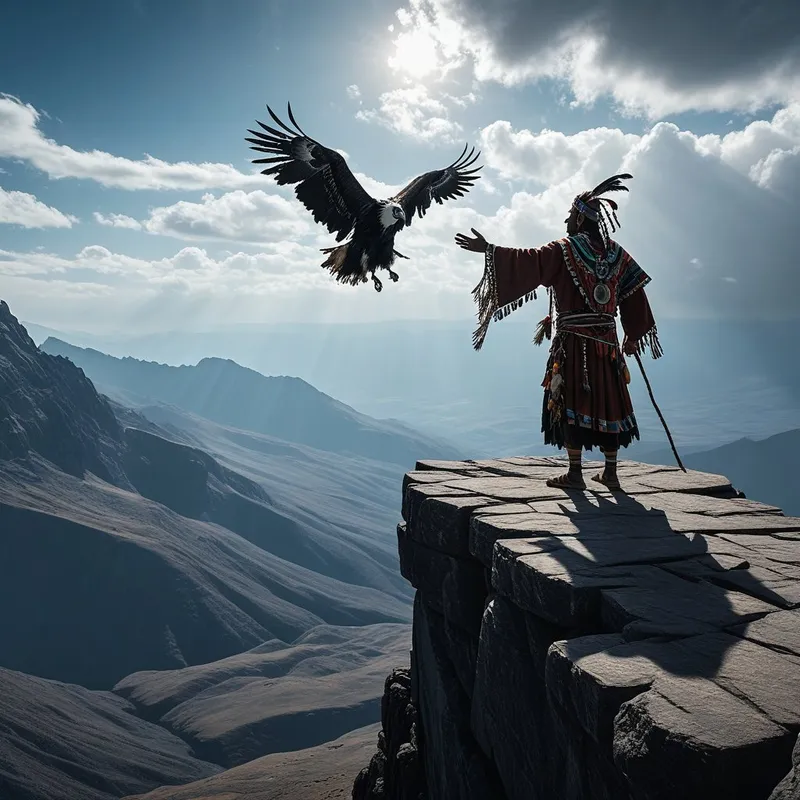
This myth is not a singular story with one author, but a living cosmological principle woven into the fabric of Andean consciousness, from the time of the Chavín to the Inka and enduring in contemporary Quechua and Aymara communities. It was passed down not by bards, but by the Paqos and elders through ritual, weaving, and oral teaching.
Its societal function was foundational: it was a map of reality. The tripartite world model (Hanan Pacha, Kay Pacha, Uku Pacha) was not just spiritual geography; it was a guide for living in balance (ayni). The Condor, as the greatest sky-being, was the natural mediator for this vertical axis. The myth taught that health—of a person, a community, or a crop—depended on the unimpeded flow of energy (sami or kawsay) between these worlds. A blocked connection meant illness, drought, or social strife. The Condor’s flight was the ideal to which all ritual and ethical action aspired: to facilitate connection and maintain cosmic equilibrium.
Symbolic Architecture
At its core, the myth is a master symbol of mediation and the transcendent function. The Condor is the ultimate unifier of opposites.
The bridge is not a path between two separate points, but the living embodiment of their essential relationship. To be the bridge is to hold the tension of the poles until a third, reconciling reality emerges.
Psychologically, the three worlds represent fundamental aspects of the psyche. Hanan Pacha is the realm of spirit, ideals, consciousness, and the father principle—our aspirations and higher thoughts. Uku Pacha is the unconscious, the instinctual, the chthonic, the mother principle—our buried memories, passions, and creative depths. Kay Pacha is the ego, the waking self, living in the "middle" of this eternal dialogue.
The Condor represents the Self (in the Jungian sense), the central archetype of order and totality. Its flight is the process of individuation. It does not reject the dark underworld for the bright heavens, nor wallow in the depths while spurning the heights. It acknowledges both as essential and connects them through the heart-center of the present moment. The "sickness" in the myth is the state of a fragmented psyche, where consciousness is alienated from its instinctual roots, and spirit feels like an empty abstraction.
The Dreamer's Resonance
When this myth stirs in the modern dreamer, it often signals a critical phase of psychic integration. One may dream of flying at immense altitudes yet feeling a pull from deep below, or of a giant bird whose shadow connects a mountaintop to a cellar. The somatic experience can be one of vertigo—a thrilling yet terrifying sense of being stretched between vastly different internal states.
This is the psyche attempting to bridge a divide. Perhaps the dreamer has been overly intellectual, living in a "spiritual bypass" of Hanan Pacha, and the dream condor forces a dive into the emotional or shadowy Uku Pacha. Conversely, one mired in depression or cyclical patterns (a stuckness in Uku Pacha) may dream of the condor's ascension, offering a vision of a higher perspective. The dream condor acts as the psychopomp of the vertical axis, guiding the dreamer's awareness to travel where it has feared to go, to hold the tension between a lofty goal and a grounded reality, or between a conscious attitude and a repressed complex.
Alchemical Translation
The alchemical process mirrored here is the coniunctio oppositorum—the sacred marriage of opposites. The modern individual's "cosmic sickness" is alienation: from the body, from nature, from the unconscious, or from a sense of meaning.
The work is not to choose between the eagle's height or the serpent's depth, but to undergo the metamorphosis that allows one to be the creature who authentically inhabits both.
The first stage is recognizing the "great silence"—the feeling that something essential is missing, that life is two-dimensional. This is the call. The "impossible task" is the ego's confrontation with the Self's demand for wholeness, which always feels beyond our capacity.
The alchemical operation is the Condor's flight. Ascension (sublimation) is the work of refining raw impulses into conscious values, seeking knowledge and perspective. Descent (mortificatio) is the equally vital work of confronting the shadow, engaging with grief, anger, and the fertile dark of the unexplored self. The pivotal, transformative moment is not in either extreme, but in the sustained tension of being the bridge—the heart where the light of awareness and the dark of the unknown meet and exchange substance.
For the individual, this translates to practices that consciously engage all "three worlds": meditation or study (Hanan Pacha), grounded action and relationship in daily life (Kay Pacha), and engaged shadow-work, dream analysis, or body-based practices (Uku Pacha). The goal is not to escape the human middle world, but to fully inhabit it as the sacred junction where spirit and matter, future and past, conscious and unconscious, can finally communicate through you. You become, in your own humble, human way, the world-bridge. The Condor’s flight becomes the model for a soul stretched into its full, connective stature, making the psyche once again a cosmos.
Associated Symbols
Explore related symbols from the CaleaDream lexicon: