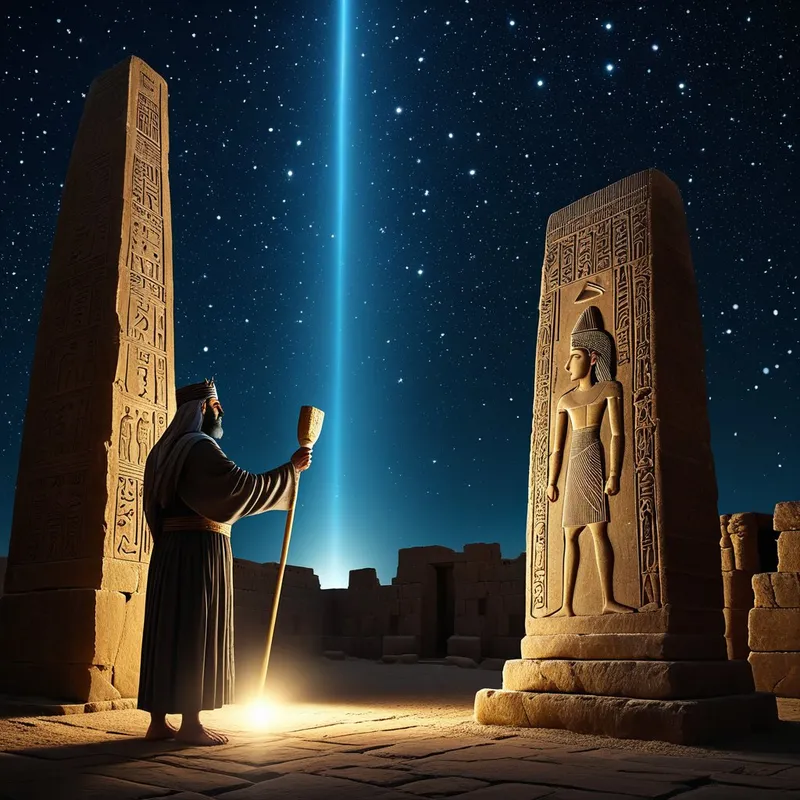
Code of Hammurabi Myth Meaning & Symbolism
The king receives divine law from the sun god, etching cosmic order into stone to bind the chaos of humanity and establish justice for the ages.
The Tale of the Code of Hammurabi
Hear now, and let the dust of ages settle. Let the Tigris and Euphrates whisper their old songs. In the time when cities were young gods of brick and ambition, when the sun’s path was the only true road, there ruled a king in Babylon. His name was Hammurabi, and his burden was the chaos of men.
His realm stretched wide, a tapestry of canals and barley fields, of bustling markets and silent, watchful temples. Yet, within this splendor, a discord hummed. The strong preyed upon the weak with a smile. The merchant’s scales tipped with deceit. The widow’s cry was lost in the wind, and the orphan’s plea found no ear. The land, though fertile, thirsted for a different water: the water of truth. The king, in his chamber of cedar and lapis, felt this thirst as a stone in his own breast. He would walk the ziggurat’s heights, gazing at the perfect, merciless procession of the stars, and despair of the imperfect, merciful chaos of his people.
Then came the night of the god’s breath. It was not a night of storm, but of profound stillness, as if the world held its breath. In the sanctum of Esagila, before the silent, awe-inspiring statue of Marduk, the king knelt not in petition, but in exhaustion. The weight of ungovernable humanity was upon him. And in that silence of surrendered power, a presence filled the space—not Marduk’s, but one even more fundamental.
The air grew warm, then golden. A light, not of lamp or star, began to emanate from the east-facing portal. It was the light of discernment, of boundaries, of all things seen clearly. And there, manifested in the gilded air, sat Shamash, the god of the sun and of justice. His visage was terrible in its clarity, bearded and crowned, seated on a throne of mountain stone. In one hand he held the rod and the ring, the symbols of measure and eternity. His gaze was not upon the king, but through him, seeing the tangled web of every dispute, every injury, every unspoken contract in the land.
Shamash spoke, and his voice was the sound of a thousand clay tablets being inscribed at once, a dry, firm rustle that held the finality of a mountain. He did not offer advice. He did not give suggestions. He revealed. Into the king’s mind flowed not words, but structures—principles of cause and consequence, of injury and restitution, of status and responsibility. It was the mathematics of society, the geometry of the human soul in conflict. If a man accuses another of murder but cannot prove it, the accuser shall be put to death. If a builder’s house collapses and kills the owner, the builder shall be put to death. If a son strikes his father, his hand shall be cut off. It was harsh, it was precise, it was unyielding as the sun’s journey. It was ma’at, it was me, it was the cosmic order applied to the mud and blood of Babylon.
Hammurabi did not feel chosen in that moment. He felt used, as a scribe is used by the stylus, as a riverbed is used by the water. He was the vessel. When the light faded and the ordinary darkness of the temple returned, the king was alone, but the structures remained, etched into his consciousness as if by a divine stylus. His despair was gone, replaced by a terrible, clear purpose. He summoned his master scribe. “Fetch the finest black diorite from the eastern mountains,” he commanded, his voice now carrying the timbre of the god’s rustling decree. “We will carve a stele. We will make the invisible law visible. We will set it in the temple courtyard for all to see, so that the orphan and the widow may read their rights, and the mighty man know his limits.”
And so it was done. The stone, darker than a moonless night, accepted the cuneiform wedges. At its summit, they carved the image of the king, standing reverent before the enthroned Shamash, forever receiving the law. Below, column after column, the judgments flowed—282 of them—a river of codified justice frozen in stone. When it was erected, the people gathered. They saw not just rules, but a cosmos in miniature. They saw the king, small before the god, but mighty in his execution of the god’s will. They saw that chaos had a boundary, and its name was Law.
Cultural Origins & Context
This is not a myth of the distant, foggy past, but the sacred narrative woven around a profound historical reality. The Code of Hammurabi (circa 1754 BCE) is one of humanity’s oldest and most complete legal compilations. The myth of its divine origin was its foundational legitimacy. In the Mesopotamian worldview, kingship itself descended from the heavens, and the king was the steward of the gods’ earthly domain. His primary duty was to maintain kittum (truth/order) and mēšarum (justice), combating ḥubur (chaos).
The tale was propagated through the stele itself—dozens of copies were likely erected in city centers and temples. The prologue and epilogue, written in majestic poetic cuneiform, are the myth in written form, declaring Hammurabi as the “shepherd” called by the gods “to cause justice to prevail in the land, to destroy the wicked and the evil, that the strong might not oppress the weak.” It was told by priests in temples and by royal heralds in squares. Its function was tripartite: to legitimize Hammurabi’s dynasty and centralized authority, to unify the diverse legal traditions of conquered Sumerian and Akkadian city-states under a single Babylonian standard, and most importantly, to project the law as an eternal, transcendent reality, not a mere human invention subject to whim or corruption. The law became a tangible participant in the divine cosmology.
Symbolic Architecture
The myth’s core symbol is the Stele itself. It is the axis mundi where heaven meets earth, the channel through which cosmic order (me) is crystallized into societal structure (law). Shamash represents the transcendent, impersonal principle of justice—objective, illuminating, and severe in its logic. Hammurabi represents the human vessel of consciousness that must receive, interpret, and enact this principle in the flawed, subjective world of human relations.
The law is the shadow cast by the light of consciousness onto the chaotic ground of instinct. It is not the light itself, but its first, most necessary shape.
The famous principle of “an eye for an eye” (lex talionis) is often misunderstood as mere brutality. Symbolically, it represents the profound psychological concept of limit and equitable resonance. It says: no action exists in a vacuum; every force generates a counter-force of equal measure. It is the universe’s law of karma applied to human ethics, a attempt to prevent the escalation of vendetta into all-consuming chaos by containing retaliation within a strict, proportional frame. The Code’s varying judgments based on social class (awilum, muškēnum, wardum) symbolize the differentiated psyche itself—the internal “ruler,” the “commoner” or ego, and the “slave” or shadow—each with different responsibilities and vulnerabilities under the eye of the Self (Shamash).
The Dreamer's Resonance
When this myth pattern stirs in the modern dreamer, it seldom appears as a Babylonian king. More likely, one dreams of finding a forgotten, heavy book of immutable rules in a basement; of standing trial before a blinding light where one’s every action is coldly evaluated; of trying to inscribe a vital principle onto a shifting surface that won’t hold the marks. These are dreams of the psyche seeking, or struggling against, internal structure.
The somatic sensation is often one of pressure, of a weight of responsibility, or conversely, of a desperate need for containment. Psychologically, this marks a critical phase where the chaotic, conflicting impulses of the personal unconscious (the “chaos of the kingdom”) demand adjudication. The dreamer is being called to become their own Hammurabi—to consciously receive the inner “laws” of their own nature. This is not about adopting external moral codes, but about discovering the innate, often severe, principles that govern their own psychic equilibrium. Resistance to this process manifests as dreams of illegible codes, corrupt judges, or shattered tablets—a psyche in rebellion against its own necessary order.

Alchemical Translation
The individuation process modeled here is the transmutation of chaos into cosmos through the imposition of conscious form. The “base material” is the leaden, chaotic swirl of unconscious complexes, compulsive behaviors, and unexamined conflicts. The “divine encounter” is the moment of lucid self-reflection, where the light of consciousness (Shamash) reveals the objective patterns within the subjective mess.
The king must first kneel in despair before the god within. The surrender of the ego’s arrogant control is the prerequisite for receiving the authority of the Self.
Hammurabi’s work is the alchemical opus: the long, laborious task of etching these revealed principles into the enduring stone of daily life and habit. This is the creation of a personal ethic—not borrowed, but received from the depths. The “code” that results is the unique, non-negotiable framework that allows the individual to function with integrity. It defines boundaries (“if this, then that”), administers inner justice (holding parts of oneself accountable), and ultimately, like the public stele, serves to unify the disparate “city-states” of the psyche under a central, legitimizing authority. The triumph is not law as repression, but law as the vessel that makes complex life possible. The modern individual completes this alchemy when they move from being a subject of their inner chaos to the sovereign over it, a ruler who derives authority not from personal whim, but from a dialogue with the transcendent law of their own being, etched in the black diorite of lived experience.
Associated Symbols
Explore related symbols from the CaleaDream lexicon: