Cloud Ladder Myth Meaning & Symbolism
A myth of a celestial ladder connecting heaven and earth, built by a hero, then destroyed by a jealous god, severing the direct link between realms.
The Tale of Cloud Ladder
In the dawn of the world, when the vault of heaven lay close enough to brush the tops of the sacred peaks, the air thrummed with a different music. It was a time of whispers between realms. The gods of Tian walked the earth, and the most virtuous of humans could, with a determined heart, ascend the mountain paths and find themselves amidst the courts of the celestial.
But the heart of a deity is a fickle and jealous thing. The Jade Emperor, gazing down from his jade palace, grew weary of the constant traffic. The sanctity of his realm, he felt, was diluted by mortal ambition and mortal sorrow. So, with a decree that shook the pillars of the clouds, he commanded the celestial winds to rise and the foundations of heaven to recede. The gap between Tian and Di widened into a terrifying, silent gulf. The music ceased. The path was lost. Humanity was left gazing upward, orphaned, remembering a communion now severed.
Yet, in the breast of one man, that memory burned as a command. His name was Zhuanxu, a grandson of the Yellow Emperor, and in his veins flowed both royal mandate and divine discontent. He could not accept this silent sky. Gathering the most potent shamans and the wisest star-readers, he convened them on the greatest of mountains, Kunlun. "We will build a bridge," he declared, his voice cutting the thin air. "Not of stone or wood, but of the substance between—of cloud and aspiration, of ritual and focused will."
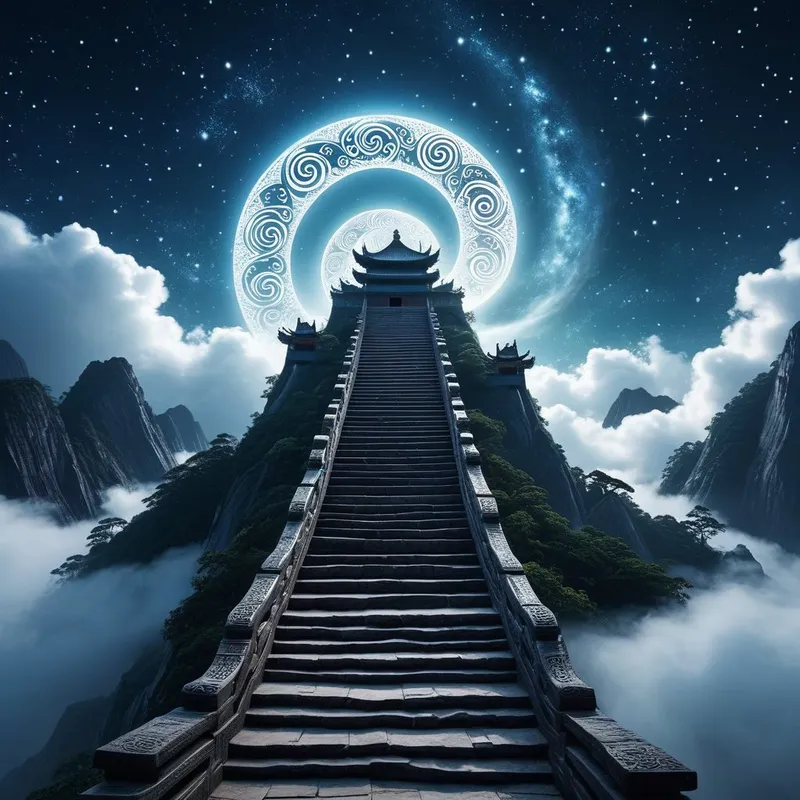
For years they labored. They did not carve; they convinced. Through intricate dances that mimicked the swirling of nebulae, through chants that held the pitch of the solar wind, and through offerings of utmost purity, they entreated the very fabric of the atmosphere. Slowly, impossibly, the mists began to obey. Vapors coalesced into luminous, solid-seeming steps. Winds braided themselves into handrails of cool, thrumming energy. A staircase emerged, spiraling upward from the pinnacle of Kunlun, its base rooted in earth, its summit vanishing into the pearlescent haze of the lower heavens. They called it the Titian, the Ladder to Heaven, or more poetically, the Cloud Ladder.
And it worked. The chosen, the righteous, began to climb. Once more, a fragile exchange was established. But in the high halls of heaven, the Jade Emperor watched this audacious scaffold with a mounting storm in his eyes. This was not merely a path; it was an act of defiance, a mortal finger tracing a line back to a door he had deliberately closed. His patience, never vast, shattered.
He summoned Zhongli and Gonggong. No gentle decree this time, but a cataclysm. He ordered the god of fire to burn the ladder's base and the god of water to drown its foundations. From the sky fell not rain, but a deluge of liquid sky-fire and crushing celestial water. The beautiful, painstakingly woven Cloud Ladder convulsed. Its ethereal steps dissolved into torrential rain and scorching mist. The connection was violently unmade, the ladder shattered into the very clouds from which it was born, scattering its essence to the four winds. The great gulf was restored, wider and more absolute than before. The direct ascent was forever lost, leaving only the echo of the climb and the enduring ache for the sky.

Cultural Origins & Context
The myth of the Cloud Ladder is not a single, codified story from one text, but a resonant fragment woven through the fabric of early Chinese mythological thought. It appears in fragments in texts like the Shan Hai Jing and is echoed in the lore surrounding mythological emperors like Zhuanxu and Huangdi. This scattering is itself symbolic; the story is about a lost unity, and its own transmission mimics that state—remembered in pieces, a shared cultural memory of a rupture.
It functioned as an etiological myth, explaining a profound cosmological and psychological shift. It answered the silent question: Why are the gods so distant? Why must we rely on omens, divination, and ancestor worship instead of direct discourse? The myth established the current world order—one of separation—as the result of a specific, tragic event involving both human ambition and divine jealousy. It was likely perpetuated by shamans (wu) and ritualists who, even as they told the tale of the ladder's destruction, performed the very rituals (ascents of spirit during trance) that sought to temporarily rebuild it in the non-material realm. The myth thus validated their role as the necessary intermediaries in a broken world.
Symbolic Architecture
At its core, the Cloud Ladder is an axis mundi—a world axis connecting the three realms of Heaven (Tian), Earth (Di), and the Underworld. Its destruction marks the traumatic transition from a participatory universe to a hierarchical, distant one.
The ladder is not just a path upward, but the connective tissue of the cosmos itself. Its shattering is the primal wound of consciousness, the moment we became aware of our separation from the source.
Psychologically, Zhuanxu represents the heroic aspect of the ego that refuses to accept a state of alienation. He is the part of the psyche that seeks reintegration with the Self (the symbolic Tian), the wholeness that consciousness has split off from. His building of the ladder is a monumental act of cultural and psychic synthesis—an attempt to consciously re-engineer a connection to the divine using the tools of ritual, symbol, and will (the shamans and their arts).
The Jade Emperor’s wrath is the inevitable counter-force from the unconscious totality. The Self, in its majestic and often terrifying autonomy, does not always welcome the conscious ego’s attempts at reunion on the ego’s terms. The destruction is a brutal lesson in boundaries. It says that direct, unmediated possession of the sacred is annihilating; the gap is necessary for life and individual identity to exist. The myth encodes the danger of inflation—of the ego believing it can storm heaven and take its place among the gods without being dissolved.
The Dreamer's Resonance
When this myth stirs in the modern unconscious, it manifests in dreams of precarious ascent. You may dream of endless staircases, ladders that sway or have missing rungs, elevators that shoot past their floors into void, or climbing a mountain that grows taller with every step. The somatic feeling is crucial: it is often one of immense effort, vertigo, and a deep anxiety about the stability of the structure beneath you.
This is the psyche working through a process of ambitious expansion that feels both necessary and perilous. Perhaps you are reaching for a promotion, striving for a spiritual breakthrough, or attempting to bridge a gap between your current identity and a perceived higher potential. The dream is rehearsing the ancient drama. The climbing is your Zhuanxu-like ambition. The instability of the ladder is the warning from the inner Jade Emperor—the Self-regulating function of the psyche that may sabotage an ascent that is too rapid, too ego-driven, or too dismissive of necessary human limitations. The dream asks: What are you trying to force? What part of heaven are you trying to claim without paying the celestial price of humility and indirect approach?
Alchemical Translation
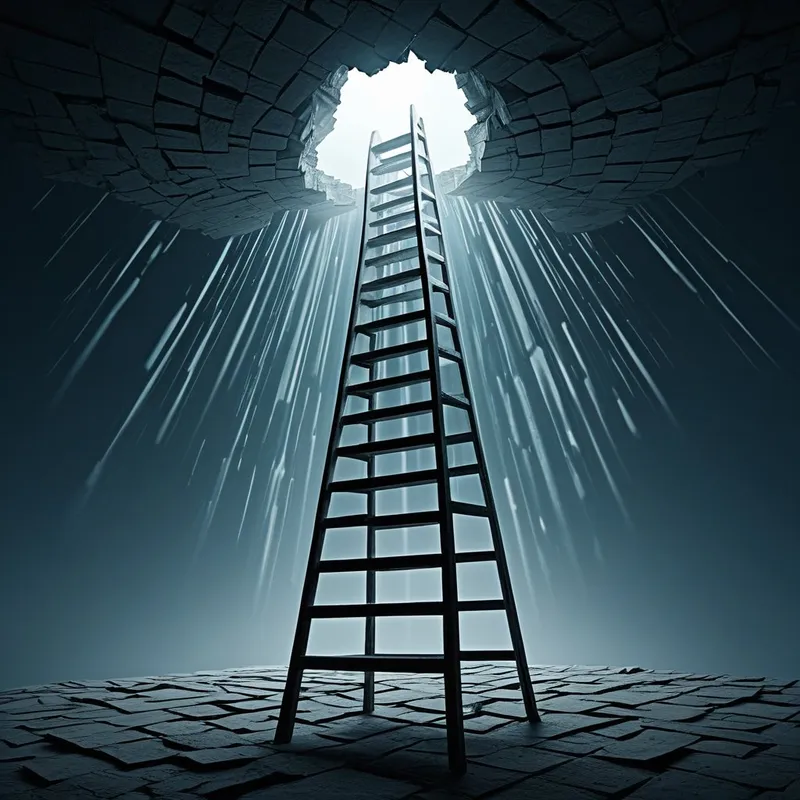
For the individual, the Cloud Ladder myth does not end with its destruction. That is merely the end of the first, naïve act. The alchemical work begins in the aftermath. The shattered ladder, its essence scattered to the winds, becomes internalized. We cannot build an external staircase to the divine, but we must, for our wholeness, find the means to make the journey within.
The true alchemy is the transmutation of the shattered ladder's substance into an inner compass. Each scattered cloud-step becomes a moment of insight, each wisp of the dissolved handrail a thread of intuition.
The forced end of direct ascent necessitates the development of indirect technologies of connection—the very practices the myth historically justified. In psychological terms, this means abandoning the hero’s brute-force will (which leads to inflation and divine wrath) and cultivating the functions of the shaman or the sage. This involves dream work, active imagination, careful attention to synchronicities, and the humble observation of complexes—all modern forms of divination. We build an inner Cloud Ladder not through defiance, but through dialogue; not by storming heaven, but by learning its symbolic language as it speaks through our own depths.
The ultimate triumph is not in reaching a static heaven, but in realizing that the gulf itself is the sacred space. It is in that tension—the yearning, the not-possessing, the eternal reaching—that consciousness is forged and creativity is born. The ladder is gone, but the impulse to climb becomes the very structure of a soul in dialogue with its own infinite mystery. We become, not gods, but human—the beings born in the crucible of that beautiful, terrible, and necessary separation.
Associated Symbols
Explore related symbols from the CaleaDream lexicon: