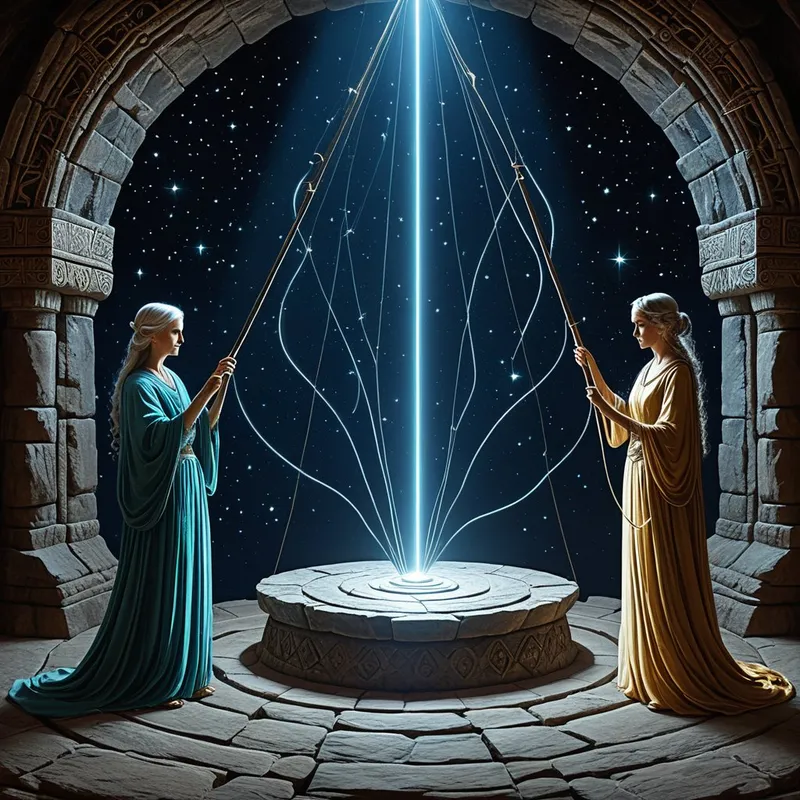
Clotho, Lachesis, Atropos Myth Meaning & Symbolism
The three Moirai, Clotho, Lachesis, and Atropos, spin, measure, and cut the thread of life, embodying the inescapable destiny of all beings.
The Tale of Clotho, Lachesis, Atropos
Listen, and hear the hum that underlies [the world](/myths/the-world “Myth from Tarot culture.”/). It is not [the wind](/myths/the-wind “Myth from Various culture.”/) in the pines, nor the crash of [the sea](/myths/the-sea “Myth from Greek culture.”/) on the shore. It is the sound of a spindle, whirling in the deepest dark. It is the song of the thread.
In a place beyond the sun’s chariot and [the moon](/myths/the-moon “Myth from Tarot culture.”/)’s silver path, where the roots of the Okeanos drink from the well of all things, there sits a cave. No mortal foot has ever found it, though every mortal soul is drawn there. The air is thick with the scent of wool, oil, and cold stone. The only light comes from the threads themselves, filaments of gossamer and starlight, each pulsing with a unique rhythm—a heartbeat, a breath, a life.
Here, [three sisters](/myths/three-sisters “Myth from Native American culture.”/) dwell. They are the [Moirai](/myths/moirai “Myth from Greek culture.”/), daughters of primordial Nyx, and their will is older than the gods. The first is [Clotho](/myths/clotho “Myth from Greek culture.”/), “the Spinner.” She is youth and inception. With fingers that never tire, she draws the raw, luminous stuff of existence from a bottomless distaff and twists it into being. Her spindle turns, and with every rotation, a soul is given its beginning. The thread is born—weak, new, full of potential, singing its first note in the cosmic hum.
The thread passes to the second sister, Lachesis, “the Allotter.” She is the fullness of time, the measurer of the middle. Her eyes, the color of a deep and knowing sky, see all the thread’s possible paths. She takes the strand from Clotho and, with a rod marked by the [constellations](/myths/constellations “Myth from Various culture.”/), she determines its length. She apportions the lot—the joys, the sorrows, the triumphs, the mundane hours. She does not decide the quality of the thread’s color, for that is spun in by the choices of the one who lives it, but she decrees its span. The thread runs through her careful hands, and its song grows complex, a melody of years.
Finally, the thread reaches the third sister, Atropos, “the Inflexible One.” She is age and ending. She does not smile. In her lap rests a pair of shears, their blades forged from a substance darker than obsidian and sharper than finality. She waits. She listens to the thread’s song as it plays out the measure Lachesis has given. When the final note is destined to sound, when the pattern is complete, her hand moves. There is no hesitation, no appeal. The snip is a sound so small it is almost silence, yet it echoes through the halls of Zeus himself. The hum ceases for that one thread. The song is over. The shears are the only [thing](/myths/thing “Myth from Norse culture.”/) in all creation that even the mightiest god fears, for what is cut cannot be rejoined.
And so it is, from the first cry of a newborn to the last sigh of an emperor. The spindle turns, the rod measures, the shears fall. The great tapestry is woven, one inevitable, singular thread at a time.
Cultural Origins & Context
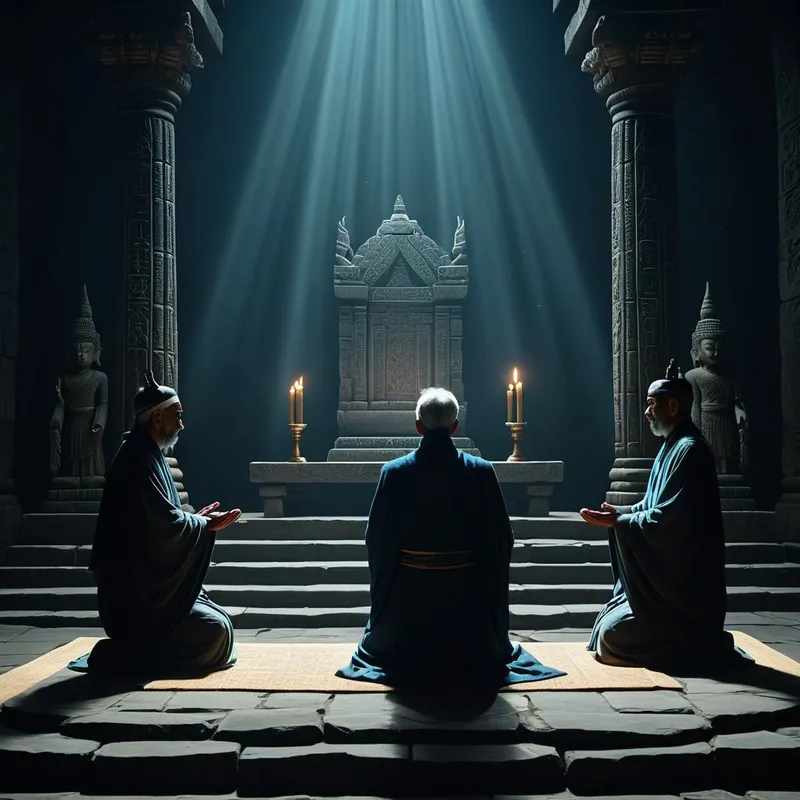
The myth of [the Moirai](/myths/the-moirai “Myth from Greek culture.”/) is not a story told for mere entertainment around a fire. It is a foundational pillar of the Greek worldview, a theological and philosophical answer to the most pressing human questions: Why do things happen? What controls our lives? Their presence permeates the literature, from the stark epics of [Homer](/myths/homer “Myth from Greek culture.”/), where they are [the force](/myths/the-force “Myth from Science Fiction culture.”/) even heroes cannot defy, to the tragic plays of Aeschylus and Sophocles, where characters wrestle with the fate written for them.
They were originally chthonic, [underworld](/myths/underworld “Myth from Greek culture.”/) powers, born of Night, which speaks to their association with the ultimate, dark mystery of [death](/myths/death “Myth from Tarot culture.”/). Over time, they were integrated into the Olympian order, often said to be the daughters of Zeus and [Themis](/myths/themis “Myth from Global/Universal culture.”/), thus linking destiny (Moira) with divine law and [justice](/myths/justice “Myth from Tarot culture.”/). This evolution reflects a cultural negotiation between an older, more impersonal cosmic order and the newer, more personified [pantheon](/myths/pantheon “Myth from Roman culture.”/). Their societal function was profound: they provided a framework for accepting the unacceptable—untimely [death](/myths/death “Myth from Tarot culture.”/), tragic downfall, the limits of power. To know one’s moira was to know one’s proper place and limit, a concept central to Greek ethics. They were worshipped in quiet, solemn cults, for one does not petition [the Fates](/myths/the-fates “Myth from Greek culture.”/) to change their mind; one seeks only the courage to meet the thread they have spun.
Symbolic Architecture
The Moirai represent the tripartite [structure](/symbols/structure “Symbol: Structure in dreams often symbolizes stability, organization, and the framework of one’s life, reflecting how one perceives their environment and personal life.”/) of time itself: beginning, middle, and end (Past, Present, Future). But more deeply, they symbolize the [architecture](/symbols/architecture “Symbol: Architecture in dreams often signifies structure, stability, and the framing of personal identity or life’s journey.”/) of a [life](/symbols/life “Symbol: The symbol of ‘Life’ represents a journey of growth, interconnectedness, and existential meaning, encompassing both the joys and challenges that define human experience.”/)—not just its chronology, but its ontological [framework](/symbols/framework “Symbol: Represents the underlying structure of one’s identity, emotions, or life. It signifies the mental or emotional scaffolding that supports or confines the self.”/).
Clotho is pure potential, the spark of existence, the “I Am” that precedes all action. She is the moment of conception, the birth of an idea, the initial condition from which all complexity unfolds.
Lachesis is the unfolding narrative, the lived experience. She is not fate as a predetermined script, but as the set of parameters, the length of the stage, and the nature of the props. Within her measure, free will dances. Our choices color the thread, but they do not lengthen or shorten it.
Atropos is necessity, the final limit, the negation that gives shape to all that is. She is the horizon of every life, the full stop that gives meaning to the sentence. Without her cut, existence would be an endless, meaningless drone.
Psychologically, they map onto [the ego](/myths/the-ego “Myth from Jungian culture.”/)‘s [relationship](/symbols/relationship “Symbol: A representation of connections we have with others in our lives, often reflecting our emotional state.”/) with [the Self](/myths/the-self “Myth from Jungian culture.”/). Clotho is the nascent ego emerging from the unconscious. Lachesis is [the ego](/myths/the-ego “Myth from Jungian culture.”/)‘s [journey](/symbols/journey “Symbol: A journey in dreams typically signifies adventure, growth, or a significant life transition.”/) through the complexities of [consciousness](/symbols/consciousness “Symbol: Consciousness represents the state of awareness and perception, encompassing thoughts, feelings, and experiences.”/), building a [personality](/symbols/personality “Symbol: Personality in dreams often symbolizes the traits and characteristics of the dreamer, reflecting how they perceive themselves and how they believe they are perceived by others.”/). Atropos is the [dissolution](/symbols/dissolution “Symbol: The process of breaking down, dispersing, or losing form, often representing transformation, release, or the end of a state of being.”/) of [the ego](/myths/the-ego “Myth from Jungian culture.”/), its necessary surrender back to the unconscious, which from the ego’s [perspective](/symbols/perspective “Symbol: Perspective in dreams reflects one’s viewpoints, attitudes, and how one interprets experiences.”/) feels like annihilation, but from [the Self](/myths/the-self “Myth from Jungian culture.”/)‘s perspective is simply a reintegration. They collectively represent the [psyche](/myths/psyche “Myth from Greek culture.”/)‘s innate drive toward wholeness through a complete cycle.
The Dreamer’s Resonance
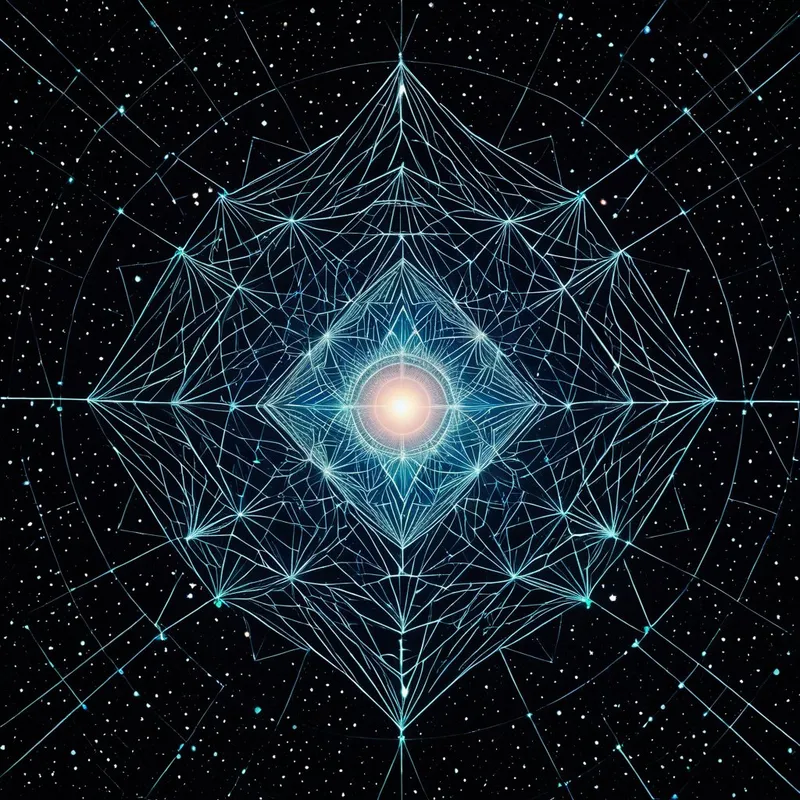
When this triad appears in modern dreams, it rarely manifests as three classical women. The dreamer may be confronted with a relentless administrative process, an unfeeling committee deciding their case, or a machine that weaves and cuts threads. The somatic feeling is one of profound constraint, of being a puppet, coupled with a deep, awe-filled dread.
This dream pattern signals a psychological encounter with the archetype of limits. The dreamer is likely facing a reality they cannot change—the end of a relationship, a career path closing, aging, illness, or the mortality of a loved one (or themselves). The psyche is processing the tension between the ego’s desire for control and the Self’s larger, fateful pattern. It is a dream of initiation into a more mature consciousness, one that can hold the paradox of making meaningful choices within a framework that is ultimately finite and unknown. The anxiety is not pathological but archetypal; it is the human animal feeling the shears in the distance.
Alchemical Translation
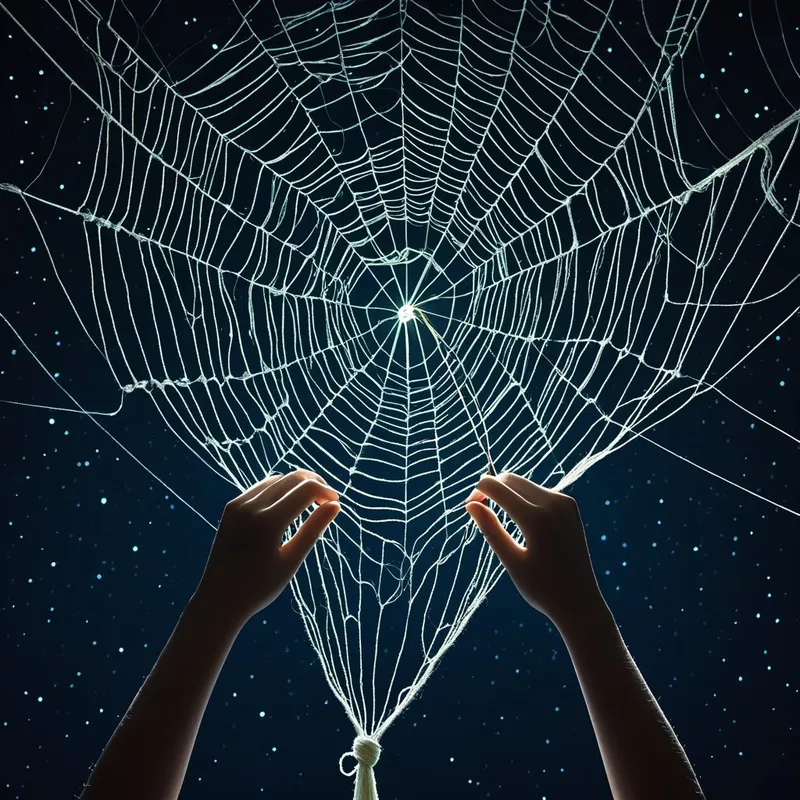
The alchemical work modeled by the Moirai is the ultimate transmutation: turning the lead of mortal terror into the gold of conscious acceptance. The process of individuation requires us to successively integrate each sister.
First, we must become Clotho in our own lives. We must take up the spindle of agency and consciously spin our thread—our values, our intentions, our daily actions. We move from passive existence to active creation.
Then, we must integrate Lachesis. This is the difficult work of reflection and measurement. We look back at the thread we have spun so far, assess its length and quality, own our choices that colored it, and consciously choose how to direct the remainder. This is the stage of taking responsibility for one’s life narrative.
Finally, and most crucially, we must make peace with Atropos.
The alchemical gold is found not in avoiding the shears, but in consciously handing them to the sister. The triumph is in affirming the cut as part of the design.
This is the amor fati (love of one’s fate) that Nietzsche described. It is the psychic act of accepting our finitude, our flaws, our endings, not with resignation, but as the necessary completion that gives our unique story its shape, weight, and beauty. To individuate is to see one’s own life as a complete thread—from the raw spin of Clotho, through the measured tapestry of Lachesis, to the clean, final cut of Atropos—and to say of it all, “This is my fate, and I would have it no other way.” In that acceptance, the mortal becomes, for a moment, akin to the immortals, not in lifespan, but in sovereignty.
Associated Symbols
Explore related symbols from the CaleaDream lexicon: