Citrus Aurantium Myth Meaning & Symbolism
A myth of a bitter, golden fruit that must be willingly sacrificed to the sun and earth to release its sweet, healing essence, mirroring the soul's alchemical journey.
The Tale of Citrus Aurantium
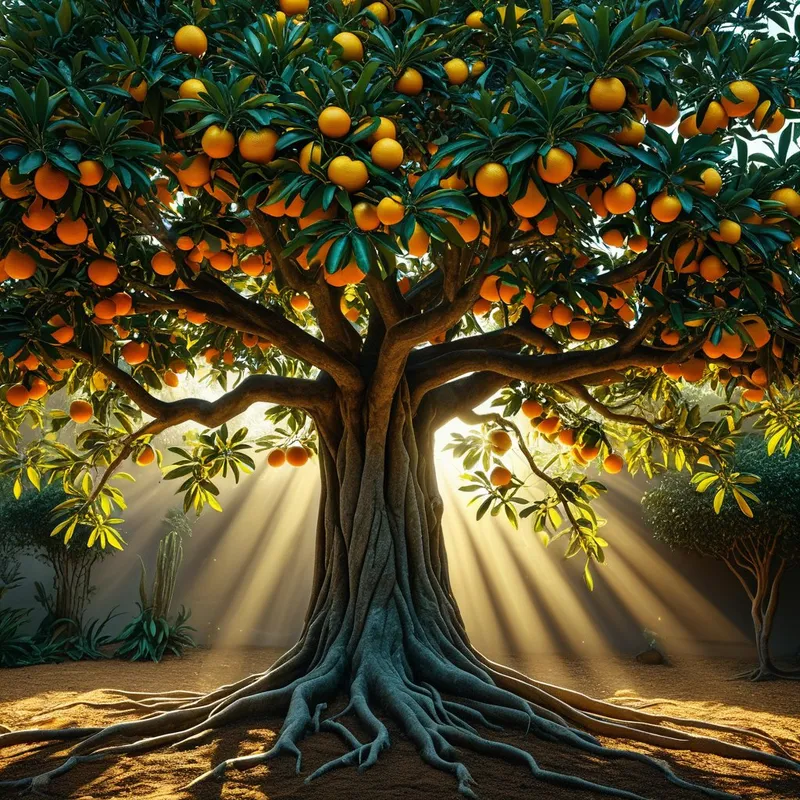
Listen, and hear the rustle of leaves in the garden where matter dreams. In the time before time was measured, there grew a tree unlike any other in the Hortus Conclusus. Its bark was the color of aged silver, and its leaves, sharp as verdant flames, whispered secrets to the wind. This was the Arbor Aurea, the Golden Tree, and from its boughs hung fruit of a most confounding nature: the Citrus Aurantium.
Each fruit was a captured sun, a globe of radiant, bitter gold. Its skin was tough and dimpled, holding within a paradox. To taste it raw was to know the essence of disappointment—a bright promise that delivered only acrid sharpness, a perfume of blossoms corrupted by a heart of gall. The tree stood in perpetual, glorious misery, abundant yet inedible, beautiful yet severe.
The Artifex who tended the garden watched this tree for cycles of the moon. He saw how the sun lavished it with light, and how the fruit only grew more resplendently bitter. He heard the tree’s sigh in the breeze, a sound of exquisite sorrow. One evening, as the sun drowned in a bath of Nigredo, a voice, dry as parchment and sweet as decay, spoke from the heartwood.
“You behold my perfection,” the tree murmured. “Yet my perfection is my prison. My gold is a lie. It asks for everything and gives nothing. I am a gift that cannot be given.”
The Artifex understood. This was not a flaw, but a divine instruction. The next morning, under a sky of pristine Albedo, he did not harvest. He performed a rite of severance. With a blade of purified copper, he cut not the fruit, but the very branch that bore the most glorious, most bitterly perfect Aurantium. The tree shuddered, and a sap like liquid amber wept from the wound.
He did not place the branch in a vessel of preservation. He laid it upon the bare, receptive earth at the tree’s own roots. He exposed the golden fruit to the full, relentless gaze of the sun by day, and the chilling, clarifying breath of the moon by night. He watched as the splendid sphere wrinkled and desiccated. The proud skin shriveled, its gold fading to a dull, leathery brown. It became an ugly, forgotten thing, a sacrifice abandoned to the elements.
From within that apparent death, a slow miracle stirred. The internal membranes, the bitter pith, began to ferment and dissolve. The hardened seeds cracked. And from the very core of the sacrificed fruit, pressed by the weight of its own decay, a single, heavy drop of essence began to form. It was not the juice of the fresh fruit, but something far denser, a nectar of concentrated light. On the forty-day dawn, under a sky of Citrinitas, the Artifex found the husk. Within, where bitterness had reigned, now pooled a thick, radiant syrup, red as the philosopher’s stone and sweet as forgiven tears. He anointed the tree’s wound with a single drop. The Arbor Aurea blossomed anew, and its next fruit, while still golden, now held the potential for both the bitter and the sweet, finally whole.

Cultural Origins & Context
The myth of the Citrus Aurantium is not a folktale of the people, but a speculum of the laboratory, passed between adepts in the cryptic language of Mutus Liber. It emerged in the late medieval and Renaissance periods within the European alchemical tradition, a culture that existed in the liminal space between proto-chemistry, mystical Christianity, Neoplatonism, and profound psychological inquiry.
Its tellers were the Artifices themselves, often monks, physicians, or natural philosophers working in solitude. The myth was rarely written as a narrative; it was encoded in emblematic drawings—a tree with golden fruit, a sun shining on a rotting orange, a vessel collecting a single drop. It functioned as an initiatory puzzle, a guide for the operator’s own spirit. To understand the myth was to understand that the primary matter to be worked upon was not in the crucible, but in the soul of the one who tended the fire. Its societal function was hermetic—it forged an invisible fraternity of those who understood that true gold was not metal, but a state of integrated being.
Symbolic Architecture
The myth presents a complete map of psychic transformation, where each element is an aspect of the self. The Citrus Aurantium itself is the brilliant, yet undeveloped, personality—the “Persona” that shines with potential but is internally conflicted and ultimately bitter (unintegrated). Its beautiful, golden exterior represents our talents, achievements, and the image we present to the world, which often hides a core of unresolved pain, judgment, and latent potential (the bitter pith and seeds).
The Artifex is the emerging consciousness, the observing ego that begins to see through the glittering illusion of mere appearance. His act of cutting the branch is the crucial, often painful, moment of Abstraction—detaching a part of the self from the tree of habitual identity for deeper examination.
The first work is not to add, but to subtract; not to build the golden statue, but to willingly tarnish it.
The exposure to sun and moon represents the necessary confrontation with opposites: the fierce, discriminating light of consciousness (Sol) and the deep, reflective waters of the unconscious (Luna). The rotting, the Nigredo, is the essential phase of breakdown. It is the depression, the dark night of the soul, the feeling that one’s prized qualities are decaying into uselessness. This is not an error, but the dissolution of the old, rigid form to release the essence trapped within. The sweet syrup that emerges—the Rubedo—is the Self realized. It is the unique, concentrated essence of the individual, born only through the sacrifice of the merely brilliant for the sake of the authentically whole.
The Dreamer's Resonance
When this myth stirs in the modern dreamer, it announces a profound somatic and psychological process of integration. To dream of a beautiful, glowing fruit that tastes of ash or poison is to encounter the Citrus Aurantium complex. The dreamer may be acutely aware of a disparity between their outward success or capability and an inner sense of emptiness, bitterness, or “imposter” syndrome.
Somatically, this can manifest as a tightness in the chest or throat—the “bitter pill” that cannot be swallowed. The psyche is presenting the brilliant but bitter fruit of an adaptation that has outlived its purpose: the relentless achiever, the eternal caregiver, the perfect intellectual. The dream of the fruit rotting on the ground, while unsettling, is a profoundly positive sign. It indicates the unconscious is already engaged in the necessary Nigredo, breaking down an outdated structure. The feeling of loss or waste in the dream is the ego protesting its own deconstruction. A dream of finding a single, precious drop of honey or medicine within a husk signals the turning point, where the dreamer’s attention shifts from the lost glory of the “golden” persona to the emerging, authentic value within.
Alchemical Translation
For the modern individual, the myth models the non-linear, often brutal, path of Individuation. Our culture prizes the “golden fruit”—the perfect career, the optimized life, the curated identity. The alchemical instruction is heresy: you must sacrifice that very gold. Not by destroying your talents, but by ceasing to identify with them as your core value.
The first operation is to “cut the branch”—to consciously withdraw from the compulsive behaviors and identities that shine but do not nourish. This is an act of will and courage, often feeling like a step backward into obscurity. The second is to “expose it to sun and moon”—to submit this detached part to honest self-reflection (sun) and to the unpredictable, symbolic material rising from the unconscious in dreams, moods, and creative impulses (moon). The putrefaction is the dark, passive phase where one must endure the feeling of falling apart, of being a husk. This is where faith in the process is essential.
The stone is not found in the seeking, but in the residue of all that was willingly let go.
The final transmutation is not the creation of something new, but the revelation of what was always, secretly, there. The “sweet syrup” is the integrated self. The bitterness of the pith is not eliminated; its energy is transmuted. The critical inner voice becomes discernment. The pain of the past becomes compassion. The shining gold of the persona becomes a genuine radiance that does not blind, but warms. The myth concludes not with the consumption of the fruit, but with the anointing of the tree—the healed source. This signifies that the process is recursive. Each integration makes the whole system (the psyche) more fertile, capable of bearing fruit that contains, from the beginning, the potential for both its bitter shadow and its sweet essence, no longer at war, but in a sacred, generative tension.
Associated Symbols
Explore related symbols from the CaleaDream lexicon: