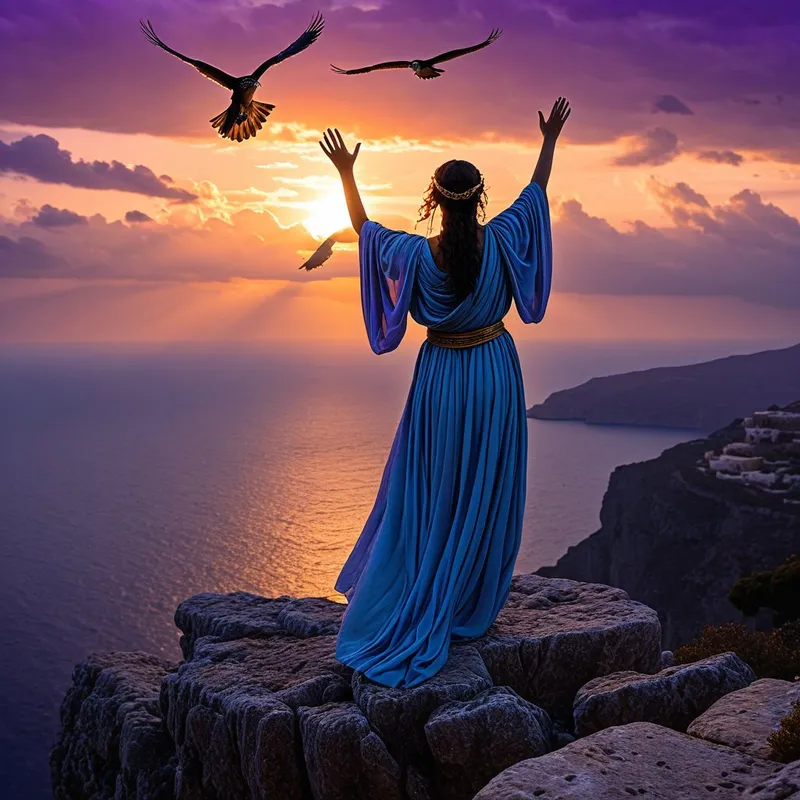
Circe's Falcons Myth Meaning & Symbolism
A story of divine wrath, where the goddess Circe transforms a king and his men into falcons, revealing the soul's struggle between instinct and consciousness.
The Tale of Circe's Falcons
Hear now a tale not of heroes, but of a king who forgot the shape of his own soul. The salt-wind whispers it still, off the coast of Zakynthos. King Dardanus ruled there, a man whose pride was as tall as the white cliffs of his island. He commanded a fleet of swift ships and men whose loyalty was as hard as the bronze on their shields. But the sea, which gives, also knows how to take.
A great storm, sent by no mortal hand, shattered Dardanus’s fleet. His men, those who did not feed the grey waves, washed ashore on a strange, wooded coast. It was the isle of Aeaea. And there, in a clearing where the light fell in dappled, uneasy pools, they found her. Circe. She was not as the bards sometimes whisper—a mere temptress. She was a power, a daughter of the Sun, and the air around her hummed with the potential for change.
The shipwrecked men, wild-eyed with loss and salt, stumbled into her sacred grove. They saw not a goddess, but a woman alone. Their fear curdled into a brutish demand. They shouted, they threatened, they claimed her domain by right of the strong. They forgot the first law: that the world is alive with unseen wills.
Circe watched them, her expression as still as a deep pool. She did not rage. She did not plead. She raised her hands, and the very light bent toward her fingertips. A word, older than the Greek they spoke, left her lips. It was not a curse, but a revelation. She showed them the truth of their own spirits, stripped of the pretense of crown and spear.
Where King Dardanus stood, a shriek tore through the air—but it was not a human sound. His body contorted, folding in upon itself. His arms became wings of dappled brown and gold, his proud gaze sharpened into the unblinking stare of a hunter. His men followed, a chorus of cries dying into avian shrieks. In moments, where arrogant men had stood, a flock of falcons clattered and beat their new wings against the earth.
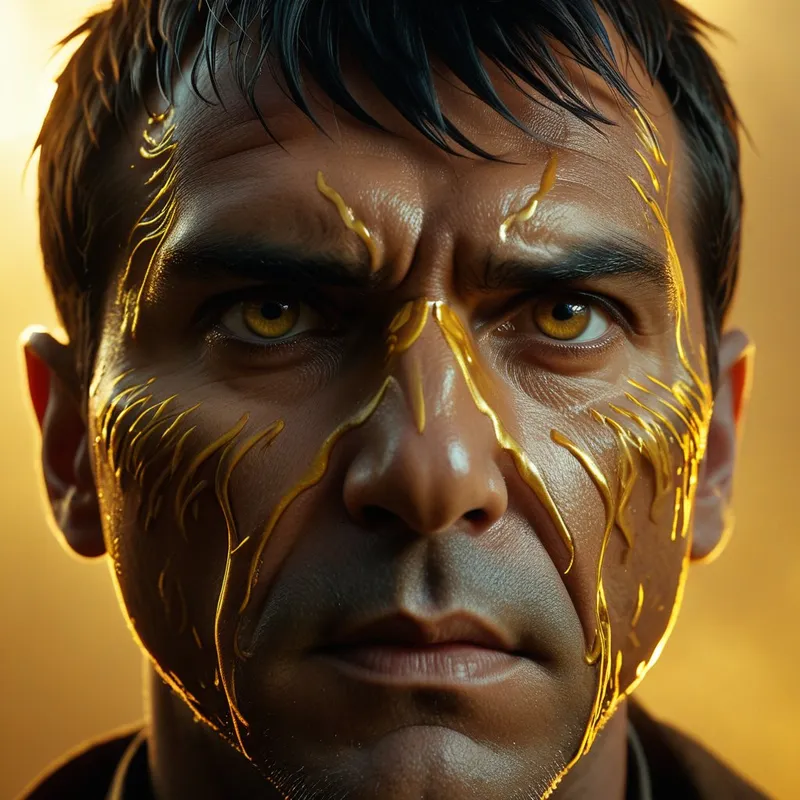
But the transformation was not complete damnation. Circe, in her merciless grace, allowed them to keep their minds. King Dardanus, trapped in the body of a falcon, knew he was a king. He felt the wind in his pinions and thought of his throne. He saw with telescopic clarity and remembered the faces of his sons. It was a prison of exquisite awareness. The goddess commanded them to fly, to hunt, to live as falcons upon her island, forever bound to the form that mirrored their inner state.
Cultural Origins & Context
This lesser-known episode, primarily preserved in the fragments of the Nostoi (The Returns) and later referenced by geographers like Pausanias, serves a specific cultural function. Unlike the famous encounter of Odysseus with Circe—a story of negotiation, resistance, and eventual departure—the tale of Dardanus is one of permanent alteration. It is a cautionary myth from the edges of the Greek world, a story told by sailors about the perils of unknown shores and the fatal error of mistaking divine hospitality for vulnerability.
It operated within the Greek concept of eusebeia and its opposite, hubris. Dardanus’s sin was not merely trespass, but the failure of perception. He saw a woman, not a force of nature. The myth reinforced a societal boundary: the wild, untamed places (like Aeaea) are the domain of potencies that do not obey human laws. The story was a tool for teaching circumspection, reminding listeners that the shape of a man is a temporary gift, easily revoked by the older powers of the world.
Symbolic Architecture
At its core, the myth is a profound allegory of the psyche’s fall into identification with a lower, instinctual state. The falcon is not a random symbol. In the ancient Mediterranean, it was a bird sacred to solar deities—a creature of piercing vision, speed, and lethal precision. To be transformed into a falcon is to be given the attributes of a god, but stripped of the consciousness to wield them wisely.
The punishment of the gods is often the granting of a literal form to our most unconscious desires. We become the thing we have secretly chosen to be.
Dardanus and his men, in their aggressive, territorial, predatory demand upon Circe’s space, were already operating from a purely instinctual, predatory mind. Circe’s magic simply made the inner reality outwardly visible. The falcon’s body is a perfect symbol for this state: magnificent, powerful, free in the sky, yet utterly bound to the cycle of hunt and kill, driven by base hunger and impulse. The retention of their human minds is the true torment—it represents the spark of reflective consciousness trapped within a compulsive pattern. They are forced to witness their own reduction.
The island of Aeaea itself symbolizes the vas hermeticum, the alchemical vessel of transformation. It is a bounded psychic space where the raw materials of the self (the sailors) are subjected to the transformative fire of the divine (Circe) and irrevocably changed.
The Dreamer's Resonance
When this myth pattern stirs in the modern dreamer, it often signals a profound psychological crisis of identity. To dream of being transformed into a bird of prey—feeling the feathers erupt from your skin, the horizon tilting as you take flight—is not necessarily a nightmare of loss. It can be the psyche’s dramatic portrayal of a felt reality.
The dream may emerge when an individual feels they have become a mere function: a hunter in the corporate jungle, a predator in relationships, a creature driven solely by sharp, analytical instinct (the falcon’s vision) without connection to heart or humanity. The somatic feeling is often one of simultaneous power and imprisonment—the exhilaration of flight coupled with the terror of lost control. The dream says, “Look. This is what you have allowed yourself to become. You see everything, yet you understand nothing of yourself.” It is a call from the anima (represented by Circe) to confront the brutal, instinctual shadow that has taken over the steering wheel of consciousness.

Alchemical Translation
The path from this mythic bind to liberation is the core of the individuation process. Circe’s falcons are the image of the ego trapped in a glorious but soul-killing complex. The alchemical work is not to reverse the spell—for one cannot un-live an insight—but to integrate it.
The goal is not to cease being the falcon, but to remember that you are also the king who can command it.
The first stage, nigredo, is embodied in the moment of transformation: the brutal confrontation with one’s own reduced state. The king must fully inhabit the despair of his falcon-form, the humiliation of his clipped majesty. This is the necessary dissolution of the old, prideful identity.
The albedo follows in the falcon’s piercing vision. From his new height, the transformed king begins to see. He sees the patterns of his island prison, the folly of his initial assault, the true nature of the goddess he offended. The solar clarity of the falcon becomes the light of self-awareness.
Finally, the rubedo is the integration. This is where the myth, in its ancient form, stops. But for the modern psyche, the journey continues. The liberated individual is not the man who was, nor the falcon he became. He is the sovereign who contains the falcon’s vision and power, but directs it with a redeemed, human consciousness. He has met his Circe—the transformative power of the unconscious—and instead of being petrified by her, has allowed her to reveal his deepest nature. He becomes the magician, wielding his own instinctual forces with wisdom instead of being wielded by them. The prison of Aeaea becomes the cultivated territory of the Self.
Associated Symbols
Explore related symbols from the CaleaDream lexicon: