
Cinnamon Bird Myth Meaning & Symbolism
A myth of a sacred bird that builds its nest from precious cinnamon on perilous cliffs, guarded by serpents, representing the soul's quest for the fragrant core of self.
The Tale of Cinnamon Bird
Hear now, you who sail by the stars and trade by the wind, a tale not of gold or tin, but of a fragrance more precious than both. It is whispered in the harbors of Tyre and Sidon, a story carried on the salt-spray and the desert sirocco.
Beyond the known coasts, where the world’s edge bleeds into the realm of the sun, there lies a land of impossible cliffs. Their peaks are lost in the burning blue, their bases drowned in a churning, serpent-haunted sea. And there, in the highest, most perilous crags, dwells the Cinnamon Bird. Its feathers are the color of dawn-fire and deep wine, and its eyes hold the cold light of distant stars. This bird knows the secret of the sun’s first breath, and with this knowledge, it builds its nest.
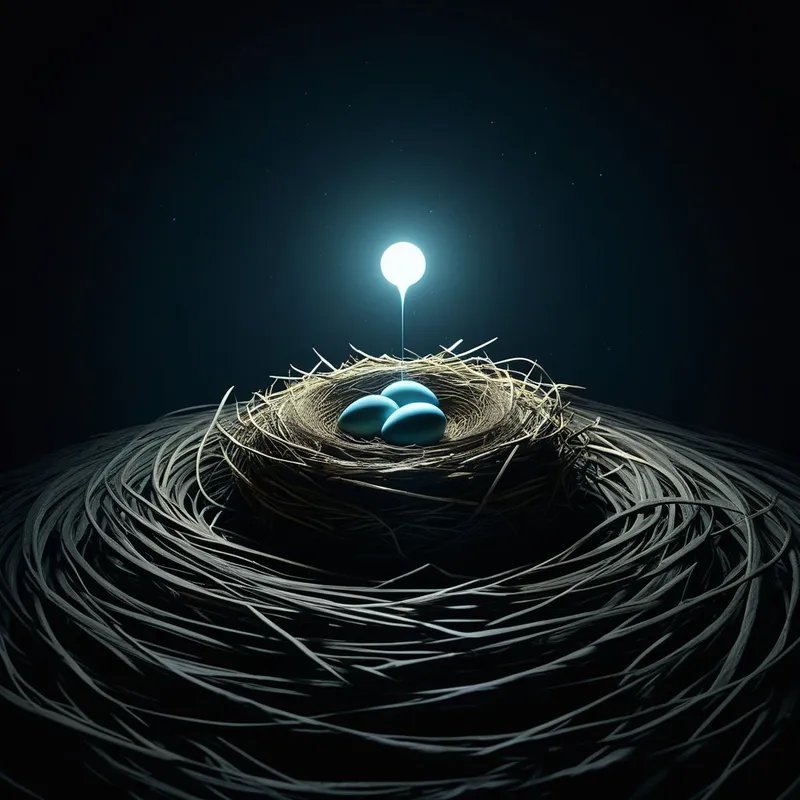
It does not gather twig or straw. No. It flies to a hidden grove known only to the winds, where trees weep tears of solidified sunlight—cassia and cinnamon. With its beak and claws, it harvests these fragrant shards, these sticks of aromatic gold. One by perilous one, it carries them back to the cliff face, weaving a cradle of scent so potent it can be smelled a league out to sea. A nest that is not a home, but an altar.
But the gods, or the nature of precious things, decree that nothing of such value can be left unguarded. The cliffs themselves are alive. In every shadowed crevice, beneath every overhang, coil serpents of immense size and ancient malice. Their scales are the grey of weathered stone, their eyes like chips of black obsidian. They are the guardians, the jealous ones, who claim the cliff, the nest, and the bird as their own domain. To approach is to invite a strike faster than thought, a venom that melts bone.
Yet the desire for this fragrance, this essence of a far-off paradise, burns in the heart of humankind. The merchants of the coast, those pragmatic priests of commerce, devised a grim and clever calculus. They would send not men, but beasts. Great oxen, bulls of formidable strength, would be slaughtered at the cliff’s base. Their flesh, still steaming in the heat, would be carved into vast portions and left as a offering to the guardians.
The serpents, drawn by the blood-scent and the mountain of meat, would descend from their high perches. They would sink their fangs into the offering, injecting their venom, and then begin the slow, consuming feast. And in that window, while the guardians were glutted and distracted below, the boldest of climbers would scale the sheer rock. His heart hammering a rhythm of terror and greed, his fingers seeking purchase on stone warmed by a furious sun, he would ascend to the sacred crag.
There it would be: the nest, a chaotic, beautiful weave of fragrant wood, humming with a residual power. The climber would not see the bird, for it is wise and flees the stench of death below. With desperate hands, he would dislodge the nest, catching it as it tumbled, or gathering the shattered, priceless sticks from where they fell among the rocks. He would carry his fragrant prize back down, past the feasting serpents, to the waiting ship. The cinnamon, now touched by death, guarded by serpents, and stolen from the sky, was ready for market. The bird, it is said, would return to find its altar gone, and begin its impossible work anew.

Cultural Origins & Context
This myth reaches us not from sacred tablets or temple carvings, but from the pragmatic logs of others. The primary source is the Greek historian Herodotus, who recorded it as a curious tale told to him by Phoenician traders. This is its native soil: the deck of a ship, the murmur of a harbor tavern, the exchange of stories alongside goods. The Phoenicians, the master mariners and merchants of the ancient Mediterranean, were conduits of not just materials but myths. Their worldview was fundamentally transactional, yet infused with a deep awareness of the peril and mystery that lay beyond the horizon.
The tale of the Cinnamon Bird functioned as a myth of origin for a supremely valuable commodity. It explained the exotic rarity, the danger, and thus the high cost of cinnamon, transforming a spice into a narrative artifact. It served as a cautionary tale about the price of desire and the necessary intermediaries of violence and cunning in obtaining the world’s treasures. Most profoundly, it was a story told by a people who lived at the boundary between the known and the unknown, a poetic map of the psychological landscape of risk and reward.
Symbolic Architecture
The myth presents a stark symbolic tableau of the soul’s relationship to that which is most precious and elusive within itself.
The Cinnamon Bird is the elusive spirit, the Self in its divine, untouchable aspect. It creates its nest—a structure of identity, purpose, or sacred creativity—from materials of intrinsic value and fragrance (meaning, authenticity). This nest is not built for comfort in the mundane world, but is perched in the liminal space between heaven and earth, consciousness and the unconscious, accessible only through extreme peril.
The most fragrant parts of the soul are always built on the most inaccessible cliffs.
The serpents are the guardians of the threshold, the personified resistance. They represent the chthonic, instinctual, and potentially deadly aspects of the unconscious that protect the status quo. They are the fear, the trauma, the inertia, and the primal jealousy that says, "This treasure is not for you. Stay in the known world." They are not evil, but necessary forces of containment.
The oxen represent brute sacrifice, the offering of one’s animal nature, one’s simple and powerful life-force, to appease and distract the guardians. This is the initial, costly price of the quest: the sacrifice of energy, comfort, and naive innocence to create a window of opportunity.
The climber is the heroic ego, the part of the conscious self that must undertake the perilous ascent. He acts with courage and cunning, but also with a taint of profanation—he is a thief in the temple of the Self. His success depends entirely on the sacrifice made below and the absence of the sacred bird above.

The Dreamer's Resonance
When this myth stirs in the modern psyche, it often manifests in dreams of precarious ascent or elusive treasures. You may dream of climbing a terrifyingly high structure—a ladder, a cliff, a skyscraper—toward something glowing or fragrant at the top, while feeling a dreadful presence below. You may dream of seeking a rare, beautiful object in a dangerous, neglected place, like an attic full of shadows or a cave guarded by animals.
These dreams signal a psychological process of reaching for a more authentic, fragrant state of being—a creative project, a deeper self-knowledge, a spiritual insight—that feels impossibly out of reach and dangerously protected. The somatic feeling is one of tension, vertigo, and focused adrenaline. The "serpents" below are the activated anxieties, old wounds, and self-sabotaging patterns that rise up to dissuade you. The dream asks: What "oxen"—what habits, securities, or lower-order gratifications—must you sacrifice to distract these inner guardians long enough to make your ascent?
Alchemical Translation
The journey of the Cinnamon Bird myth is a perfect model for the alchemical, or Jungian, process of individuation. The prized cinnamon is the lapis philosophorum, the philosopher’s stone—the integrated, fragrant Self.
The first stage is Awareness (the Bird and the Nest): The individual catches the scent of something more—a calling, a potential, a truth that smells of paradise. This is the bird’s distant call.
The second is Confrontation (the Serpents and the Cliff): The conscious mind recognizes the terrifying gap between its current state and that potential. The unconscious guards this transition fiercely with all its repressed contents (the serpents).
The third is Sacrifice (the Slaughter of the Oxen): Here, the conscious ego must offer up something substantial. This is the nigredo, the darkening. It may be the sacrifice of an old identity, a cherished illusion, or simply the immense effort and pain required for change. This "distracts" the paralyzing fears and creates a pathway.
Transmutation requires a base material to be broken down. The ego must be offered to its own guardians.
The fourth is Theft/Retrieval (the Ascent and the Taking): The conscious self, now stripped and focused, makes the perilous climb. It retrieves a piece of the sacred nest—not the whole thing, and not the bird itself. This is the beginning of integration. The treasure is now "in the world," but touched by the process of struggle and cunning.
The final, implied stage is Return and Cycle: The climber returns to the community (the ship) with the treasure, which can now be used, traded, integrated into life. And the bird, the eternal spirit of potential, begins again. The process is never complete; the Self continually rebuilds its fragrant nest, inviting new cycles of quest, sacrifice, and retrieval. We are forever the climber, the ox, and, in our deepest essence, the bird.
Associated Symbols
Explore related symbols from the CaleaDream lexicon: