
Cinderella's Glass Slipper Myth Meaning & Symbolism
A tale of ash and grace, where a lost slipper of impossible glass becomes the key to a hidden self, revealing destiny through a perfect, fragile fit.
The Tale of Cinderella's Glass Slipper
Listen, and let the embers of the hearth tell the tale. There was a girl whose name was lost to the ashes. She lived in the shadow-place, where the cinders were her blanket and the scorn of her kin her daily bread. Her world was grey, a realm of soot and servitude, bounded by the hearthstone and the bitter words of a stepmother who saw her not as a child but as a stain to be worked into oblivion.
But in the deepest part of the forest, where the old ways still whisper, there lived a power. Some called her a godmother, but she was the spirit of the Hearth-that-Remembers, the keeper of promises made to the earth and to the dead. When the girl’s tears fell upon the roots of the old hazel tree that grew upon her mother’s grave, the spirit heard. On the night of the King’s great ball, when the girl’s despair was a palpable chill in the air, the spirit arrived not with a clap of thunder, but with the soft rustle of owl’s wings.
“Bring me a pumpkin from the garden,” she said, her voice like the settling of autumn leaves. And from the humble gourd, she conjured a coach of burnished gold. “Bring me mice from the trap.” And they became proud, prancing horses. “Bring me lizards from the stone wall.” And they became footmen in livery. Then she turned to the girl in her rags, touched her with a wand that was perhaps just a branch of that same hazel tree, and the ashes fell from her like a shell. In their place was a gown that seemed woven from starlight and memory, and upon her feet… slippers. Not of silk or leather, but of glass. Clear, impossibly delicate, and radiant, as if they had been breathed from the heart of a frozen flame.
“Remember,” whispered the spirit, her eyes holding the gravity of the turning moon. “The magic endures only until midnight. When the clock strikes, all returns to what it was.”
The girl, transformed, entered the palace. She was a mystery wrapped in light. The prince saw not a kitchen maid, but a vision. He danced with her, and in her glass slippers, she did not merely step—she floated, each movement a silent chime. For a few stolen hours, she inhabited her true shape. But as the great clock began its fateful toll, the spell frayed at its edges. She fled, a streak of silver and fear down the marble stairs. In her desperate flight, one precious glass slipper was left behind, a crystalline confession on the steps.
The prince held the slipper, not as a prince, but as a man haunted by a ghost of wholeness. He swore to find the foot it fit. A decree went out. Across the land, women presented their feet, from the noble to the vain, but the slipper rejected them all. It was too small, too strange, too demanding. It fit no one until the search came to the house of ashes. The stepsisters pushed and crammed, but their feet were swollen with ambition and spite. Then, from the corner, the girl in cinders stepped forward. She sat, wiped the ash from her skin, and slid her foot into the slipper. It was not a forced entry, but a homecoming. The fit was perfect, seamless, as if the glass had grown around her flesh. And as it did, the other slipper appeared from her pocket, and the remembered light of her gown flickered once more around her. The prince saw her, truly, for the second time—not as a phantom of the ball, but as the woman who lived in both worlds, of ash and of crystal. In that recognition was her redemption, and his.

Cultural Origins & Context
The tale of the glass slipper is a story that has walked on many feet across countless cultures. Its most famous literary incarnation comes from Charles Perrault’s 1697 Histoires ou contes du temps passé, where the slipper was first rendered in glass (verre). Scholars note a possible pun in the French folk tradition, where verre (glass) could be confused with vair (squirrel fur), a luxurious material for an earlier, perhaps more practical, slipper. But Perrault’s choice of glass was not a mistake; it was an act of mythic alchemy.
Before Perrault, the story existed in the oral traditions of Europe and beyond. A version appears in the Grimm brothers’ collection as “Aschenputtel,” where the slippers are gold, and the helper is a magical bird from the mother’s grave. In ancient China, a similar story, “Ye Xian,” features a golden slipper. The tale was told by the hearth, by grandmothers and nurses, to listeners young and old. Its societal function was multifaceted: for children, a fantasy of reward for virtue; for the disenfranchised (particularly young women), a narrative of hope that innate worth, however obscured, would be recognized by a cosmic justice. It served as a cultural rite of passage, modeling the transition from the neglected state of childhood into a recognized, sovereign adulthood through the crucible of suffering and the mystery of a destined match.
Symbolic Architecture
The myth’s power lies in its stark, profound symbols. The ashes are not merely dirt; they are the residue of a consumed past, the ego dissolved in the fires of humiliation and loss. Cinderella works in them, signifying an unconscious incubation within the shadow.
The glass slipper is the symbol of the soul’s unique and irreducible identity. It is not made to be worn by the many, but to be found by the one.
It represents a destiny that is both dazzlingly clear and terrifyingly fragile. Glass reveals everything—it hides no flaw, accepts no compromise. To wear it is to be utterly seen. Its perfect fit signifies the moment when one’s inner, essential self (the Self) aligns perfectly with one’s outer life and relationships. The stepsisters’ mutilation of their own feet is a grotesque parody of the ego’s attempt to force itself into a destiny that is not its own.
The godmother is the activating principle of the unconscious, the inner guide that orchestrates synchronicity and provides the resources (pumpkin, mice, lizards) of the mundane world, transformed by vision. The midnight deadline is the law of reality; even the most glorious inflation of the psyche must eventually reconcile with the limits of time and embodied existence. The loss of the slipper in flight is necessary—the Self cannot be fully claimed in a single moment of glory. It must be sought, tested, and ultimately recognized in the full light of day, ashes and all.

The Dreamer's Resonance
When this myth stirs in modern dreams, it speaks to a profound process of identification and belonging. To dream of trying on shoes, especially ones that do not fit, points to a somatic feeling of being out of step with one’s current role, career, or relationship. The feet, our point of contact with the earth, symbolize our grounding in reality.
A dream of a singular, beautiful, but fragile shoe left on a staircase suggests a haunting by a lost potential or a true identity that was glimpsed but abandoned under pressure (the “midnight” of anxiety, societal expectation, or fear). The dreamer may be working through feelings of being an orphan in their own life, overlooked and undervalued. The appearance of a helpful but demanding feminine figure (the godmother) can indicate the emerging influence of the inner guide, often after a period of despair or “sitting in the ashes.” Such dreams mark the psyche’s preparation for a coming alignment, a search for the “fit” that feels destined, not forced.
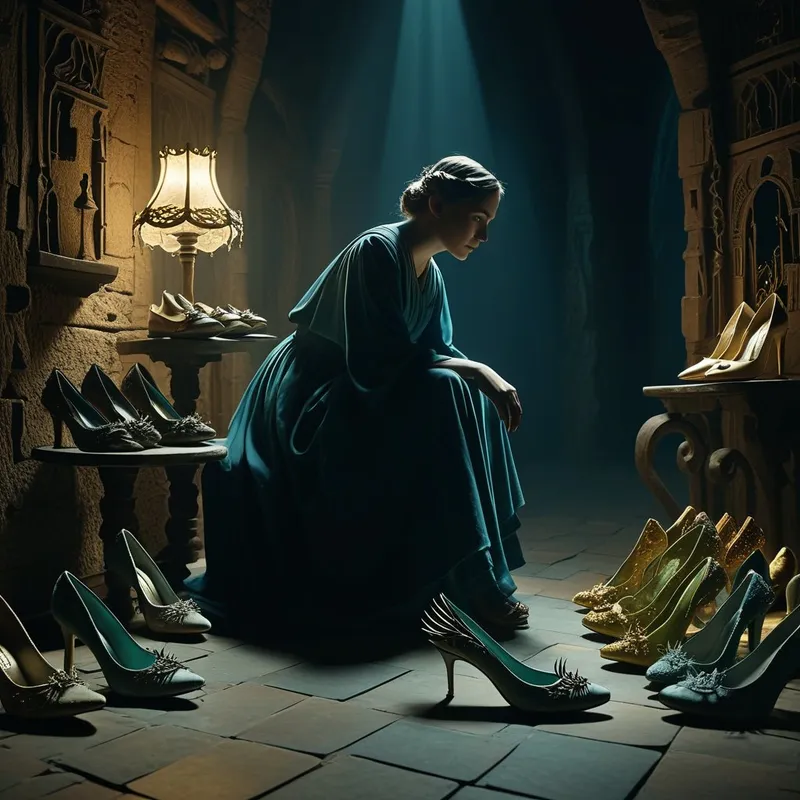
Alchemical Translation
The Cinderella myth is a precise map of the individuation process. The starting materia prima is the ego in a state of nigredo—blackened, dissolved in the ash of suffering and alienation. The hearth, though a place of labor, is also the alchemical furnace.
The transformation occurs not by escaping the ashes, but by fulfilling the humble tasks within them until the hidden spirit of the hearth takes notice.
The godmother’s intervention represents the influx of unconscious contents (archetypal images) that temporarily elevate the ego to a glorious, but inflated, state (the albedo, or whitening). The ball is this state of conscious brilliance. But integration requires the rubedo, the reddening, the return to earth with the treasure. This is the critical phase of losing the slipper and the subsequent search.
The prince with the slipper is not merely a romantic other; he symbolizes the active, seeking consciousness that has been touched by the vision of the Self and will not rest until it finds its source in reality. The final fitting is the conjunctio, the sacred marriage. It is the moment when the seeking consciousness (prince) and the enduring, authentic identity (Cinderella, with her foot in the slipper) are united. She is recognized not just as the vision from the ball, but as the woman who emerged from the cinders. The glass slipper, the symbol of the Self, is the vessel that makes this union possible. For the modern individual, the myth teaches that our deepest fulfillment comes not from constructing a persona that fits the world’s expectations, but from having the courage to present our fragile, transparent, and unique essence—our “glass slipper”—and finding the life into which it, and we, perfectly fit.
Associated Symbols
Explore related symbols from the CaleaDream lexicon: