
Cinderella's Ball Gown Myth Meaning & Symbolism
A divine gift of raiment transforms an ash-covered maiden, revealing her hidden sovereignty for a single, fateful night of destiny.
The Tale of Cinderella’s Ball Gown
Listen, and hear the tale not of a princess born, but of a queen revealed. In the dim, ash-strewn hearth of a forgotten house, there lived a soul known only as [Cinderella](/myths/cinderella “Myth from Grimm’s Fairy Tales culture.”/). Her world was one of cinders and cruelty, her true form obscured by grime and grief. She was a portrait painted over with soot.
But the soul, when pressed to its nadir, sometimes sings a frequency only heaven can hear. Her weeping, not for a prince but for a shred of belonging, watered a barren place. And from that place, a response blossomed. It arrived not as a [thunderclap](/myths/thunderclap “Myth from Various culture.”/), but as a shimmer in the air—her [Fairy Godmother](/myths/fairy-godmother “Myth from Fairy Tale culture.”/), a being of amused compassion who saw not the rags, but the radiant outline of what was missing.
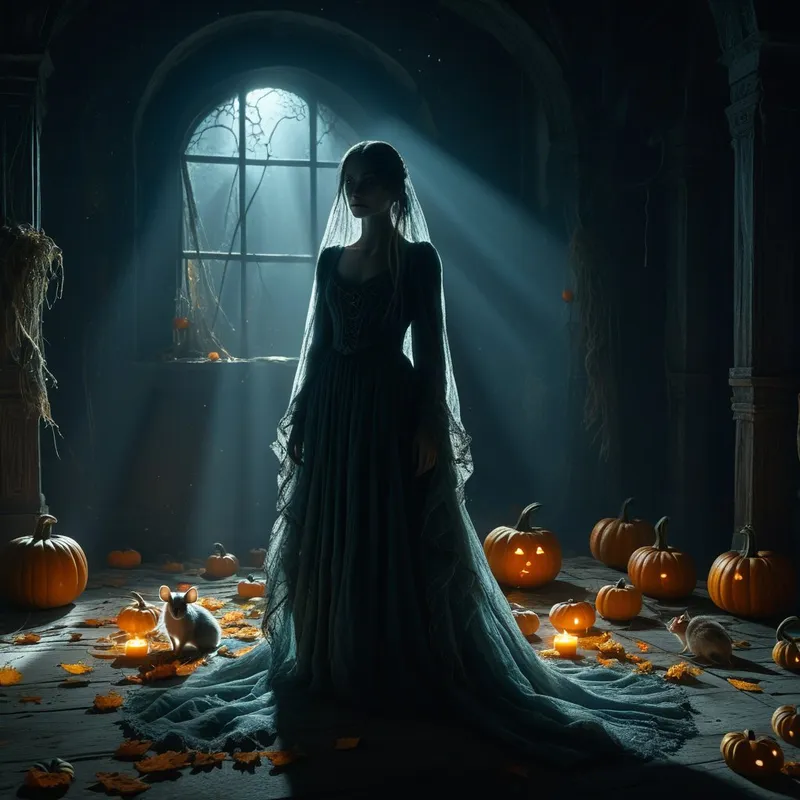
“You wish to go to the ball?” the godmother mused, her voice like chimes. “Then we shall need a carriage.” A pumpkin, plump and ordinary, was touched. It groaned, shimmered, and unfolded into a gilded coach. Mice, symbols of the small, overlooked, and nimble, became proud horses. And a lizard, a creature of [the threshold](/myths/the-threshold “Myth from Folklore culture.”/) between worlds, became a coachman.
Then came the heart of the magic. The godmother did not wave away Cinderella’s sooty dress. She turned to it. Her wand tapped not the girl, but the very fabric of her poverty. “Now, my dear,” she whispered, “let us see what is already there, waiting.”
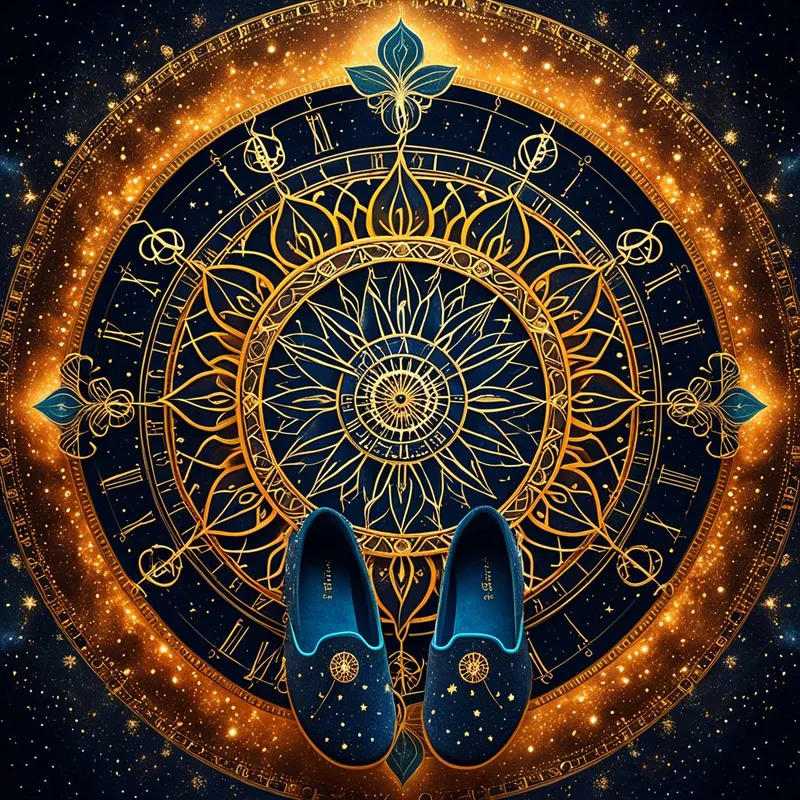
The air grew dense with possibility. A mist of silver and gold particles, like captive starlight, swirled from the wand’s tip. It did not cover the rags; it consumed them in a gentle vortex. Cinderella felt not a change of clothes, but a metamorphosis of substance. The coarse linen dissolved into a sensation of cool moonlight against her skin. Where patches had been, intricate embroidery of silver spiderwebs and frost roses bloomed. The fabric itself became a living twilight, deep blue like [the sky](/myths/the-sky “Myth from Persian culture.”/) just after sunset, shot through with threads that caught the light like distant stars. It was weightless, yet it held her with a regal embrace. Upon her feet, slippers of pure crystal formed, cool and solid, as if she walked on captured moonlight.
She was not dressed. She was revealed. The ash-covered maiden was gone. In her place stood her own essence, made visible. The gown was her soul’s signature, written in light and shadow. A warning chimed like a bell: the spell would break at midnight. The magic was a loan, a glimpse, a single night’s truth. And with that, she departed, not as an imposter to a palace, but as a sovereign returning, however briefly, to her realm.

Cultural Origins & Context
The tale of Cinderella is a true mythic vagabond, with roots tracing back over a thousand years to Tang Dynasty China in the story of Ye Xian, and appearing in vibrant variations from Charles Perrault’s French Cendrillon to the Brothers Grimm’s darker, German Aschenputtel. It is a foundational narrative of the European “Fairy Tale” canon, told by [the hearth](/myths/the-hearth “Myth from Norse culture.”/) to children, primarily by women (the conteuses of 17th-century French salons, like Madame d’Aulnoy, were pivotal). Its societal function was multifaceted: a moral fable about kindness rewarded, a fantasy of social mobility for the oppressed (particularly young women), and a profound container for psychological truths. The ball gown sequence, especially in Perrault’s version which introduces the fairy godmother and the glass slippers, serves as the central transformative engine of this function. It gave tangible, glorious form to the deepest wish of the marginalized: to be seen not for one’s circumstances, but for one’s inherent, magnificent worth.
Symbolic Architecture
The [ball](/symbols/ball “Symbol: The ball symbolizes playfulness, joy, and the cyclical nature of life, often representing the search for balance and wholeness.”/) gown is far more than a beautiful dress. It is the symbolic manifestation of the Self, the total, authentic [personality](/symbols/personality “Symbol: Personality in dreams often symbolizes the traits and characteristics of the dreamer, reflecting how they perceive themselves and how they believe they are perceived by others.”/) that lies buried under the complexes and hardships of [life](/symbols/life “Symbol: The symbol of ‘Life’ represents a journey of growth, interconnectedness, and existential meaning, encompassing both the joys and challenges that define human experience.”/) (the ashes). Cinderella’s daily rags represent the [persona](/symbols/persona “Symbol: The social mask or outward identity one presents to the world, often concealing the true self.”/) of the degraded, worthless servant—a false [identity](/symbols/identity “Symbol: Identity represents the sense of self, encompassing personal beliefs, cultural background, and social roles.”/) imposed by the outer world (the stepfamily) and tragically internalized.
The gown is the soul made visible, a temporary embodiment of wholeness that proves one’s royalty is not conferred, but recognized.
The [Fairy](/symbols/fairy “Symbol: Fairies represent the magical and whimsical aspects of life, often symbolizing transformation and the unseen forces that guide us.”/) Godmother represents the activating grace of the unconscious itself—the benevolent, guiding force (the daimon) that intervenes when the conscious ego has reached its limit. She does not create from nothing; she transforms what is at hand: the [pumpkin](/symbols/pumpkin “Symbol: The pumpkin is often associated with harvest, abundance, and transformation, particularly during the autumn season.”/) (potential), the mice (neglected skills), the lizards (instinct), the rags (the wounded [persona](/myths/persona “Myth from Greek culture.”/)). This is the key: the raw [material](/symbols/material “Symbol: Material signifies the tangible aspects of life, often representing physical resources, desires, and the physical world’s influence on our existence.”/) for our wholeness already exists within our lived experience, however humble. The [glass](/symbols/glass “Symbol: Glass in dreams often symbolizes clarity, transparency, fragility, and the need for introspection.”/) slippers are the ultimate [symbol](/symbols/symbol “Symbol: A symbol can represent an idea, concept, or belief, serving as a powerful tool for communication and understanding.”/) of perfect fit—the unique, fragile, and transparent [truth](/symbols/truth “Symbol: Truth represents authenticity, honesty, and the quest for knowledge beyond mere appearances.”/) of one’s identity that cannot be worn by another (the stepsisters’ mutilation). The [midnight](/symbols/midnight “Symbol: The liminal threshold between days, representing transitions, hidden truths, and the unconscious mind’s emergence.”/) [deadline](/symbols/deadline “Symbol: A deadline symbolizes pressure, urgency, and the constraints of time in achieving goals or fulfilling obligations.”/) is the crucial law of [reality](/symbols/reality “Symbol: Reality signifies the state of existence and perception, often reflecting one’s understanding of truth and life experiences.”/); enlightenment must be integrated into the fabric of time, or it remains a fleeting fantasy.
The Dreamer’s Resonance
To dream of Cinderella’s ball gown is to dream of imminent self-recognition. The dreamer is often in a psychological state of feeling undervalued, obscured by life’s “ashes” (a dead-end job, a draining relationship, inner criticism). The gown’s appearance signals that the unconscious is preparing a revelation of the dreamer’s hidden capabilities, beauty, or true stature.
Somatically, one might feel a sensation of expansion, lightness, or luminous chill—the body registering the shift from a constricted to an authentic state. The dream often carries anxiety (the midnight clock) alongside the awe, reflecting the [psyche](/myths/psyche “Myth from Greek culture.”/)’s warning that this new, powerful self-image is fragile and must be consciously claimed and protected. Dreaming of being in the gown but then losing it points to a fear of owning one’s power or a painful reversion to old, small self-concepts. The dream is an invitation from the psyche to identify the “fairy godmother” moments in waking life—the unexpected opportunities, insights, or help that offer a glimpse of who you are beyond your struggles.
Alchemical Translation
The myth models the alchemical opus of individuation with stunning clarity. Cinderella’s initial state is the [nigredo](/myths/nigredo “Myth from Alchemical culture.”/)—the blackening, the descent into the ashes of despair and humiliation. Her tears are the [solutio](/myths/solutio “Myth from Alchemical culture.”/), the dissolution of the old rigid ego. The Fairy Godmother’s intervention is the arrival of the scintilla, [the divine spark](/myths/the-divine-spark “Myth from Gnostic culture.”/) that initiates transmutation.
The transformation of the mundane objects is the albedo—the whitening, where the base materials of one’s life (memories, wounds, simple talents) are purified and seen in their latent, higher form. The gown itself is the citrinitas—the yellowing, the dawning of the solar, conscious awareness of one’s inherent nobility. The flight to the ball and the prince’s recognition represent the beginning of the [rubedo](/myths/rubedo “Myth from Alchemical culture.”/)—the reddening, the integration of this soul-image into a conscious relationship (with the animus/Prince) and the social world.
The ultimate goal is not to live forever at the ball, but to bring the memory of the gown—the knowing of one’s true nature—back into the kitchen, thereby transforming the inner world forever.
The lost slipper is the crucial token. It is the fragment of the transcendent experience that remains in the realm of time and matter, the clue that allows the conscious self (the Prince) to seek out and permanently unite with the once-hidden soul. For the modern individual, the process asks: What are the “ashes” that cover your sovereignty? What humble, overlooked parts of your life (your pumpkins and mice) hold the seed of your transformation? And having glimpsed your “gown,” what token are you leaving behind in [the world](/myths/the-world “Myth from Tarot culture.”/) to guide your conscious self back to its truth? The myth assures us that the grace to become whole is not earned; it is remembered, and it often arrives dressed in rags, waving a wand at a pumpkin.
Associated Symbols
Explore related symbols from the CaleaDream lexicon: