
Cinderella's Ball Myth Meaning & Symbolism
A soul, cloaked in ash, is granted a single night of wholeness before a midnight reckoning reveals its true, royal nature.
The Tale of Cinderella's Ball
Listen, and hear the tale whispered on cinders and carried on the scent of orange blossoms. It begins not in a palace, but in the ashes. Here dwells a girl, her true name forgotten, known only by the place she sweeps: the hearth. Cinderella is a ghost in her own life, a shadow against the soot-stained stones, serving the brittle vanity of a stepmother and the cruel laughter of stepsisters. Her world is one of grit and grey, of endless labor and invisible worth.
But deep in the earth, where roots remember and old magic sleeps, a promise stirs. From the grave of her mother, from the tears watered into the earth, a power answers. It arrives not with thunder, but with the soft rustle of leaves and the twitch of a whisker. A Fairy Godmother appears, clad in light that hurts eyes accustomed to gloom. She does not pity; she sees. With a touch that is both command and blessing, she performs the great alchemy of the overlooked: the pumpkin swells into a gilded coach, mice become proud steeds, lizards transform into footmen. And for the girl herself? The rags fall away like a discarded skin. From the ashes rises a vision in silver and glass, a woman whose beauty is not of cosmetics, but of essence revealed.
The Ball is not merely a party; it is a realm of potential, a temenos under a thousand candles. When Cinderella enters, time itself holds its breath. The prince, a figure of sovereign seeking, is struck not by a face, but by a presence—a completeness that answers a question he did not know he asked. They dance, and in that dance, the forgotten self is remembered. The ash-girl is a queen, and for a few fleeting hours, the inner truth and outer reality are one.
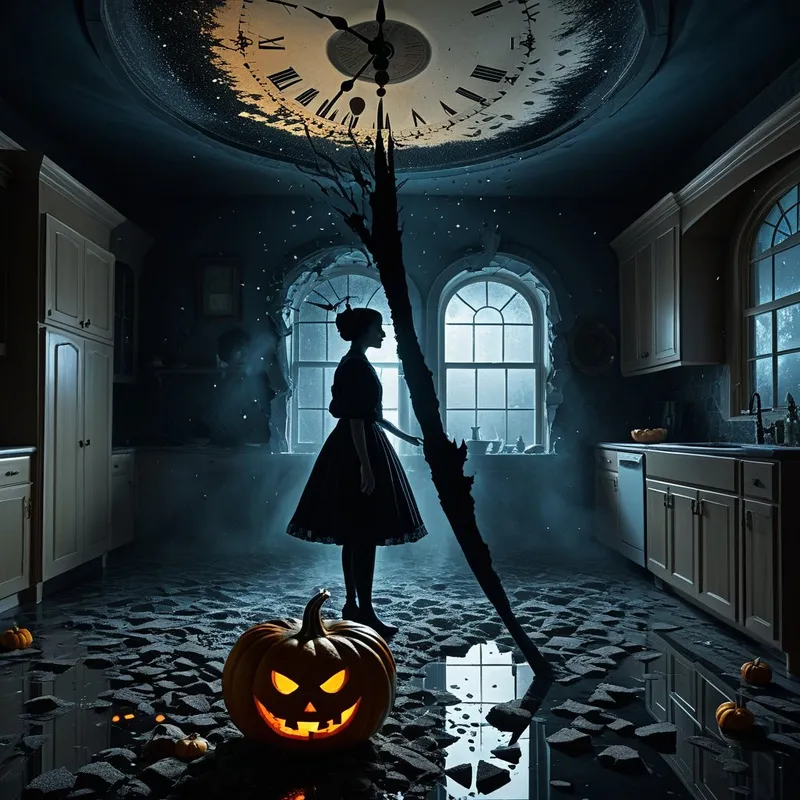
But magic, like dreams, has its laws. It exists in the tension between the eternal and the temporal. The warning is a heartbeat in the night: "Remember, you must leave before the clock strikes twelve. For then, the spell will be broken, and all will be as it was." Midnight is not just a time; it is a threshold, a dissolution. As the first bell tolls, the enchantment cracks. The second, and the glass slippers are all that remain of the gown. The third, fourth, fifth—a frantic flight through a palace that is now a labyrinth. On the final, twelfth stroke, she is in the kitchen yard again, clothed in rags, the coach a smashed pumpkin, the world returned to its cruel, familiar shape. All is lost.
Yet, on the palace steps, a single clue remains: a slipper of purest glass. This is the hook in the soul of the world, the undeniable proof of the numinous that breached the mundane. The prince’s search is not for a woman, but for the owner of that essence. It is a quest through the kingdom of appearances, a fitting of form to spirit. When the slipper slides onto Cinderella’s foot—not as a test, but as a recognition—the spell does not need to be recast. It is made permanent. The ash falls from her forever. The stepmother’s grimace is frozen; the stepsisters’ envy turns to dust. The orphan is seen, known, and crowned. The soul has come home.

Cultural Origins & Context
The myth of Cinderella's Ball is a folkloric rhizome, with roots digging deep into the soil of countless cultures, from the Ye Xian of 9th-century China to the Cat Cinderella of Naples. The version cemented in the "Fairy Tale" canon of the West is primarily a synthesis by Charles Perrault, who softened older, more violent variants into a story emphasizing grace, magic, and poetic justice. It was a tale told by the hearth it describes, passed from mother to daughter, from nurse to child, functioning as a narrative balm for the powerless.
Its societal function was multifaceted. For the marginalized—the young, the orphaned, the overworked—it was a myth of hope, asserting that intrinsic worth could triumph over circumstantial oppression. For the collective, it reinforced a moral cosmology where goodness (often coded as patience, piety, and beauty) is ultimately recognized and rewarded by a higher order (the prince, the king, fate itself). It served as a psychic container for the universal experience of being unseen, offering a template where suffering is not the end, but the necessary prelude to a glorious, destined reversal.
Symbolic Architecture
The myth is a perfect symbolic engine for the psyche's journey from negation to wholeness.
The Hearth & The Ashes: This is the prima materia of the soul. The hearth is the center of the home, yet Cinderella resides in its waste product. She is the valuable spirit buried in the residue of life's burdens, the potential self ignored and trampled by the conscious personality (the stepfamily).
The Fairy Godmother & The Midnight Law: She represents the sudden, grace-filled intervention of the Self, the archetypal force of transformative possibility. Her decree—"home by midnight"—is the crucial law of incarnation. True transformation cannot be sustained in a single, ecstatic, inflated moment. The ego must return to its humble reality to integrate the experience; otherwise, the new consciousness shatters.
The Glass Slipper: This is the myth's master symbol. It is not a shoe of leather, which molds to the foot, but of glass—brittle, transparent, and exact.
The glass slipper is the perfect, immutable shape of the soul's identity. It cannot be stretched or forced; it can only fit the one whose essence matches its form. It is the criterion of the absolute self.
- The Prince's Search: This is the active, seeking principle of consciousness (the animus) striving to reconnect with the lost, complete image of the soul. Trying the slipper on all is the process of discrimination, of rejecting false identities and societal masks until the true one is found.

The Dreamer's Resonance
When this myth stirs in modern dreams, it signals a profound moment of psychic emergence. Dreaming of being covered in ash or grime in a grand, neglected house speaks to a deep sense of one's talents, beauty, or spirit being buried under duty, family dynamics, or a stale life narrative. The appearance of a magical helper—often not a fairy, but a surprising figure or an empowering animal—marks the activation of inner resources the dreamer had forgotten.
Dreams of preparing for a great event but being thwarted, or of arriving at a magnificent ball only to have one's clothes disintegrate, directly mirror the "midnight crisis." This is the somatic anxiety of inflation—the fear that one's newfound confidence, role, or relationship is an illusion that will be exposed. The frantic search for a lost shoe in a dream is the psyche's urgent work to reclaim and prove its authentic identity amidst confusion. These dreams are not anxieties of failure, but of integration; the psyche rehearses the triumphant return to wholeness after a necessary, terrifying moment of dissolution.
Alchemical Translation
The myth of Cinderella's Ball is a precise allegory for the individuation process. The Nigredo, the blackening, is her life in the ashes—a state of depression, alienation, and mortificatio where the ego is crushed by circumstance. The Albedo, the whitening, is the arrival of the Fairy Godmother and the radiant gown—a moment of illumination, where the hidden self is seen in its pristine, lunar clarity.
The dance at the ball is the fleeting Citrinitas, the yellowing, where the illuminated inner self is joyfully united with the outer world (the prince/anima/animus). But this golden state is unstable. The strike of midnight is the crucial Rubedo, the reddening. It is not a regression, but a necessary shattering of the magical inflation. The glorious, projected self-image must break so that its core, indelible truth (the glass slipper) can be left behind as an objective fact.
The final, lasting marriage is not between Cinderella and the prince, but between the ego that endured the ashes and the Self that was always royal. The slipper is the symbol of that union—the point where the temporal and the eternal, the conditioned and the absolute, perfectly meet.
The search and the fitting of the slipper represent the final, conscious integration. The ego, having experienced both abjection and glory, now must prove its ownership of its true nature to the ruling principle of its own psyche. When the slipper fits, the transformation is complete. The orphan archetype is not erased, but redeemed; its suffering becomes the foundation of its sovereignty. The psyche has, at last, recognized and claimed its own kingdom.
Associated Symbols
Explore related symbols from the CaleaDream lexicon: