Cincinnatus Myth Meaning & Symbolism
A Roman farmer reluctantly accepts absolute power to save the state, then renounces it to return to his plow, embodying civic virtue and selfless duty.
The Tale of Cincinnatus
Hear now a tale not of gods, but of a man. A tale of earth and iron, of the furrow and the fasces.
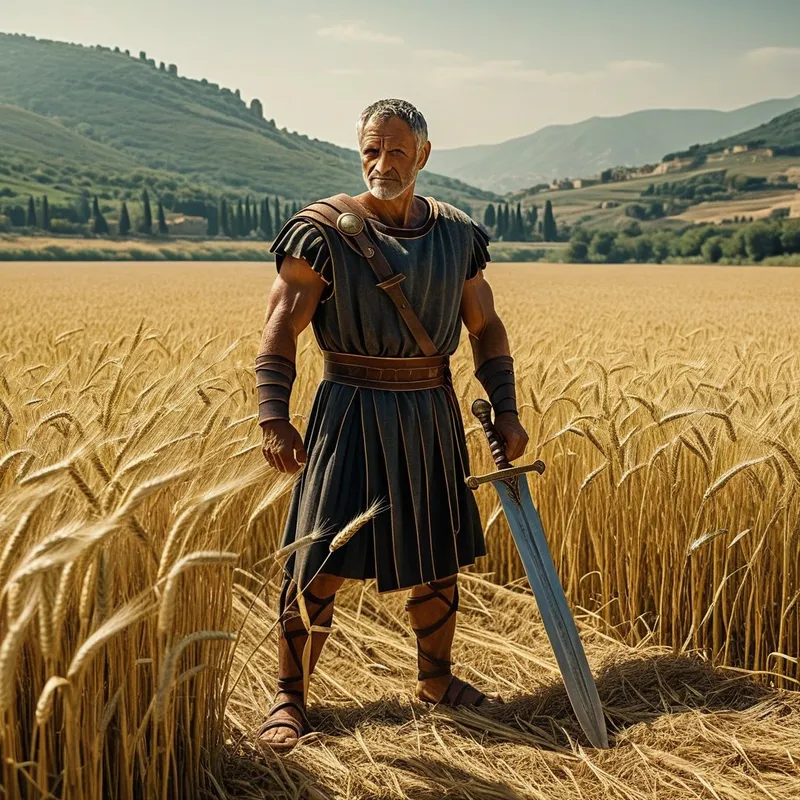
The sun was a hammer on the fields beyond the Tiber. The air smelled of crushed thyme and dry soil. There, bent to his labor, was Lucius Quinctius Cincinnatus. His hands, cracked and strong, guided the wooden plow. His world was the measure of his land, the rhythm of the seasons, the honest fatigue at day’s end. Rome, that clamorous heart of the world, was a distant rumor.
But Rome was dying. The Aequi had trapped a consular army in the mountains. Panic, thick as river fog, seeped through the city gates. The Senate, robed and desperate, knew only one law could save them: the Dictatorship. And they knew only one man.
So they came. A delegation of the most solemn senators, their white togas brilliant against the brown earth, crossing the freshly turned furrows. They found Cincinnatus, perhaps wiping sweat from his brow, the simple dust of the farmer upon him. They addressed him not as a peer, but as Dictator. They told him of the noose tightening around Rome’s army, of the city naked to its enemies.
He listened. The silence was profound, broken only by the wind in the wheat. He did not smile at the power offered. He did not preen. He looked at his plow, rooted in the soil, and then at the city across the river. A sigh, deep from the chest. He called for his toga—the garment of civic duty—and asked his wife to fetch it from their humble cottage.
With the ceremony performed there in the field, the imperium was his. Absolute. Unquestionable. He marched to Rome, raised a new army in a single day, and marched out again. He found the Aequi, encircled them as they had encircled the Romans, and broke them utterly in a single swift battle. He returned to Rome in triumph, the savior of the Republic.
They expected a king. They prepared for a master. The Senate waited, breath held, for the man who held all power to decide how he would keep it.
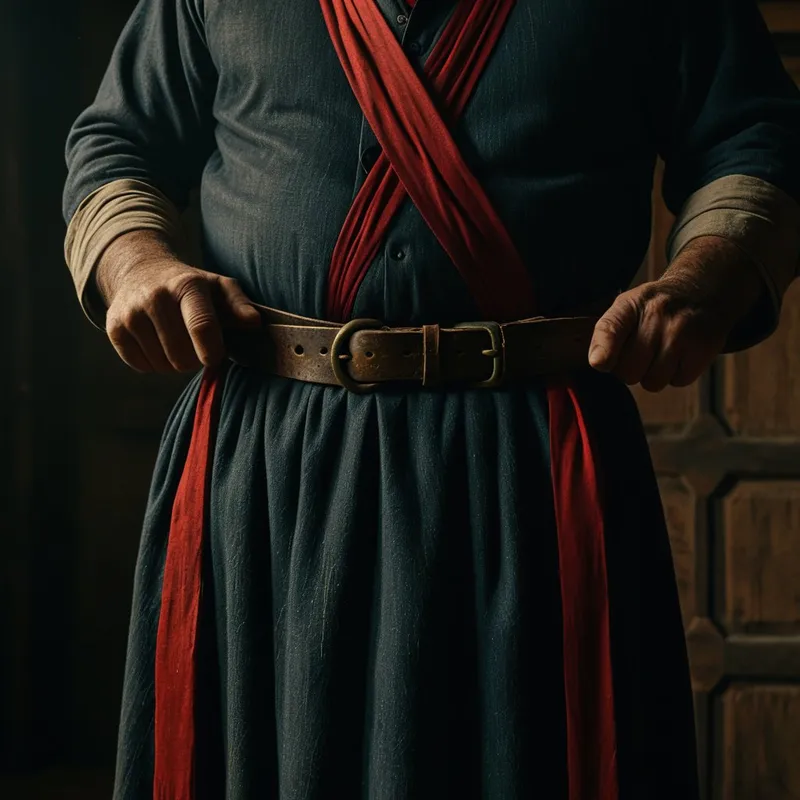
Cincinnatus stood before them. He had saved the state. His task, for which the dictatorship was granted, was complete. For sixteen days he had held the scepter of life and death. On the seventeenth, he laid it down. He resigned the dictatorship. He removed the crimson sash, hung up the toga, and walked back across the Tiber. He returned to his field, to his plow, to the furrow he had left unfinished. He took up the handles, and without a backward glance, pushed the blade once more into the waiting earth.
Cultural Origins & Context
This is not a myth of the primordial age, but a legend from the early Roman Republic (circa 458 BCE). It was a story told by Romans, to Romans, about themselves. Historians like Livy recorded it not merely as history, but as exemplum—a moral example. It was a foundational narrative of Republican ideology, repeated in the forum, in the home, and in the education of young patricians.
Its societal function was paramount: to define the ideal Roman citizen. In a culture obsessed with virtus (manly excellence) and pietas (duty), Cincinnatus was the ultimate embodiment. The story served as a bulwark against ambition (ambitus) and a warning against the corruption of power. It reinforced the agrarian ideal—that the best leaders were those rooted in the land, untainted by the luxuries and intrigues of the city. It was a political myth that weaponized humility, creating a cultural standard against which all subsequent leaders, from senators to generals, would be measured and often found wanting.
Symbolic Architecture
At its core, the myth of Cincinnatus is an alchemical drama of Power and Renunciation. The symbols are stark and potent.
The Plow represents the authentic self, the connection to one’s own ground, the simple, productive labor that defines a life of integrity. It is the tool of creation, tied to the cycles of nature, not the schemes of men.
The Fasces (the bundled rods and axe borne by the dictator’s lictors) symbolize bound, legitimized, but absolute power—the force of the state, the ability to command and to punish. It is the collective will given to a single individual.
The drama is in the exchange. Cincinnatus is called from his opus (work) to take up the imperium (command). He does so not for glory, but because it is his duty. The true magic, however, is in the return.
The ultimate mastery is not in the holding of power, but in the conscious, voluntary act of letting it go. The hero is not he who conquers the enemy, but he who conquers the temptation to remain conqueror.
Psychologically, Cincinnatus represents the integrated Ruler archetype. He possesses the capacity for order, decisiveness, and authority, but these are held in service to a higher principle—the health of the collective (the Republic) and the integrity of the self (the farmer). His journey is one of temporary inflation—the ego is granted immense power—followed by conscious deflation, a return to the baseline of the authentic personality. He does not identify with the role; he performs it, then steps out of it.

The Dreamer's Resonance
When this myth stirs in the modern soul, it rarely appears as togas and legions. It manifests in dreams of being suddenly, overwhelmingly promoted; of being handed a project, a company, or a family crisis of impossible magnitude. You dream you are in your familiar space—your kitchen, your garden, your workshop—when a solemn delegation arrives (as colleagues, parents, or even faceless authorities) and bestows upon you a crushing responsibility.
The somatic feeling is key: a profound heaviness in the shoulders, a mixture of dread and resolve in the solar plexus. You accept not with joy, but with a grim sense of "it must be me." The dream often skips the "battle"—the actual work of resolving the crisis—and moves directly to the aftermath. You are at a ceremony, expected to take a throne, but you turn and walk away, back to your simple room, your book, your garden. The profound relief upon waking is the clue. The psyche is working through a complex of inflated responsibility.
The dream asks: Where have you taken up a fasces that is not yours to keep? What role—be it the flawless caregiver, the indispensable manager, the perfect parent—have you identified with so completely that you’ve forgotten your own plow, your own foundational, nourishing work? The Cincinnatus dream is a call to perform necessary duty, but then, crucially, to lay it down and return home to the self.

Alchemical Translation
The individuation process modeled here is the Nigredo of Duty followed by the Albedo of Renunciation.
First, the Nigredo: The call to dictatorship is a descent into the shadow of the Ruler. One must consciously engage with power, authority, and control—not as an abstract idea, but as a practical, burdensome reality. This is the blackening, the confrontation with the weight of the world and one’s own capacity to bear it. It is a necessary inflation, a tasting of the potion of supremacy to understand its toxicity.
Then, the miraculous Albedo: The purification. This is not an avoidance of power, but its distillation. Having held it, one sees its nature clearly. The return to the plow is the whitening, the act of separatio. One separates one's essential identity (the farmer) from the temporary role (the dictator). The power is not rejected; it is transmuted. It becomes a memory, a skill integrated but not defining.
The gold produced is not a crown, but a character. It is the integrity of a self that can interact with the world's demands without being consumed by them. The plow is no longer just a tool; it is a symbol of chosen simplicity, a conscious return to the core after having touched the periphery of absolute potential.
For the modern individual, the alchemy lies in the rhythm of engagement and withdrawal. To be able to step fully into a role of leadership, responsibility, or crisis management—to wield the "fasces" with competence and resolve—and then, when the task is done, to know how to step out. To de-identify. To return to the "plow"—be it creative work, solitude, family, or simple reflection—and recharge in the authenticity of one's fundamental being. In a world that rewards perpetual inflation, the Cincinnatus within whispers the most radical command of all: You have done enough. Now, go home.
Associated Symbols
Explore related symbols from the CaleaDream lexicon: