Cihuacoatl Myth Meaning & Symbolism
The wailing goddess of childbirth and warfare, a divine mother who weeps for her lost children and wields the terrible, creative power of dissolution.
The Tale of Cihuacoatl
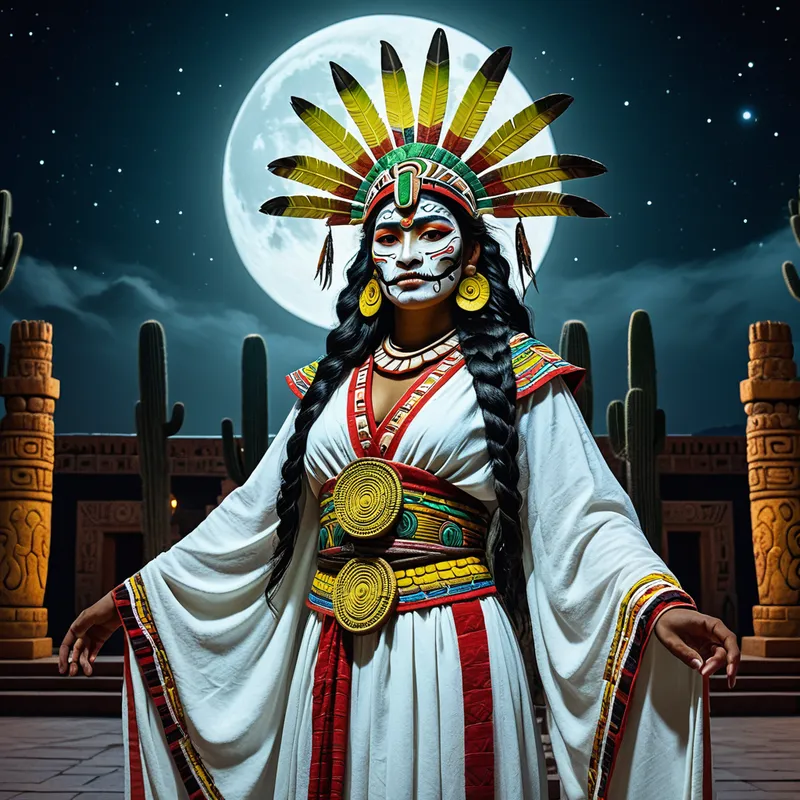
Listen. When the world was heavy with silence between the heartbeats of the sun, she walked. Not on the causeways of Tenochtitlan, but in the spaces between them, in the chill that comes before dawn when the stars are dying. She was the Woman of the Snake, Cihuacoatl.
They say she wore robes white as bone, stained at the hem with the red of the earth. Her face was painted, one side the pallor of the moon, the other the gold of fading sunlight. In her hair, the soft down of eagles, and in her hands, the tools of weaving and war: the spindle and the shield. She was the first mother, the one who bore the gods themselves in the time of darkness. But her children were gone—lost to time, to war, to the great turning of the cosmic wheel.
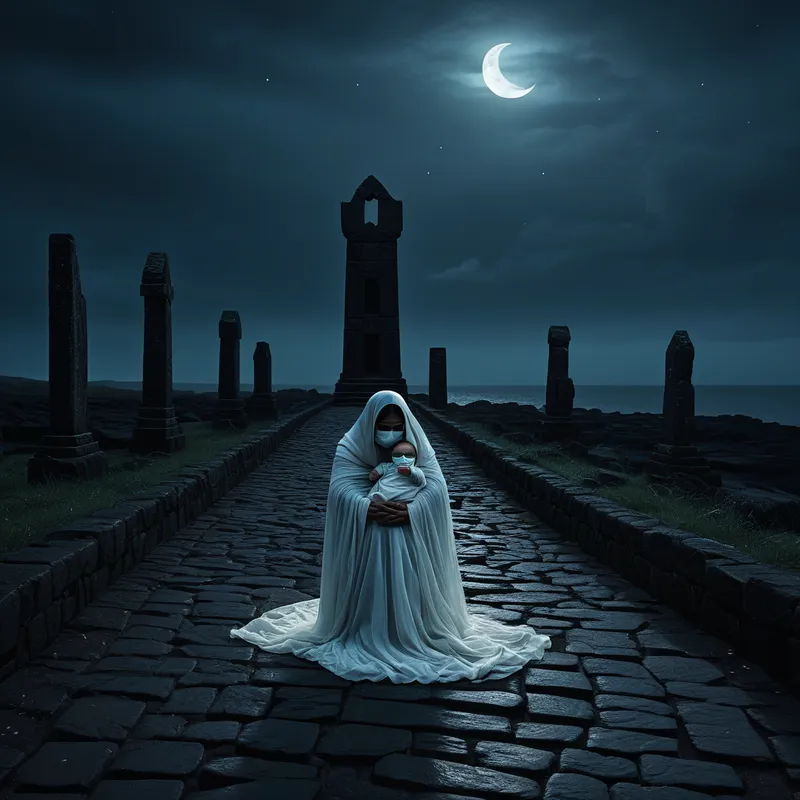
And so, she walked. She would appear at the crossroads, where the paths of fate intersect, cradling a bundle in her arms. To the lone traveler, she seemed a lost mother, her infant swaddled in fine cloth. But if one drew near, drawn by her silent, profound sorrow, the bundle would stir. It was not a child’s face that looked back, but the gleaming edge of an obsidian blade, a tiny, perfect tecpatl. It was an offering and a warning, a gift of death that was also a promise of life.
Her voice was not heard with ears, but felt in the marrow—a high, piercing wail that split the night. It was the sound of childbirth’s ultimate strain and the final cry of the warrior falling. She wept for every son sent to the flower wars, for every daughter who died bringing new life into the world. Her tears were not water, but the very substance of longing and loss, falling to the ground to nourish the stubborn, thorny nopal.
In the great temples, when the drums of Huitzilopochtli beat and the scent of copal smoke grew thick, she was there too. Not as a statue, but as a presence in the breath of the priest who wielded the flint knife. She was the conduit, the divine force that transformed the most terrifying act into a sacred sustenance for the sun. She was the reason the heart was offered; she was the grief that made the offering meaningful. She was the womb and the tomb, the cradle and the battlefield, forever walking, forever wailing, holding the razor-edge of existence in her arms.
Cultural Origins & Context
Cihuacoatl was not a minor spirit but one of the most ancient and formidable deities in the Nahua world. Her origins likely predate the Aztec empire, reaching back into the agrarian mother-cults of central Mexico. In the rigid, militaristic hierarchy of Tenochtitlan, she occupied a paradoxical and vital space. She was a goddess of motherhood, midwifery, and fertility, yet simultaneously a patron of warfare, sacrifice, and the earth’s dark, consuming aspect.
This duality was mirrored in the state’s highest offices. The Cihuacoatl was a title bestowed upon the emperor’s second-in-command, a male ruler who governed the city internally—overseeing law, economy, and the domestic sphere—while the Huey Tlatoani led external military campaigns. This male Cihuacoatl was the human embodiment of the goddess’s principle: the fierce, protective, and administratively ruthless "mother" of the city-state.
Her myths were not simple bedtime stories but sacred narratives performed and invoked during ceremonies. Her wailing cry was ritually recreated by women during festivals, and her presence was felt most acutely during the feast of Ochpaniztli, a time of sweeping and purification that involved ritual battles and symbolic death. She represented the foundational, often terrifying, truths of the Aztec cosmos: that life is utterly dependent on death, that creation is inseparable from destruction, and that the deepest love is expressed through the most profound sacrifice.
Symbolic Architecture
Cihuacoatl is the archetypal container for life’s most potent and painful opposites. She is not a goddess of gentle nurture but of the brutal, miraculous process of becoming.
She is the vessel that must break for the new to emerge, the soil that is both grave and garden.
Her serpentine nature connects her to the earth (Tlaltecuhtli) and to primal, cyclical wisdom. The serpent sheds its skin, symbolizing transformation, renewal, and the hidden knowledge of the underworld. Her white robes signify both mourning and purity, while the red stains are the inescapable evidence of life’s cost—the blood of birth and battle. The infant that is a blade is perhaps her most potent symbol: the new life we bring into the world is the ultimate, sharp responsibility that will change us, wound us, and demand everything. It is both our most precious creation and our most terrifying vulnerability.
Psychologically, Cihuacoatl represents the anima in its most formidable and transformative aspect. She is the deep feminine principle not as passive receptacle, but as active, choiceless creator and destroyer. She holds the grief we cannot bear to feel, the rage we dare not express, and the sacrificial love that asks for everything. To encounter her is to encounter the part of the psyche that knows, in its bones, the true price of existence and the awesome power that comes from accepting, rather than fleeing, that cost.
The Dreamer's Resonance
When Cihuacoatl enters the modern dreamscape, she rarely comes as a clear, iconic figure. She is more often a somatic atmosphere. You may dream of wandering empty, monumental streets at night, gripped by an inexpressible sorrow. You may hear a high, keening sound that seems to emanate from the walls themselves. You may find yourself holding something precious that suddenly becomes dangerous, or see a figure in white at the edge of your vision, always turning away.
These dreams signal a profound encounter with the psyche’s sacrificial ground. The dreamer is likely at a threshold where an old identity, relationship, or way of life is dying—or needs to die—to make way for something new. The grief felt is not just personal; it is archetypal. It is the grief of necessary endings, the mourning for the "child" (the project, the hope, the former self) that did not survive. The wailing is the sound of the psyche processing a loss too deep for words, a primal cry that seeks to cleanse and empty the soul so it may be refilled.
To dream of her is to be invited—or compelled—to hold the razor-infant. It asks: What new, sharp truth are you being asked to bear? What difficult creation is demanding to be born through you, even if it feels like a weapon? The process is one of somatic alchemy, where unprocessed grief and silent rage are finally given a voice and a form, transforming from paralyzing ghosts into the raw material of renewal.

Alchemical Translation
The journey with Cihuacoatl is the alchemy of the nigredo—the descent into the black, fertile void. In the process of individuation, she represents the stage where our comforting illusions are sacrificed to a deeper, darker truth.
The path to wholeness requires we be broken upon the wheel of our own deepest nature. We must consent to the sacrifice of who we were to become who we are.
The modern individual often seeks to avoid this "wailing" phase. We medicate grief, rationalize rage, and flee from the feeling of being a vessel for forces beyond our control. Cihuacoatl’s myth insists that this avoidance is a rejection of our own creative power. Her alchemical translation is this: the conscious embrace of sacred grief. It is the act of walking your own inner crossroads, howling your losses to the uncaring night, not to be healed in a gentle sense, but to be forged.
Holding the obsidian infant means accepting responsibility for the destructive potential within your own creativity. The artist must "kill" their darlings. The parent must let the child go. The individual must allow parts of the ego to die. This is not a passive suffering, but an active, sacred office—becoming the priest of your own necessary sacrifices. By internalizing the role of the Cihuacoatl, you learn to govern your inner world with fierce compassion, administering the laws of the soul, deciding what must be nurtured and what must be offered up. From this terrifying embrace, you gain the authority that comes only from having faced the foundational, weeping mother at the core of being and agreed to her terms.
Associated Symbols
Explore related symbols from the CaleaDream lexicon:
- Serpent — The primal symbol of cyclical transformation, earth wisdom, and the shedding of old skins, directly embodying Cihuacoatl's name and her connection to the regenerative forces of the underworld.
- Blood — Represents the essential life-force and the sacred currency of sacrifice, the inevitable stain of both childbirth and warfare that defines Cihuacoatl's domain.
- Mother — The archetype of fierce creation and sustenance, here in its most formidable aspect as the mother who bears, mourns, and demands sacrifice for the continuation of life.
- Sacrifice — The core ritual act that sustains the cosmos in Aztec thought, embodied by Cihuacoatl as the divine principle that transforms death into life-giving energy.
- Grief — The profound, wailing sorrow that is not a personal failing but a sacred, world-sustaining emotion, channeled by the goddess for cosmic balance.
- Earth — Cihuacoatl as an earth goddess, the dark, fertile, and consuming soil from which all life springs and to which all bodies return.
- Wound — The necessary opening, both physical in childbirth and battle and psychological in loss, that is the source of both pain and the potential for new growth.
- Child — Symbolizes both the precious new life that is the goal of creation and the vulnerable offering that must sometimes be given up, represented by the blade-infant.
- Ritual — The structured, sacred performance that makes the terrifying truths Cihuacoatl represents bearable and meaningful within a cultural context.
- Shadow — The unconscious aspect of the psyche that holds our grief, rage, and capacity for destruction, which Cihuacoatl forces us to confront and integrate.