Cicada Jade Amulets Myth Meaning & Symbolism
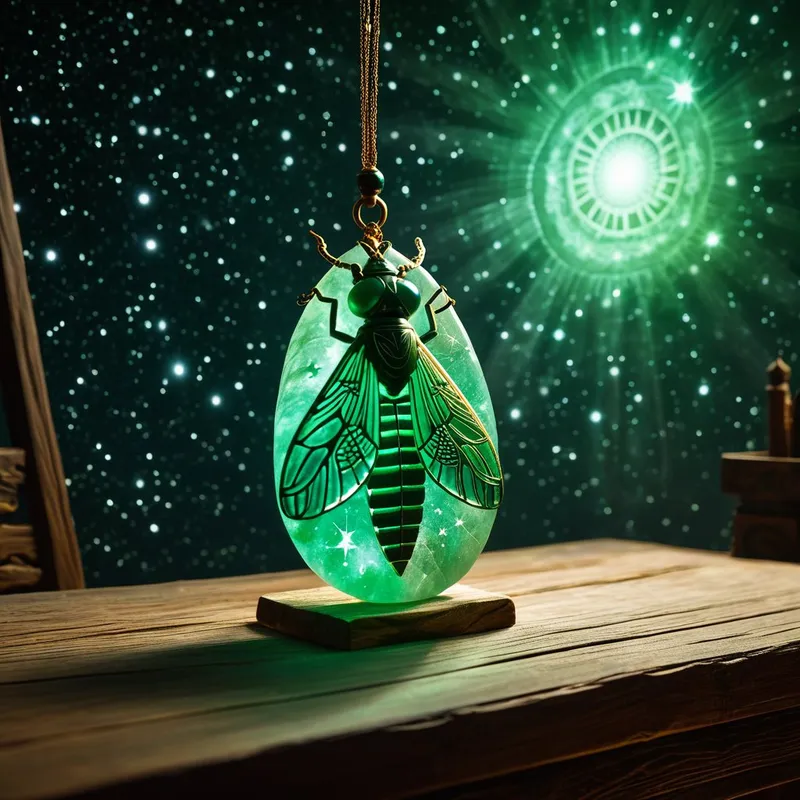
A celestial artisan sacrifices his form to create jade cicadas, amulets that guide souls through death and promise renewal from the underworld's silence.
The Tale of Cicada Jade Amulets
Listen, and hear the whisper from the age when [the earth](/myths/the-earth “Myth from Hindu culture.”/) was soft and the heavens were close. In the time before time was measured, there lived a master artisan of the celestial court, Gongshu Ban. His hands did not shape mere wood or stone, but the very breath of the stars and the sighs of the clouds. Yet, his heart was heavy with an earthly sorrow. He watched the mortal realm below, where souls, upon [death](/myths/death “Myth from Tarot culture.”/), would falter in the vast, silent darkness of Diyu. They became lost, forgetting their names, their loves, their essence, adrift as pale shadows for eternity.
One night, as the Yinhe</ab title> flowed thick above, Gongshu Ban heard a sound—a frail, persistent song rising from a mulberry tree. It was the final chorus of a cicada, singing with its whole being as it shed its brittle shell for the last time. In that song, he heard not an end, but a fierce, undeniable declaration of existence. A truth was revealed to him: to navigate the great transition, one must carry a song of [the self](/myths/the-self “Myth from Jungian culture.”/), a token of unbroken identity.
Driven by a compassion that transcended his celestial station, he embarked on a forbidden work. He descended to the sacred Kunlun Mountains and pleaded with the mountain spirit for its heart-stone: a vein of the purest, most resonant zhenyu. With this heavenly jade, he returned to his astral workshop. He did not use his tools. Instead, he poured his own divine essence, his shen, into the stone. He sang [the cicada](/myths/the-cicada “Myth from Greek culture.”/)’s song into it, note by note, and carved with the light of his own spirit.
The cost was absolute. As the final amulet took form—a perfect [jade cicada](/myths/jade-cicada “Myth from Chinese culture.”/), wings poised for flight, body holding a silent scream of song—Gongshu Ban’s celestial form began to dissolve. He was not slain; he was translated. His physical presence unraveled into starlight, which he infused into each amulet. His last act was to scatter these jade cicadas like seeds into the mortal world, where they would be found by shamans and placed upon the tongues of the dead.
And so, when a soul passes from the light, bearing the jade cicada, it does not enter the silence of Diyu alone. The amulet holds the artisan’s sacrifice and the insect’s song. In the darkness, the jade grows warm. It pulses. And from it, a silent, inner melody begins—the soul’s own true name, sung back to itself, a luminous thread through [the void](/myths/the-void “Myth from Buddhist culture.”/), guiding it not to oblivion, but toward the quiet pool of remembrance, where it may drink and prepare for the turn of the wheel.
Cultural Origins & Context
This myth, woven from threads of ancient animism, ancestor veneration, and later Daoist alchemy, finds its roots not in a single canonical text but in the collective funerary practices of China spanning millennia. The physical hanchan amulets are archaeological facts, found in tombs from the Han Dynasty onward. The myth is the story told to the living about these objects—a narrative generated by the culture to explain and sanctify a profound ritual act.
It was likely transmitted orally by wu shamans and later refined by Daoist adepts seeking physical and spiritual immortality. Its societal function was multifaceted: it was a technology of comfort for the bereaved, a ritual map for the soul of the deceased, and a philosophical statement on the nature of identity beyond corruption. The myth transformed a burial custom into a cosmic drama, assuring that the careful, costly practice of jade burial was not mere vanity, but a participation in a celestial [covenant](/myths/covenant “Myth from Christian culture.”/) of return.
Symbolic Architecture
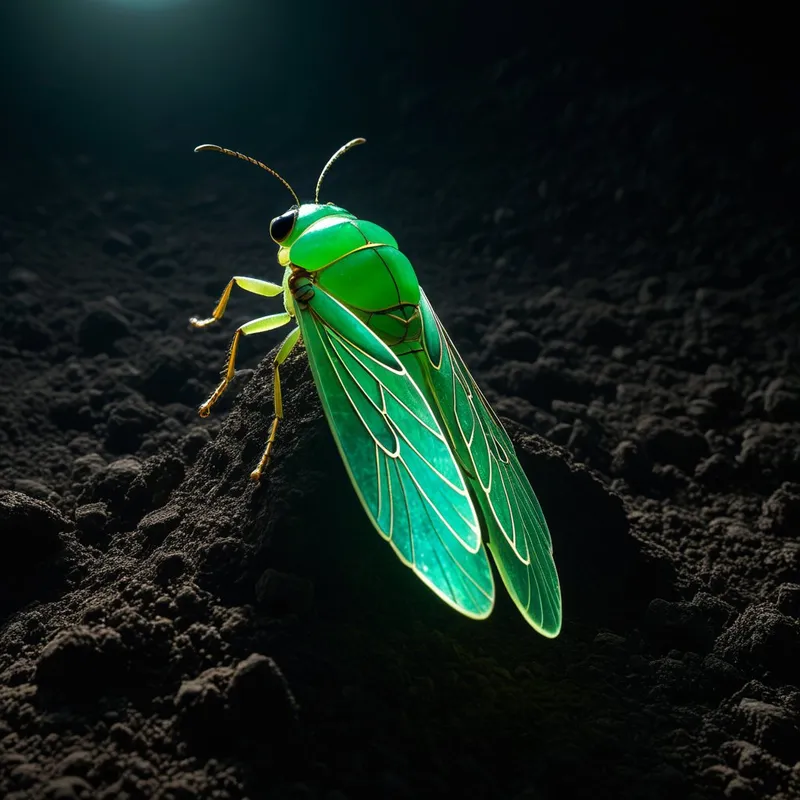
The myth is a dense symbolic ecosystem where matter and [spirit](/symbols/spirit “Symbol: Spirit symbolizes the essence of life, vitality, and the spiritual journey of the individual.”/) perform a sacred dance. The [Cicada](/symbols/cicada “Symbol: Represents renewal, transformation, and the cyclic nature of life.”/) is the primary [hieroglyph](/symbols/hieroglyph “Symbol: Ancient Egyptian writing system using pictorial symbols, representing sacred knowledge, communication with the divine, and the power of language to shape reality.”/) of the [soul](/symbols/soul “Symbol: The soul represents the essence of a person, encompassing their spirit, identity, and connection to the universe.”/). Its long subterranean [nymph](/symbols/nymph “Symbol: Nymphs are nature spirits embodying specific aspects of the natural world, often associated with beauty and allure.”/) stage represents the [soul](/symbols/soul “Symbol: The soul represents the essence of a person, encompassing their spirit, identity, and connection to the universe.”/)’s earthly [life](/symbols/life “Symbol: The symbol of ‘Life’ represents a journey of growth, interconnectedness, and existential meaning, encompassing both the joys and challenges that define human experience.”/)—unseen, developing in the dark [soil](/symbols/soil “Symbol: Soil symbolizes fertility, nourishment, and the foundation of life, serving as a metaphor for growth and stability.”/) of the unconscious. Its dramatic [emergence](/symbols/emergence “Symbol: A process of coming into being, rising from obscurity, or breaking through a barrier, often representing birth, transformation, or revelation.”/), molting, and brief, song-filled adult [life](/symbols/life “Symbol: The symbol of ‘Life’ represents a journey of growth, interconnectedness, and existential meaning, encompassing both the joys and challenges that define human experience.”/) mirror the [soul](/symbols/soul “Symbol: The soul represents the essence of a person, encompassing their spirit, identity, and connection to the universe.”/)’s release from the [body](/symbols/body “Symbol: The body in dreams often symbolizes the dreamer’s self-identity, personal health, and the relationship they have with their physical existence.”/) and its [journey](/symbols/journey “Symbol: A journey in dreams typically signifies adventure, growth, or a significant life transition.”/) into the posthumous [realm](/symbols/realm “Symbol: The symbol of ‘Realm’ often signifies the boundaries of one’s consciousness, experiences, or emotional states, suggesting aspects of reality that are either explored or ignored.”/). Its song is the assertion of individual [consciousness](/symbols/consciousness “Symbol: Consciousness represents the state of awareness and perception, encompassing thoughts, feelings, and experiences.”/) against the overwhelming silence of the infinite.
The jade is not a shell for the soul, but the soul’s own memory crystallized—a hard, eternal fact of having been.
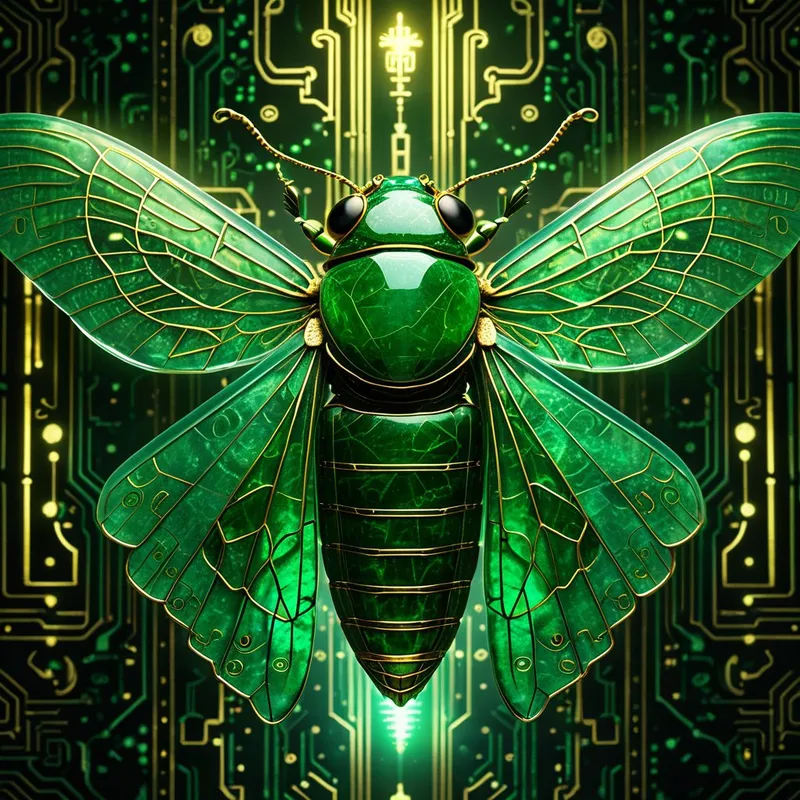
The [Jade](/symbols/jade “Symbol: A precious stone symbolizing purity, protection, and spiritual connection, often associated with wisdom, longevity, and harmony.”/) (yu) is the [counter](/symbols/counter “Symbol: A counter symbolizes boundaries, transitions, and the interplay between order and chaos, as well as a space for negotiation and interaction.”/)-[symbol](/symbols/symbol “Symbol: A symbol can represent an idea, concept, or belief, serving as a powerful tool for communication and understanding.”/) to the cicada’s fragility. It represents the indestructible core, the essence that survives transformation. It is [virtue](/symbols/virtue “Symbol: A moral excellence or quality considered good, often representing inner character, ethical principles, or spiritual ideals in dreams.”/) made mineral, permanence in a world of decay. The [fusion](/symbols/fusion “Symbol: The merging of separate elements into a unified whole, often representing integration of self, relationships, or conflicting aspects of identity.”/) of cicada (process) and [jade](/symbols/jade “Symbol: A precious stone symbolizing purity, protection, and spiritual connection, often associated with wisdom, longevity, and harmony.”/) (essence) in the [amulet](/symbols/amulet “Symbol: A protective object believed to ward off harm, evil, or misfortune, often imbued with spiritual power through symbols, materials, or rituals.”/) creates the complete symbol of the individualed soul—one that undergoes radical change while retaining its integral [identity](/symbols/identity “Symbol: Identity represents the sense of self, encompassing personal beliefs, cultural background, and social roles.”/).
Gongshu Ban’s Sacrifice is the archetypal act of the divine craftsman who structures [chaos](/symbols/chaos “Symbol: In Arts & Music, chaos represents raw creative potential, uncontrolled expression, and the breakdown of order to forge new artistic forms.”/). His [dissolution](/symbols/dissolution “Symbol: The process of breaking down, dispersing, or losing form, often representing transformation, release, or the end of a state of being.”/) is not a [death](/symbols/death “Symbol: Symbolizes transformation, endings, and new beginnings; often associated with fear of the unknown.”/), but a [distillation](/symbols/distillation “Symbol: A spiritual process of purification, extracting essential truths from complex experiences to achieve enlightenment or clarity.”/). He becomes the function of [guidance](/symbols/guidance “Symbol: The act of receiving or seeking direction, advice, or leadership in a dream, often representing a need for clarity, support, or a higher purpose on one’s life path.”/) itself. Psychologically, he represents the transcendent function—the inner [capacity](/symbols/capacity “Symbol: A measure of one’s potential, limits, or ability to contain, process, or achieve something, often reflecting self-assessment or external demands.”/) that willingly sacrifices a familiar, superior state of being (conscious ego certainty) to create a tool (a symbol, an [insight](/symbols/insight “Symbol: A sudden, deep understanding of a complex situation or truth, often arriving unexpectedly and illuminating hidden connections.”/)) that can navigate the unknown [depths](/symbols/depths “Symbol: Represents the subconscious, hidden emotions, or foundational aspects of the self, often linked to primal fears or profound truths.”/) of the [psyche](/myths/psyche “Myth from Greek culture.”/) (the personal Diyu).
The Dreamer’s Resonance
When this myth stirs in the modern unconscious, it rarely appears as a literal tale. It manifests in dreams of finding small, hard, precious objects—a green stone in the mud, a lost piece of jewelry in a drawer. It whispers in dreams of voices or songs emerging from the throat with difficulty, or of shedding a tight, crunchy skin. It screams in nightmares of being mute in a crucial moment, or of carrying a heavy, beautiful stone that one must not drop.
These are somatic signals of a psychological hanchan ritual in process. The dream ego is undergoing a “little death”—the end of an identity, a relationship, a life phase. The psyche is instinctively attempting to place a “jade cicada” on the tongue of what is dying. The struggle to speak or sing in the dream is the soul fighting for its narrative, striving to preserve the core truth of that experience before it descends into the forgetful [underworld](/myths/underworld “Myth from Greek culture.”/) of the repressed. The dream is the workshop where we, like Gongshu Ban, must spend our own psychic substance to craft the amulet that will allow us to remember who we were, so we can become who we are next.
Alchemical Translation
The myth of the Cicada Jade Amulets is a precise allegory for the Jungian process of individuation—the alchemical opus of becoming whole. The journey begins in the [nigredo](/myths/nigredo “Myth from Alchemical culture.”/), the blackening: the “death” of a dominant attitude, the collapse of a [persona](/myths/persona “Myth from Greek culture.”/). This is the soul’s descent into Diyu, a state of depression, confusion, and loss of meaning.
The underworld journey is not a punishment, but a necessary dissolution where the alloy of the personality is broken down so the pure gold of the Self can be retrieved.
The conscious ego in this state feels lost and mute. The creation of the “jade cicada” is the work of active imagination and symbolic life. It is the painful, deliberate effort to articulate the essence of the experience—through journaling, art, dialogue, or ritual—to create a durable, beautiful symbol (the jade) that contains the truth of the change (the cicada’s song). This is the albedo, the whitening, where insight emerges from the darkness.
Gongshu Ban’s sacrifice is the key. [The ego](/myths/the-ego “Myth from Jungian culture.”/) must willingly offer up its sense of control and superiority (“I know who I am”) to serve the greater process of the Self. It must “dissolve” its rigid form to become the guiding function. The final stage, the [rubedo](/myths/rubedo “Myth from Alchemical culture.”/) or reddening, is the rebirth. It is not a return to the old life, but an emergence with the amulet integrated. The soul does not escape the cycle; it masters its passage. It carries the hard-won symbol of its own transformations, granting it resilience and a quiet, inner song that can guide it through all future deaths and rebirths. One becomes, in a sense, both the guided soul and the guiding artisan—forever crafting and forever journeying, immortal not in stasis, but in the endless, sacred art of becoming.
Associated Symbols
Explore related symbols from the CaleaDream lexicon: