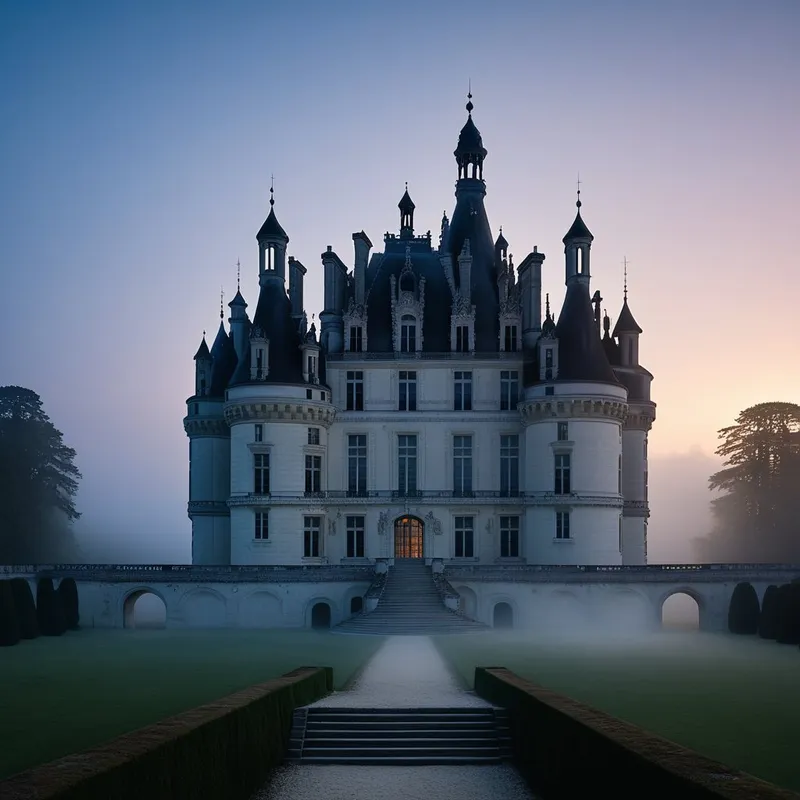
Château de Chambord Myth Meaning & Symbolism
A king dreams a divine geometry into stone, a palace born from the marriage of forest and sky, a monument to human aspiration and cosmic order.
The Tale of Château de Chambord
Listen, and hear the tale not of a building, but of a dream made manifest. In the deep, wild heart of the Forêt de Boulogne, where the mist clings to ancient oaks and the stag’s call echoes like a forgotten prayer, a king walked. He was François Premier, a man whose soul was a battleground of fire and geometry. He had known the glory of war and the sweetness of art, but his spirit remained restless, a caged eagle.
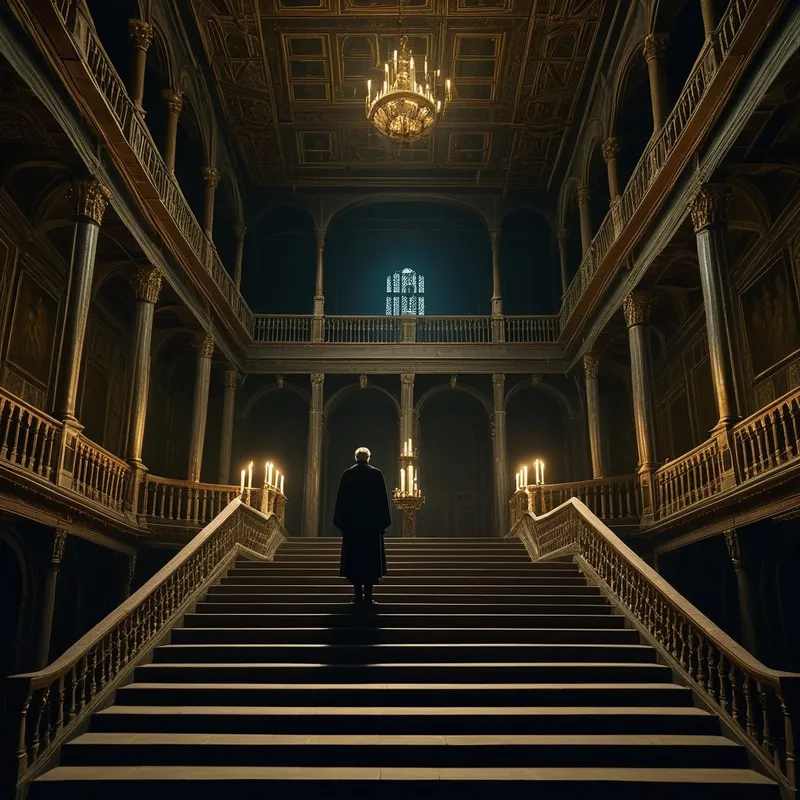
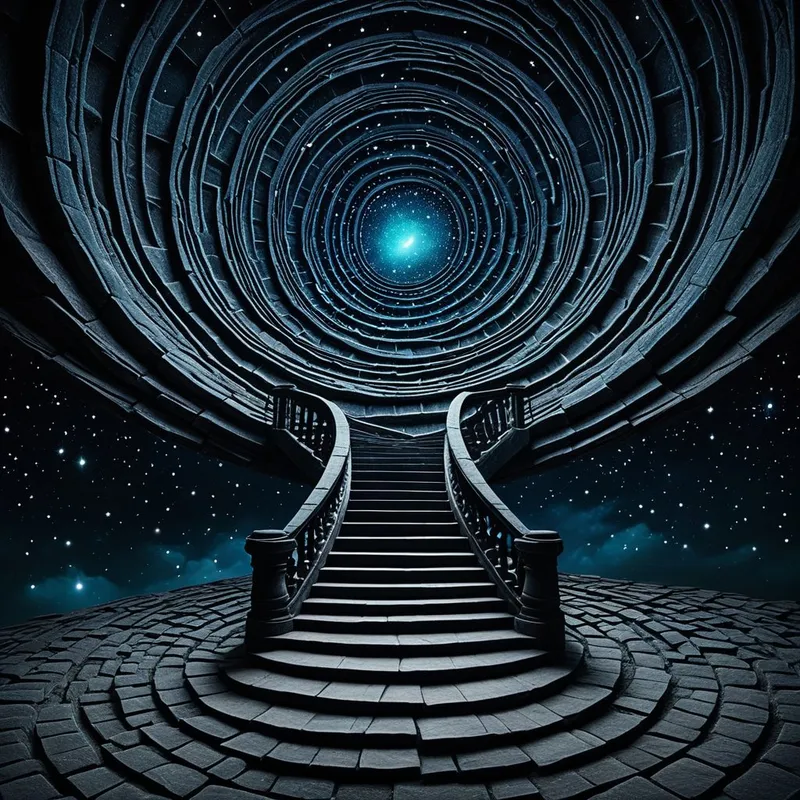
One evening, as the sun bled into the Cosson’s waters, he fell into a slumber not of the body, but of the will. In this twilight state, he did not dream of conquests or courtly love. He dreamed of order. A vision descended upon him, not from the Christian heaven he knew, but from a more ancient, celestial realm. It was the spirit of Harmonia, she who weaves the music of the spheres. She showed him a form—a perfect, impossible staircase. Two spirals, intertwined like the strands of life itself, ascending and descending in the same space yet never meeting. A dance of stone.
He awoke with the cold clarity of destiny. The forest clearing was no longer just land; it was a blank page. He summoned not just masons and carvers, but visionaries. He spoke of central plans, of a Greek cross crowned by a lantern that would hold a piece of the sky captive. For twenty-eight years, the clearing roared with creation. Stone rose from the earth, not as a fortress, but as a testament. The forest yielded its substance, transformed into 800 sculpted capitals, into a roofscape of chimneys and lanterns that mimicked a city skyline seen from heaven. The king would often walk the unfinished halls, his fingers tracing the cool stone, whispering to the nascent double staircase, “You are the axis of my world.”
And when it was done—though such a dream is never truly finished—the château stood. It was not merely a royal lodge. It was a frozen moment of aspiration, a palace where every line, every window, every vault sang a hymn to the marriage of human intellect and divine pattern. The king walked his staircase, one hand on the ascending rail, and felt the universe turn around him. The myth was born: not of a man who built a house, but of a dream that built a man, and in doing so, built a world.
Cultural Origins & Context
The story of Chambord is a quintessential Renaissance française myth, born at the precise crossroads of medieval mysticism and burgeoning humanist confidence. Historically, it is the pet project of King Francis I, begun in 1519. But its passage into the realm of cultural myth occurred through the voices of court poets, ambassadors’ letters, and the awestruck reports of travelers.
The tale was not passed down in peasant cottages, but in the salons and courts of Europe. It functioned as a piece of propagande royale, but of a uniquely sophisticated kind. It proclaimed that the French king was not just a warrior or a politician, but a philosopher-king, a new Platonic guardian who could channel cosmic principles into earthly form. The myth served to elevate the monarch from a temporal ruler to a demiurge, a world-creator. It also answered a deep cultural anxiety and ambition: after the chaos of the Hundred Years' War, France was consciously constructing a new identity, one of order, brilliance, and centralized power. Chambord, in its impossible symmetry and scale, was the stone manifesto of that new France.
Symbolic Architecture
At its core, the myth of Chambord is an allegory of the psyche imposing order on chaos, of consciousness seeking to structure the vast, unruly contents of the unconscious. The wild Forêt de Boulogne represents the primordial, untamed Self—instinctual, dense, and mysterious. The dream of the perfect staircase is the irruption of a transcendent symbol, an archetype of order from the collective unconscious.
The double helix is the psyche’s own blueprint: the conscious and unconscious spirals, eternally distinct yet inseparably bound, enabling ascent and descent within the same psychic space.
The château itself is a symbol of the Self as a temenos, a sacred precinct. Its hundreds of rooms, fireplaces, and intricate roofscape represent the staggering complexity of the individual psyche. Yet, all this complexity is organized around a central, void space—the Greek cross plan—anchored by the double staircase. This is the ultimate symbol: the center that holds the chaos, the immutable axis around which the personality revolves. The lantern tower is the crowning consciousness, the "lamp" that illuminates the inner structure, aspiring to touch the divine.

The Dreamer's Resonance
When the pattern of Chambord arises in a modern dream, it seldom appears as a literal castle. More often, it manifests as a profound experience of psychic architecture. One might dream of discovering a vast, impossibly complex building within themselves, of finding a central, spiraling core in a labyrinth, or of witnessing two opposing forces or paths that are mysteriously and beautifully intertwined without conflict.
This dream signals a critical phase of psychological integration. The somatic feeling is often one of awe mixed with vertigo—the body responding to the scale of the inner discovery. Psychologically, the dreamer is undergoing a process of centering. The chaotic elements of their life—conflicting ambitions, tangled relationships, creative impulses—are being recognized as parts of a grand, if bewildering, internal design. The dream is an affirmation from the unconscious: order is possible. The central "staircase" is the emerging principle that can harmonize these opposites, allowing the dreamer to "ascend" to higher awareness or "descend" into deeper instinct without losing their way. It is the birth of an inner sovereign, capable of governing the vast kingdom of the self.
Alchemical Translation
The alchemical process mirrored in the Chambord myth is that of coagulatio—the transformation of the volatile spirit (spiritus) into a fixed, enduring form (corpus). King Francis’s initial state is one of ambition (the prima materia), a fiery, restless energy. The forest is the massa confusa, the chaotic raw material of the unconscious.
The divine dream is the moment of inspired illumination (illuminatio), where the Lapis Philosophorum—here symbolized by the perfect geometric plan—is revealed. The decades of construction represent the arduous, meticulous work of individuation: bringing that transcendent vision into concrete, earthly reality. Every stone laid is a conscious choice, a sacrifice of raw possibility for defined form.
The triumph is not in the dream, but in the enduring patience to translate its airy substance into the weight and grain of stone—this is the alchemy of the soul.
For the modern individual, the myth models the journey from possessing a fleeting insight or a grand ideal to building a life architecture that can stably contain it. The "château" we are called to build is the structure of our character, our values, and our life’s work, organized around a central, unifying principle (our personal "double helix"—perhaps the reconciliation of heart and mind, solitude and relationship, tradition and innovation). The process is slow, often frustrating, and requires the marshaling of all our inner resources. But the result is a Self that is not a scattered collection of experiences, but a coherent, majestic, and inhabitable whole—a sacred space where one can truly reside.
Associated Symbols
Explore related symbols from the CaleaDream lexicon: