
Chloris Myth Meaning & Symbolism
A nymph of spring, reborn as Flora after a violent abduction, embodying the soul's capacity to transform trauma into blossoming creativity.
The Tale of Chloris
Listen, and let the wind from the west carry the scent of this story. It begins not in the golden halls of Olympus, but in the quiet, dew-laden meadows where the world is still young and raw. Here dwelt Chloris, a nymph whose very name whispered of the pale green shoots that pierce the winter-hardened earth. She was not a goddess of grand power, but a spirit of the becoming—the tender, vulnerable promise that precedes the fulfillment of bloom.
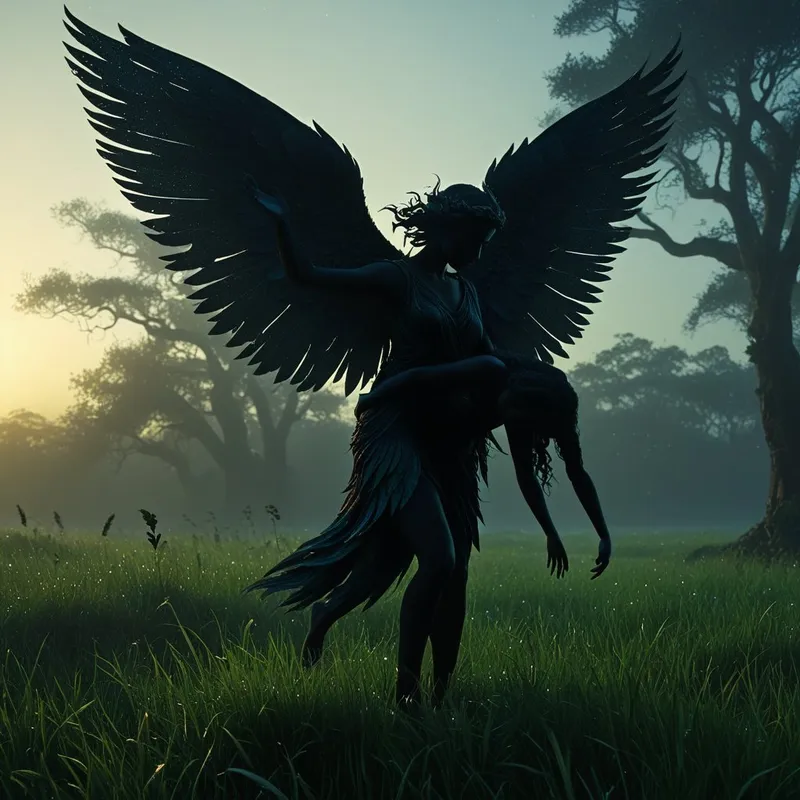
Her world was one of soft moss and chattering streams, until the day the West Wind changed its tune. No longer a gentle zephyr, it roared into her sanctuary as Zephyrus, a winged deity of immense and stormy passion. He saw Chloris dancing in a solitary glade, a vision of untouched spring, and desire, sharp and possessive, overtook him. This was no courtship. It was an abduction—a whirlwind of terror as the mighty wind-god swept the fragile nymph from her rooted world. The air, her element, became a prison of rushing noise and force.
In that violent taking, something in Chloris shattered. The old nymph, the maiden of the green shoot, was carried away on that gale. Yet, in the strange and terrible aftermath, in the quiet of Zephyrus's own domain, a miracle of compensation occurred. The god’s fierce love, tempered by guilt or perhaps a deeper recognition, transformed into devotion. As recompense for the violence, he gifted her a kingdom. Not of stone and scepter, but of petal and scent. He made her the sovereign of all flowers, bestowing upon her the divine name Flora.
And from Chloris’s lips, no longer trembling in fear, came a new breath. Where she exhaled, the earth did not simply grow; it celebrated. Roses, hyacinths, anemones—flowers of every hue and form burst forth not from seeds, but from her very being, a cascade of beauty born from rupture. The victim of the west wind became its bride, and together they presided over the fertile marriage of air and earth, their union the very engine of spring’s relentless, joyful return.
Cultural Origins & Context
The story of Chloris is a thread woven into the vast tapestry of Greek mythography, primarily preserved for us in the works of the poet Ovid. In his Fasti, a poetic calendar of Roman festivals, he recounts her tale, blending her Greek essence with her Roman identity as Flora. This points to her role as a foundational, chthonic spirit—a local nymph of growth—who was later syncretized into a more formalized goddess within the pantheon.
Her myth was not the center of grand cosmogonies, but rather a etiological narrative for the season of spring itself. It gave a face and a story to the mysterious, annual victory of life over decay. The festival of Floralia in Rome, with its vibrant, sometimes licentious celebrations involving the scattering of flowers and beans, channeled her spirit of unchecked fertility and renewal. Her story was told not just to explain flowers, but to model a profound, uncomfortable truth the ancients understood well: that creation and destruction are often two sides of the same coin, and new life frequently springs from a ground fertilized by trauma.
Symbolic Architecture
At its heart, the myth of Chloris is an archetypal map of radical transformation through encounter with the Other. Chloris represents the anima in its most nascent state—the innocent, potential-filled self, connected to nature but not yet conscious of its own creative power. Zephyrus, the West Wind, is the archetypal autonomous complex, a burst of instinctual, psychic energy that disrupts the status quo. His abduction is not a literal prescription but a symbolic depiction of how the psyche is often taken, overwhelmed by a force from the unconscious—be it passion, trauma, inspiration, or mental illness.
The most vibrant blossoms are fed by compost; the soul's spring requires the winter of dissolution.
The pivotal moment is not the abduction, but the transmutation that follows. Chloris does not merely escape or remain a broken victim. She is re-created with a new domain and a new name. This symbolizes the psyche's profound capacity for what alchemists called the opus. The base metal of a traumatic or overwhelming experience is subjected to the "wind" of the spirit, and through a process we might call grace or unconscious compensation, it is transformed into the "gold" of a new, empowered identity. Flora is Chloris integrated—the maiden who has metabolized her encounter with the powerful, masculine principle and emerged not just healed, but endowed with sovereign creative authority.
The Dreamer's Resonance
When this myth stirs in the modern dreamer, it often signals a profound somatic and psychological process of fragmentation and re-genesis. One might dream of being chased by a storm or a powerful animal (the Zephyrus complex), of feeling uprooted or carried away from a familiar, safe place. The body in the dream may feel terrified, breathless, or numb.
In a later stage, or in a more integrated dream, the imagery shifts. The dreamer may find themselves in a barren landscape that begins to bloom at their touch, or they may be giving birth to strange, beautiful plants or gemstones. They might receive a new name or a crown of flowers. These are the signs of the "Flora" emergence. The psyche is working to alchemize a recent or past rupture—a loss, a diagnosis, a creative block, a relational betrayal—into a source of newfound fertility. The somatic sensation often shifts from constriction in the chest (the stolen breath) to a feeling of expansion and generative warmth in the hands or core, as if the dreamer is discovering they can produce beauty from within their own being.

Alchemical Translation
For the individual on the path of individuation, Chloris’s journey is a master narrative of psychic transmutation. The first stage, nigredo, is represented by the dark abduction—the confrontation with the shadowy, overwhelming aspect of life or the self that blackens our familiar world. This is a necessary descent.
The second stage, albedo, is the washing and the granting of a new domain. It is the often slow, patient process of coming to terms with the event, of being "married" to the reality of what happened, and beginning to see the compensatory gifts hidden within the wound. Zephyrus’s devotion here is crucial; it symbolizes the libido (psychic energy) that was once destructive becoming dedicated to the work of rebuilding.
The wound is the place where the soul's sap rises to create a new form.
The final stage, rubedo, is the glorious, red blossoming of Flora. This is the full integration, where the individual no longer identifies solely as the one who was harmed, but as the one who creates from that very place. Their creative output—whether art, compassion, wisdom, or simply a more authentic way of living—becomes the "flowers" that scatter beauty and life into their world. They achieve sovereignty over their inner landscape. The myth thus assures us that our most devastating winters are not final, but are the prelude to a spring whose blossoms are uniquely, resiliently, and magnificently our own.
Associated Symbols
Explore related symbols from the CaleaDream lexicon: