Chiron Myth Meaning & Symbolism
The immortal centaur, wounded by a poisoned arrow, surrenders his immortality to end his agony, becoming the archetype of the wounded healer.
The Tale of Chiron
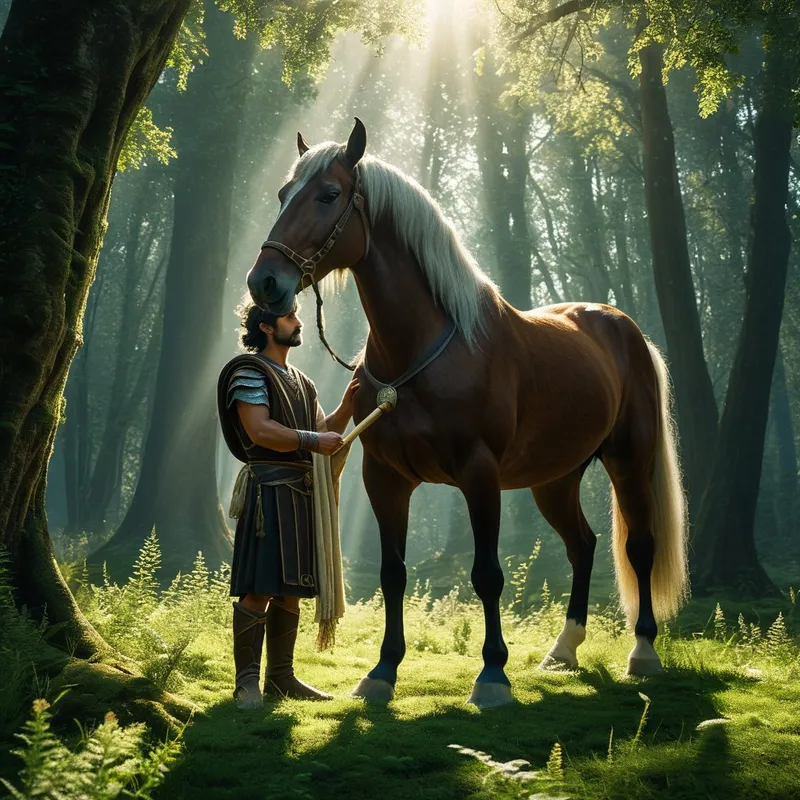
Listen, and hear the tale of the one who was not like the others. In the wild, untamed mountains of Thessaly, where the pines whispered secrets to the wind, there lived a being of two natures. He was Chiron, son of the Titan Cronus and the sea nymph Philyra. Where his kin, the centaurs, were born of lust and cloud, creatures of raucous appetite, Chiron was fashioned from different clay. From the haunch down, he was stallion, powerful and sure-footed upon the earth. But his torso and mind were that of a man, yet a man touched by the divine—kind-eyed, gentle-handed, and infinitely patient.
His cave on Mount Pelion was no mere den. It was a hall of learning, fragrant with drying herbs and alive with the soft scratch of stylus on wax. Here, the greatest heroes of the age were not born, but made. Achilles learned the lyre and the art of war from those same hands that could suture a wound. Asclepius was taught the secrets of plants and potions that could cheat death. Jason and Heracles sat at his hearth, learning justice, music, and the stars. Chiron was the bridge between the wild and the civilized, the instinctual and the intellectual, the only centaur invited to dine with the gods.
But fate, which he could read in the constellations he taught, had woven a bitter thread into his tapestry. During the fourth of his famed labours, the hero Heracles journeyed to the centaurs’ land. A conflict erupted—wine was spilled, tempers flared. In the chaotic skirmish, Heracles let fly one of his arrows, tipped with the venomous blood of the Lernaean Hydra. The arrow, meant for a wild centaur, found its mark in the noble flank of Chiron.
A scream, not of rage but of profound, cosmic injustice, tore from his throat. The pain was an abyss. The hydra’s venom was a fire that did not consume, an agony that promised no end. Here was the cruel paradox: Chiron, the master healer, bore a wound he could not cure. His divine ichor, the blood of immortality, kept him alive, but only to feel the poison’s eternal burn. For years uncounted, the wise teacher became the eternal patient, wandering the sacred groves in unending torment, a living lesson in suffering.
The resolution came not from a battle, but from a bargain. When the Titan Prometheus was bound to his rock, enduring an eagle’s feast on his liver each day, Zeus declared he could only be freed if an immortal being willingly descended to Hades in his place. Chiron, whose pain had become his only kingdom, saw his release. He stepped forward. He, the immortal, chose mortality. He surrendered his endless life so that Prometheus, the bringer of fire and wisdom to humanity, could be unbound.
As his great spirit departed, Zeus, in honor and pity, lifted him from the funeral pyre and placed him among the stars. There he remains, not as the suffering centaur, but as the constellation Sagittarius, forever aiming his bow at the heart of the Scorpion, a celestial healer watching over the turning world.

Cultural Origins & Context
The myth of Chiron originates from the rich tapestry of ancient Greek mythology, primarily preserved in the epic poetry of Hesiod’s Theogony and later elaborated by Roman poets like Ovid. Unlike the oral folktales of purely local heroes, Chiron’s story was part of the sophisticated, pan-Hellenic mythological system that served as a national literature and a framework for understanding the world. He was a fixture in the "biographies" of major heroes, acting as the foundational tutor. His myth was told not around campfires, but in the symposia of the educated and the texts of philosophers, serving as a profound narrative device to explore themes of wisdom, suffering, and the nature of sacrifice. His function was societal and pedagogical: he represented the ideal teacher, the civilizing force that could temper heroic might with art and ethics, and his final act provided a mythological precedent for the concept of the noble, redemptive sacrifice.
Symbolic Architecture
Chiron is the archetype of the Wounded Healer. His symbolism is a complex architecture of duality and transcendence.
The deepest wound holds the precise medicine you are destined to administer to the world.
His very body is the first symbol: the centaur. He is the enduring tension between animal instinct (the horse) and human consciousness (the man). Unlike his bestial kin, Chiron has mastered this tension, integrating his earthy, somatic wisdom with intellectual and spiritual insight. He is wholeness achieved not by denying one half, but by elevating both.
The incurable wound is the core of his mythos. It represents the primal, existential hurt that every conscious being carries—a trauma, a flaw, a profound sense of lack or otherness that cannot be simply "fixed." His immortality makes the wound eternal, symbolizing how our core wounds shape our identity; they are not events we recover from, but landscapes we must learn to inhabit.
His role as teacher is directly born of this wound. He does not teach from a place of perfect, untroubled knowledge, but from the authority of endured suffering. His students—the heroes—represent the various potentials of the human psyche, which he guides not to perfection, but to a more conscious, integrated expression of their own natures.
Finally, his voluntary death is the ultimate alchemical act. He transmutes his endless, personal agony into a deliberate, meaningful sacrifice for the liberation of another (Prometheus). His mortality is not a defeat, but a chosen completion. His apotheosis into the stars signifies that the essence of the Wounded Healer is not destroyed but eternalized, becoming a guiding pattern in the collective human psyche.
The Dreamer's Resonance
When the pattern of Chiron stirs in the modern dreamer, it often manifests as dreams of a chronic, inexplicable ailment; of being a teacher or guide while feeling utterly broken inside; or of a hybrid self, part human, part creature, navigating a world that doesn't understand the whole. One might dream of a mentor figure who is themselves limping or carrying a hidden injury, or of finding a sacred text or medicine in a place of personal pain.
Somatically, this is the psyche processing a core wound—often one related to early childhood, a foundational betrayal, or a sense of innate "otherness." The dream is not presenting a solution, but making the wound conscious. It is the psyche's way of saying, "This pain is not a mistake to be erased; it is the central fact of your particular consciousness. The agony you feel is the pressure of a wisdom trying to be born." The dreamer is undergoing the initial, often terrifying, recognition of their own shadow as the source of their unique authority.
Alchemical Translation
The Chiron myth is a precise map for the individuation process, the alchemical journey of turning leaden suffering into golden wisdom. It models psychic transmutation in three distinct stages.
First is The Wounding and the Recognition. This is the descent, the unavoidable encounter with the poisoned arrow—the trauma, the complex, the neurosis. The alchemical work begins not by avoiding this pain, but by fully acknowledging it as one's own, as Heracles' arrow was meant for another but lodged in Chiron. One must stop trying to "cure" it in the conventional sense and instead begin to study it.
Second is The Holding of the Tension. This is the long, dark night of the soul—Chiron's immortal agony. Psychologically, this is the sustained, conscious endurance of opposites: strength and fragility, wisdom and ignorance, healer and patient. One learns to host the contradiction, to live in the cave of one's own pain without being utterly consumed by it. In this space, the old, heroic ego that seeks a quick fix dies, and a more compassionate, witness-consciousness begins to form.
The surrender of immortality is the acceptance of limitation, and in that acceptance, the birth of true meaning.
Finally, there is The Sacred Exchange and Constellation. This is the mortificatio and sublimatio of the alchemists. The ego's demand for a pain-free existence (immortality) is voluntarily surrendered. One accepts their mortal, wounded nature. In doing so, the personal pain is lifted from a purely subjective complaint and offered up—transmuted into empathy, art, guidance, or service for others. The wound becomes the wellspring. The individual identity, now fully conscious of its flaw, is released from its purely personal orbit and becomes a fixed point of reference—a constellation—in one's own inner cosmos and in the lives one touches. One becomes, at last, a sage not of abstract knowledge, but of embodied, earned compassion.
Associated Symbols
Explore related symbols from the CaleaDream lexicon:
- Teacher
- Master
- Pastor
- Grandpa
- Coach
- Backseat
- Senior
- Sick
- Guru
- Herb Garden
- Wounded Soul
- Friendly Monster
- Talking Animals
- School Bus
- Rooted Sage
- Doodlebug Hide
- Sun-Kissed Centaur
- Inspiring Teacher
- Teacher's Desk
- Teacher's Lesson Plan
- Tow Truck
- Flatbed Tow Truck
- Goldenrod
- Devil's Claw Plant
- Herbal Poultice
- Dried Herbs Bundle
- Herbal Infusion
- Medicinal Herb
- Mentor Figure
- Senex Figure
- Senex
- Tutorial
- Emeritus
- Suture
- Bandage
- Cured
- Herbal
- Turmeric