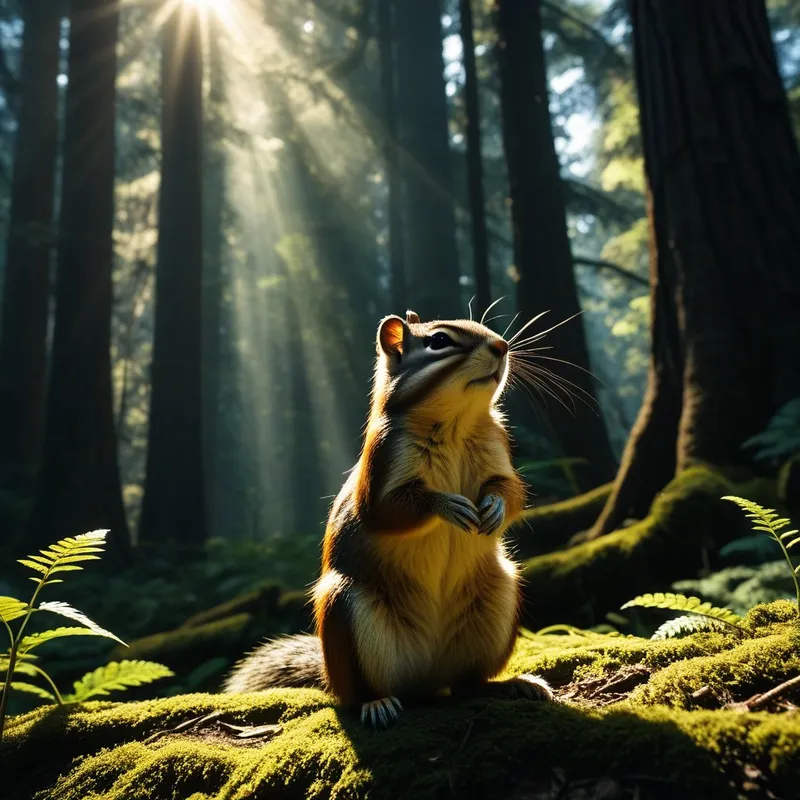
Chipmunk Myth Meaning & Symbolism
A small creature's clever defiance of a giant bear reshapes the world, teaching that true power lies in wit and spirit, not size.
The Tale of Chipmunk
Listen. In the time before time, when the world was still soft and the shapes of things were not yet fixed, there walked a being of immense power and immense pride. He was the Great Bear, Mato, whose shadow alone could darken a valley. In those days, Bear declared that it would be forever day. The sun, he commanded, would never set. His will was law, for who could challenge him? The world grew weary under the endless, scorching light. The streams whispered in exhaustion, the flowers bowed their heads, and all creatures moved in a slow, heat-hazed dream of fatigue.
But in the roots of the great oak, in the cool dark where the light could not reach, lived a small one. Chipmunk. While others complained in hushed tones, Chipmunk’s heart beat a rhythm of rebellion. Not with anger, but with a clever, sparkling fire. “This is not balance,” she chittered to herself. “The world needs its rest. It needs the blanket of night.”
She ventured into the glaring light, a tiny speck of fur and nerve before the mountain that was Bear. “Great One,” she piped, her voice a needle in the silence. “Your light is mighty. But what of the stars? What of the cool dew and the dreams that come in the dark? Let there be night, too.”
Bear’s laughter shook the trees. “You? You who fits in my footprint? You dare to tell me how the world should be? Very well. Run. Run from my anger. If you can escape me, I will grant your wish. If I catch you… you will be silence.”
And so the chase began. Bear’s thunderous charge split the earth. Chipmunk, a bolt of brown lightning, darted and zigzagged, not in a straight line of fear, but in a pattern of pure, desperate wit. The ground trembled. Claws like fallen trees gouged the earth behind her. She could feel the hot breath, smell the fury. Just as a vast shadow engulfed her, just as a giant paw descended to crush her spirit, she darted sideways with a final, impossible leap.
The paw came down. It did not catch her body, but its very tip, one mighty claw, grazed her back as she fled into the safety of a rocky crevice.
Panting, hidden, she called out, “You missed! The bargain is struck!”
And from that day, the sun learned to set. Night, soft and star-strewn, returned to the world. But upon Chipmunk’s back, from shoulder to tail, were etched five long, pale stripes—the forever mark of Bear’s claw, a sacred scar of her courage. And Bear, in his defeat, learned respect. The world found its rhythm: day for work and light, night for rest and dreams. All because one small voice, one quick spirit, dared to challenge the impossible.
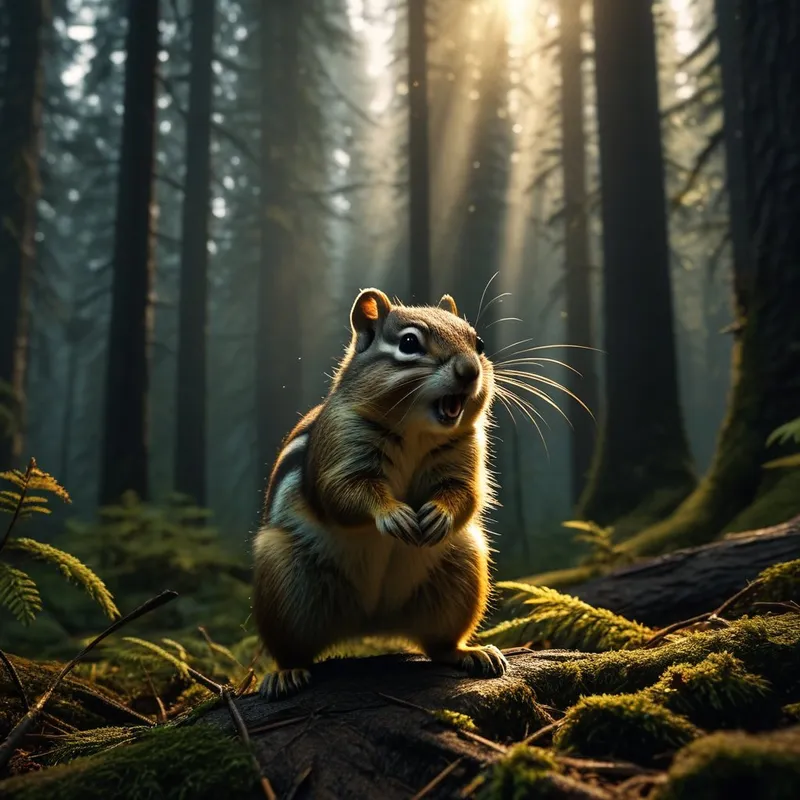
Cultural Origins & Context
This myth, in its many variations, is found among numerous Algonquian and other Eastern Woodlands peoples. It was not a mere children’s fable but a foundational etiological narrative, told by elders and storytellers during long winter nights or in teaching moments. Its primary function was to explain a natural phenomenon—the origin of the chipmunk’s stripes and the cycle of day and night. But its deeper purpose was pedagogical. It served as a societal compass, teaching that authority is not absolute, that physical size is not equivalent to power, and that the cleverness and courage of the seemingly insignificant are vital forces for maintaining cosmic and social balance. The storyteller, by voicing both Bear’s booming arrogance and Chipmunk’s piercing defiance, performed a ritual of memory, reminding the community that their world was shaped by such dynamic tensions and that every creature, no matter how small, has a role in the great story.
Symbolic Architecture
At its heart, this myth is a masterclass in the symbolism of necessary rebellion and the intelligence of the small. Bear represents the ego in its most inflated, tyrannical form: a force that seeks to impose its singular will upon the entirety of existence, denying the needs of the whole for its own comfort. The eternal day is the state of unconscious dominance, where one principle (light, action, consciousness) refuses to yield to its opposite (darkness, rest, the unconscious).
Chipmunk is the archetypal spark of consciousness that arises from the ignored, repressed, or undervalued depths. She is the voice of the ecosystem, the psyche’s innate drive toward wholeness.
Her home in the roots symbolizes her connection to the instinctual, hidden world—the very collective unconscious that Bear’s eternal sun seeks to deny. The chase is the terrifying but necessary process of confrontation. The stripes are critical: they are not wounds of failure, but sacred stigmata of transformation. They are the permanent, visible record of an encounter with overwhelming power, a testament that the individual spirit engaged with the colossal and was fundamentally changed, yet not destroyed. The resulting balance of day and night is the achieved state of coniunctio oppositorum—the psyche functioning in its healthy, rhythmic polarity.
The Dreamer's Resonance
When this myth pattern stirs in the modern dreamer, it often manifests as dreams of being pursued by a massive, overwhelming force—a monster, a tidal wave, a giant. The dream ego feels tiny, terrified, and yet finds itself navigating the chase with an unexpected, almost preternatural agility. Somaticly, one might awaken with a tightness between the shoulder blades—the very site of Chipmunk’s marking.
Psychologically, this signals a critical moment of confronting an inner “Bear.” This could be an overbearing internal critic, a rigid belief system, a domineering complex (like the power complex), or an outdated life structure that demands “eternal day”—constant productivity, perfect control, or the suppression of vulnerability and rest. The dream is the psyche’s enactment of the rebellion. The clever running is not evasion; it is the active, adaptive engagement of the dreamer’s own resourcefulness, their “Chipmunk” spirit, which knows that a direct, head-on fight is impossible, but that a strategic, intuitive dance with the danger can change the rules of the game itself.
Alchemical Translation
The alchemical journey modeled here is not one of slaying the dragon, but of outsmarting it to restore the natural law. For the modern individual, Bear is the ruling principle that has grown despotic. It might be the relentless drive for career success that extinguishes creativity, or a persona of strength that forbids tears. The first step, Chipmunk’s realization in the roots, is the moment of consciousness—the faint, irritable sense that “this way of being is unsustainable. It is killing my spirit.”
The chase is the confrontation with the shadow. We must allow the giant to be angry, to feel its full force, and to trust our innate, nimble intelligence—our intuition, our humor, our core values—to guide us through the peril. We are not trying to destroy this part of ourselves, but to escape its crushing dominance.
The triumph is the establishment of a new rhythm. The granting of night is the permission to rest, to doubt, to be vulnerable, to dream. The stripes are the indelible wisdom gained.
They are the humility that comes from knowing your own limits and the courage that comes from having tested them. The individual does not become Bear, nor do they remain the unmarked creature hiding in the roots. They become the striped one—the one who carries the evidence of a transformative negotiation between the great power of the world and the swift, clever spirit of the soul. The psyche’s tyranny is broken, and in its place, a sacred, balanced rhythm reigns.
Associated Symbols
Explore related symbols from the CaleaDream lexicon: