Chintamani Myth Meaning & Symbolism
The celestial gem born from the ocean's churning, a symbol of ultimate desire that demands profound sacrifice to be held without corruption.
The Tale of Chintamani
In the age when the world was still soft and the gods walked with a palpable anxiety, a great weariness had fallen upon the heavens. The celestial realms, for all their splendor, were haunted by a subtle decay. The Devas had grown frail, their immortality a fading echo. Across the cosmic divide, the Asuras, the titans of power and ambition, chafed against their own limitations. A shadow had fallen between the states of being, a malaise that whispered of an end to all things.
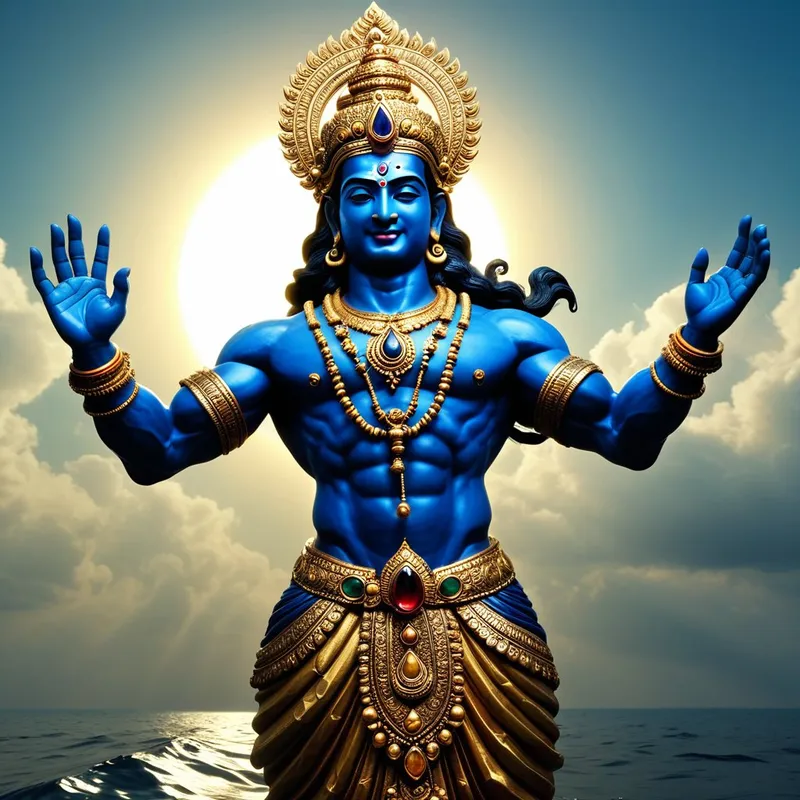
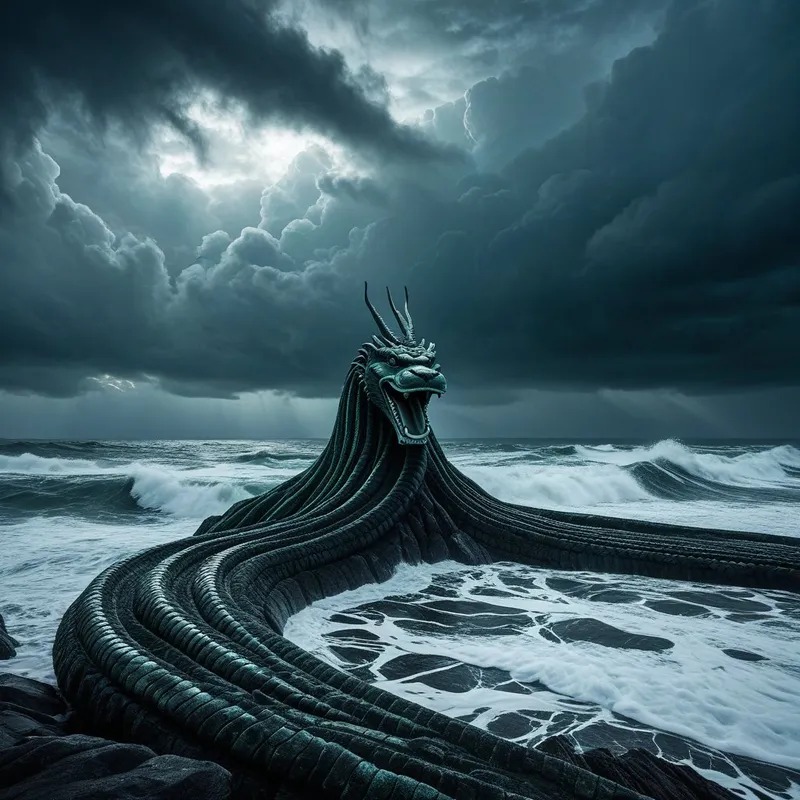
It was the preserver, Vishnu, who perceived the root of this cosmic fatigue. The nectar of immortality, Amrita, was lost, hidden in the depths of the primordial Kshirasagara. To retrieve it would require an impossible labor: the churning of the ocean itself. A temporary, uneasy truce was struck between Devas and Asuras. Their tool would be the great mountain Mandara. Their churn-rope would be the king of serpents, the mighty Vasuki. Vishnu, in his boundless compassion, took the form of a colossal tortoise, Kurma, to bear the mountain’s weight upon his cosmic shell.
And so the churning began, a sight of terrifying grandeur. The Devas took the head of the serpent, the Asuras its tail. They pulled with all their might, back and forth, the mountain spinning, grinding against the shell of the world-tortoise. The ocean frothed and roared, heaving not with water, but with a thick, white milk of potential. For an age, they labored, and the first thing to emerge was a deadly poison, Halahala, so virulent it threatened to dissolve creation. The poison was swallowed by the great ascetic Shiva, who held it in his throat, turning it blue, saving all by containing the first, bitter fruit of their endeavor.
Then, from the churning depths, wonders began to rise. The celestial cow Kamadhenu, the goddess of wine, the moon, the divine tree. And then, a light unlike any other pierced the foam. It was a gem, but to call it such is to call the sun a candle. It was the Chintamani, the wish-fulfilling jewel. Its radiance was not of color, but of pure possibility. It held within its facets every unformed desire, every silent prayer, every latent dream of every being in the three worlds. It pulsed with a promise so absolute it was terrifying.
A gasp, half of awe, half of avarice, swept through the ranks of both Devas and Asuras. Hands reached out instinctively. But before the gem could be claimed, the divine discus of Vishnu, the Sudarshana Chakra, flashed. It did not strike a being, but the space around the gem, carving out a sphere of sacred law. A voice, calm and oceanic, resonated in every mind—it was the voice of the cosmos itself, of Vishnu as the underlying order. The law was simple, absolute, and non-negotiable: The Chintamani could not be owned. It could only be held in stewardship by one who had mastered desire itself, who could bear its infinite promise without being consumed by a single wish. It was a touchstone for the soul, revealing not what one could have, but what one truly was. In the stunned silence, the radiant gem ascended, not to the vault of the gods or the vaults of the titans, but into the custody of the one whose nature is preservation, into the hand of Vishnu, where it rests, not as a possession, but as a testament to a truth deeper than fulfillment.
Cultural Origins & Context
The myth of the Chintamani is embedded within the grander narrative of the Samudra Manthan, or the Churning of the Ocean of Milk. This epic episode is detailed in several Puranic texts, most prominently the Mahabharata, the Vishnu Purana, and the Bhagavata Purana. It functions as a foundational cosmogonic tale, explaining the origin of various celestial beings, objects, and elixirs.
Passed down through oral tradition by storytellers and priests, the Samudra Manthan served multiple societal functions. It was a metaphor for the spiritual struggle—the churning of one’s own consciousness to extract the nectar of enlightenment from the ocean of existence. It also reinforced cosmic and social order, illustrating the necessity of Dharma even in cooperation with adversarial forces (the Asuras). The Chintamani, appearing amidst this generative chaos, is a pivotal symbol. It is not the ultimate goal of the churning (that is the Amrita), but rather its most profound and dangerous preliminary revelation. It tests the churners before the final prize is even in sight, establishing that the journey of transformation is first about confronting the nature of one’s own desires.
Symbolic Architecture
The Chintamani is the ultimate symbol of the unconscious’s creative and destructive potential. It is not merely a “wish-fulfilling stone” in a trivial sense; it is the concretized energy of the libido itself, the raw stuff of longing, aspiration, and psychic potential.
The gem does not grant wishes; it mirrors the soul of the wisher. To gaze into it is to see the unvarnished architecture of your own desire, which is the blueprint of your fate.
The myth brilliantly situates this symbol within a process of immense effort and collaboration (the churning). This tells us that such profound psychic contents do not appear in a vacuum. They are dredged up only through sustained inner work, often involving the tension of opposites—our divine aspirations (Devas) and our primal, power-seeking instincts (Asuras). The emergence of the deadly Halahala poison first is a critical psychological truth: the initial contact with the deep unconscious often releases toxic material—repressed shadows, traumas, and fears—that must be integrated (as Shiva integrates the poison) before any “treasure” can be safely approached.
The gem’s custodianship by Vishnu is the central teaching. Vishnu, the sustainer, represents the principle of consciousness that can contain paradox without being fractured by it. He is the self-regulating psyche, the Self, which can hold the totality of our potential without identifying with any single part. The “law” declared is the law of psychological health: if a fragment of the psyche (the ego) seizes this total power (the Self’s potential), it leads to inflation and destruction. The treasure must remain connected to the whole.
The Dreamer's Resonance
When the pattern of the Chintamani myth manifests in modern dreams, it often signals a critical phase in confronting one’s personal power and deepest yearnings. One might dream of finding a radiant jewel, only to have it transform into something terrifying or vanish when grasped. Or one may dream of being in a vast collaborative effort (a team, a family) churning something, from which emerges a beautiful but dangerous object that causes conflict.
Somatically, this can correlate with feelings of intense energy rising in the chest or solar plexus—a “fire in the belly” of ambition or creativity that feels too hot to handle. Psychologically, the dreamer is going through the process of the Samudra Manthan itself. They are “churning” their life experiences, their relationships, their work, and from this turmoil, a core truth about their desire is rising to the surface. The anxiety in the dream mirrors the mythic anxiety: “I have found the source of my power and fulfillment… but can I handle it? What will it cost? What darkness must I swallow first?” It is the psyche’s way of presenting the ultimate question of responsibility that accompanies any genuine empowerment.

Alchemical Translation
The myth models the complete alchemical opus of individuation. The churning is the arduous nigredo phase—the confrontation with shadow, the stirring up of the murky, unconscious contents. The poison (Halahala) is the necessary dissolution, the facing of one’s own toxicity, which must be contained and transformed (Shiva’s blue throat) rather than expelled.
The emergence of the various treasures represents the albedo and citrinitas—the rising of sublimated energies, talents, and insights. The Chintamani is the pinnacle of this: the lapis philosophorum, the Philosopher’s Stone. But the myth adds a crucial, often overlooked stage: the custodianship.
Individuation is not about possessing the Self, but about being possessed by it. The ego does not become a god; it learns to serve the god within.
For the modern individual, the alchemical translation is this: We spend our lives churning—through education, career, relationships, therapy—seeking our “wish,” our purpose, our fulfillment. We may eventually touch a profound sense of our own potential, our “gem.” The triumph is not in claiming that gem as an ego trophy (“I am now enlightened/powerful/successful”). That is the Asura’s error. The triumph is the relinquishment of ego-ownership. It is the realization that this boundless potential is not “mine” to wield, but a force of nature that flows through me, which I must steward with humility and align with wisely. It is the shift from “I have the power to get what I want” to “I am a vessel through which life wishes to manifest.” This is the sacred law. This is the preservation. This is the hand of Vishnu, holding the light, not for himself, but for the sustenance of the entire world within and without.
Associated Symbols
Explore related symbols from the CaleaDream lexicon: