Chicomecōātl Myth Meaning & Symbolism
The myth of the Maize Goddess, whose sacred sacrifice and rebirth cycles embody the soul's nourishment through necessary loss and transformation.
The Tale of Chicomecōātl
Hear now the rustling tale, whispered by the wind through the endless fields. In the time before time, when the sun was young and the earth was hungry, there was a great silence. The people scratched at the dry soil, their bellies hollow, their spirits thin as husks. They cried out to the Ometeotl, the Two Who Are One, but the silence remained.
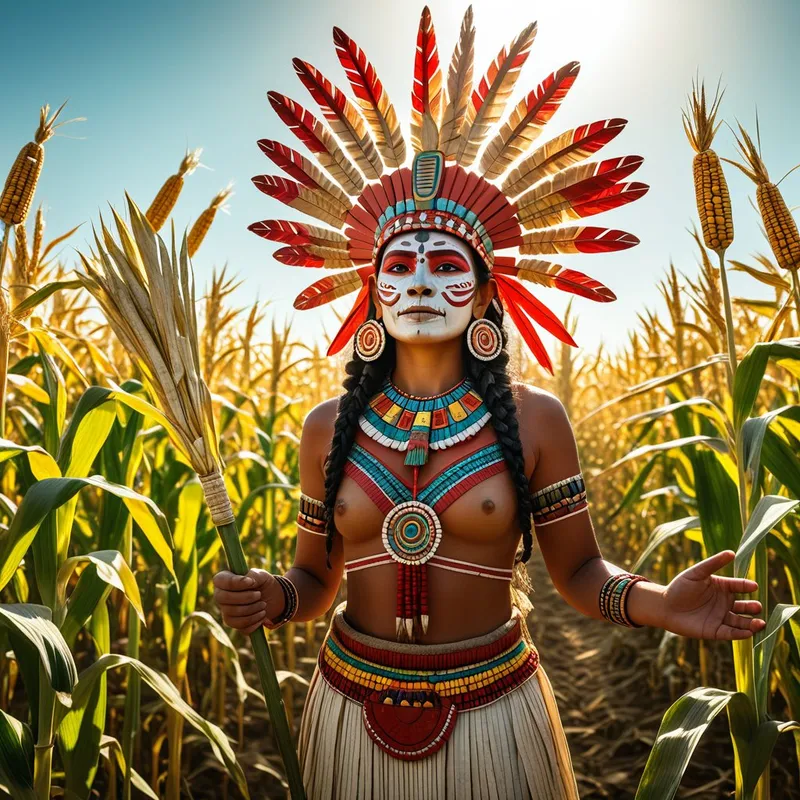
Then, from the place of mist and origin, she came. She was not born of battle, like the fierce sun, but of a deeper, quieter necessity. She was Chicomecōātl, and her skin was the color of life-blood and sunset. Upon her head rose a magnificent crown of paper, a mountain reaching for the sky. In one hand, she carried a shield, not for war, but a round mirror that reflected the suffering of the world. In the other, she held two ears of maize, fat and golden, more precious than any jade.
She walked among the people, and where her bare feet touched the parched earth, green shoots erupted, curling toward the light. She did not speak with thunder, but with the soft sound of leaves brushing together. She taught the women to grind corn on the metate, to pat the dough into tortillas, to make the sustenance that was more than food—it was life itself. For a time, there was fullness. Laughter returned. The people wove her image into their clothes and sang her praises at every meal.
But the world’s balance is a delicate, demanding thing. The sun, Tonatiuh, required his share. The earth, having given, grew tired and demanded repayment. The great silence returned, not as absence, but as a question hanging in the arid air. The green stalks began to wither. The people’s fear turned their eyes back to the goddess who had fed them.
And she knew. The knowledge was in the weight of the maize in her hand, in the reflective surface of her shield. To give life, life must be given. Sustenance is not a gift, but a sacred exchange. With the same serenity with which she had walked the fields, she prepared. They painted her body with red ochre, the color of her own divine essence and the coming sacrifice. They adorned her with the finest paper regalia and the feathers of sacred birds.
The procession to the temple was not a march of conquest, but a solemn pilgrimage of reciprocity. The drums beat a slow, inevitable rhythm. At the summit, under the gaze of the hungry sun, she did not resist. For in that final moment, she was both the giver and the gift, the nourisher and the nourishment. Her body did not simply fall; it was transformed. Her blood soaked into the temple stone, and then, as if following a secret path, into the very heart of the earth below.
The silence that followed was different. It was the silence of fertile soil, of a seed swelling in the dark. And then, from that rich, red earth, a new kind of life burst forth. Not just shoots of corn, but the very understanding of the cycle itself. She was gone, and yet she was everywhere—in every kernel, in every meal, in the strength of the children who ate. She had descended into the dark belly of the earth, Mictlan, and from it, she returned eternally as the food that makes blood and bone. The Maize Mother had completed the circle. She had become the sustenance she promised.
Cultural Origins & Context
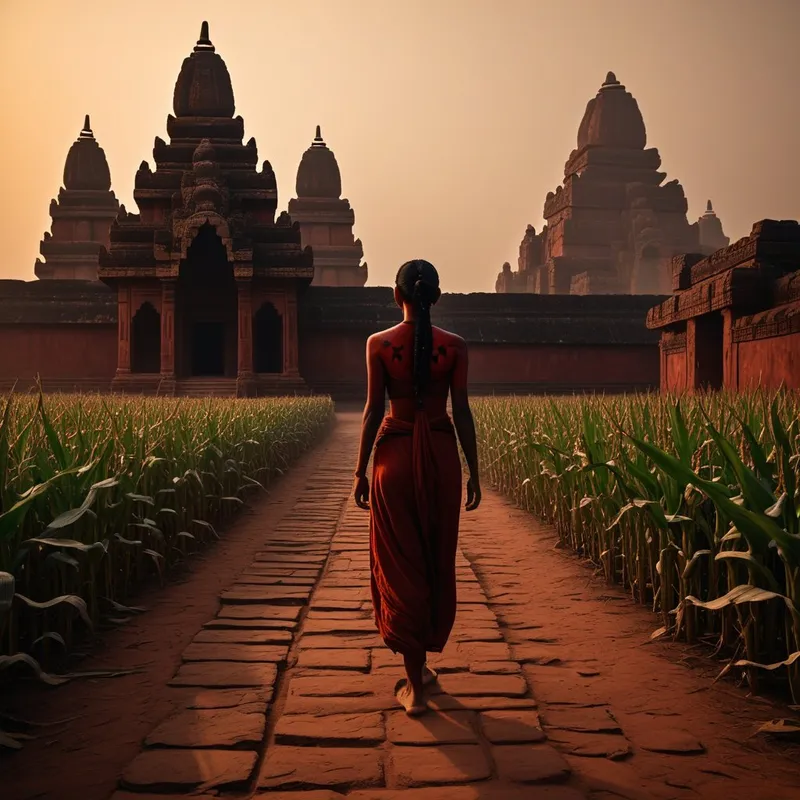
The myth of Chicomecōātl is woven into the very fabric of the Nahua world, primarily the Mexica (Aztec) civilization of central Mexico (14th-16th centuries CE). This was not a bedtime story for entertainment, but a foundational narrative performed, visualized, and ritually enacted to explain and manage the most critical reality of existence: the food supply. In a world where agriculture was a precarious dance with drought, flood, and famine, the goddess of maize was survival.
Her story was passed down through sacred codices, through the intricate iconography of temple sculptures, and most powerfully, through state-sponsored public rituals. During the festival of Huey Tozoztli, a young girl would be chosen to embody the goddess. Adorned in Chicomecōātl’s regalia, she was treated as divine, worshipped, and then sacrificed. Her blood, like the goddess’s in the myth, was offered to the earth, and her body was flayed. A priest would then wear her skin in a gruesome and profound ritual of identification, symbolizing that the divine force of nourishment now resided within the community’s religious structure. The myth provided the sacred script for this terrifying necessity, transforming a act of violence into a cosmic guarantee of continued life. It was told by priests to justify the ways of the gods to the people, and by mothers to explain why the corn must be treated with reverence. It functioned as theology, agricultural manual, and social contract all at once.
Symbolic Architecture
At its core, the myth of Chicomecōātl is an archetypal map of the law of reciprocity. It states unequivocally that nothing comes from nothing; all creation requires a sacrifice.
The deepest nourishment is always born from a sacred surrender. What we consume to live must, in turn, be given back to the cycle from which it came.
Chicomecōātl herself is the ultimate symbol of the Great Mother, but with a crucial Mesoamerican inflection: she is not a mother who merely gives birth, but one who is consumed so that her children may live. The maize kernel is the perfect symbol of this paradox: it is both the dead seed and the potential for infinite life. Her red paint signifies both life (blood) and ritual death. Her paper headdress, a product of human craftsmanship from a plant (the amate tree), represents the cultural transformation of raw nature into sacred symbol.
Psychologically, she represents the part of the self that must be offered up—our time, our energy, our old identities—to feed new growth. The conflict is not against an external monster, but against the human illusion of getting something for nothing. The resolution is the hard-won wisdom that true sustenance comes through a cycle of loss, transformation, and return.
The Dreamer's Resonance
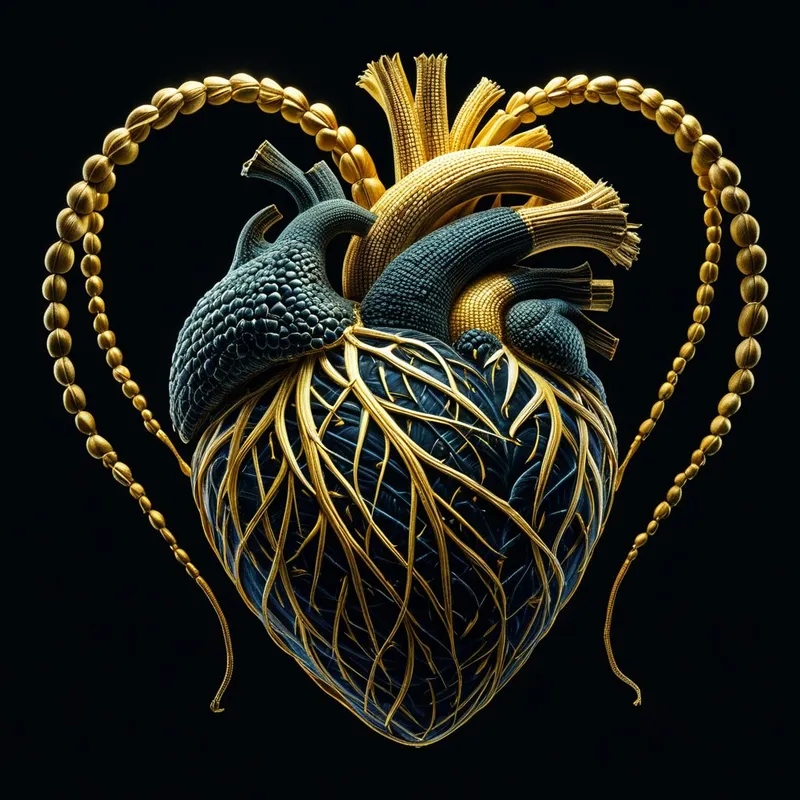
When this myth stirs in the modern dreamer, it often surfaces during periods of profound personal depletion or a crisis of nourishment. One may not dream of a literal maize goddess, but of its symbolic equivalents.
Dreaming of endlessly preparing a meal that is never eaten, of a garden that withers no matter how much it is watered, or of being forced to eat something sacred or repulsive—these are the echoes of Chicomecōātl. The somatic feeling is one of hollow exhaustion, of giving from an empty vessel. The psychological process at work is the unconscious highlighting a severe imbalance in the individual’s economy of energy. The dream asks: What are you being asked to sustain that is draining your essence? Or conversely, what vital sustenance are you refusing to accept because you have not acknowledged the necessary sacrifice that precedes it? The myth in dreams points to the need to identify what in one’s life represents the “maize”—the core nourishment—and to honor the cycle of its giving and receiving, which may involve a difficult letting go.
Alchemical Translation
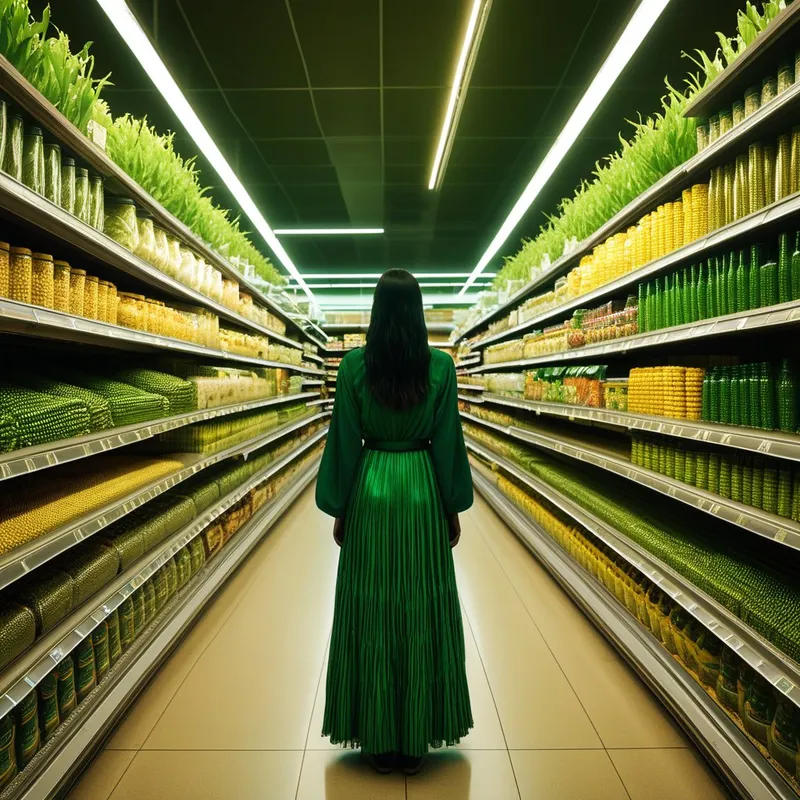
For the modern individual on the path of individuation, Chicomecōātl’s journey is a model for psychic transmutation. The “cornfield” is the field of one’s own potential. The initial gift of growth represents those early talents, relationships, or energies that come to us naturally and feed our young psyche.
The alchemical work begins with the recognition of the “great silence”—the inevitable plateau, the burnout, the sense that our inner resources are depleted. This is the call to the temple. The sacrifice is not a literal death, but the conscious, voluntary offering up of an outmoded version of the self that once served us. It may be a cherished identity (“the perpetual caregiver,” “the endless provider”), a defensive pattern, or a source of pride that has become a prison.
The alchemical fire is lit not to destroy, but to separate the essential nourishment from the husk of form. We must be willing to grind our own experiences on the metate of reflection to find the meal that will sustain the soul.
This process feels like a death. It is the descent into Mictlan—a period of depression, confusion, or withdrawal. But Chicomecōātl teaches that this is not the end. It is the necessary gestation in the dark earth. The rebirth is the emergence of a new, more resilient form of sustenance from within oneself. The maize that grows after the sacrifice is self-knowledge, earned wisdom, and a capacity for nourishment that is cyclical and sustainable, not linear and exhausting. One becomes both the nourisher and the nourished, having integrated the sacrifice into the very structure of being. The goddess’s final form is the integrated self, who understands that to create, to love, and to live fully, one must periodically and sacredly consent to be transformed.
Associated Symbols
Explore related symbols from the CaleaDream lexicon: