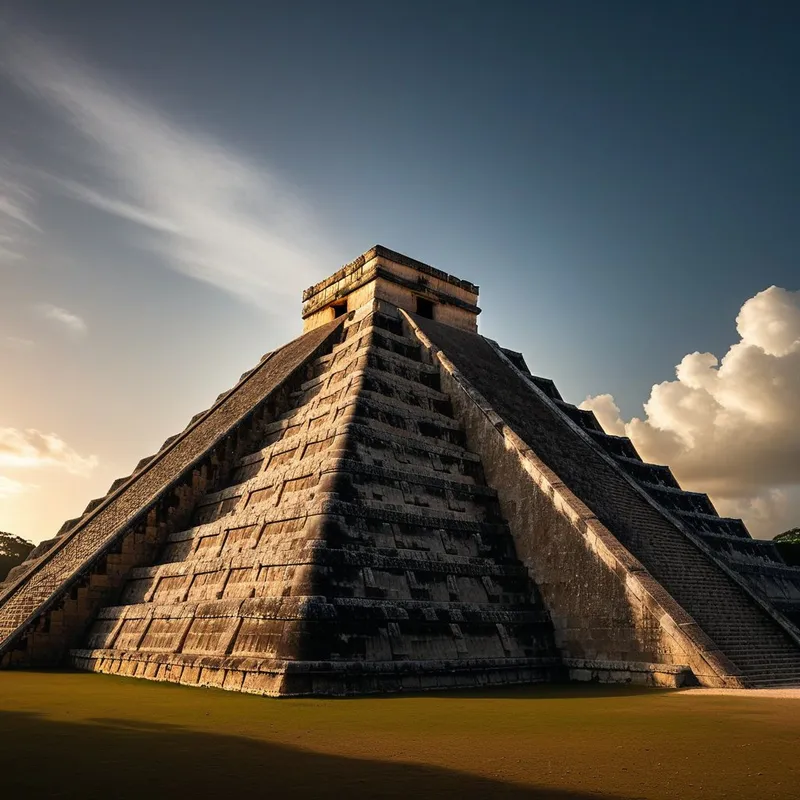
Chichen Itza Myth Meaning & Symbolism
A tale of divine sacrifice at the sacred cenote, where the Feathered Serpent descends into darkness to bring forth the waters of life and cosmic renewal.
The Tale of Chichen Itza
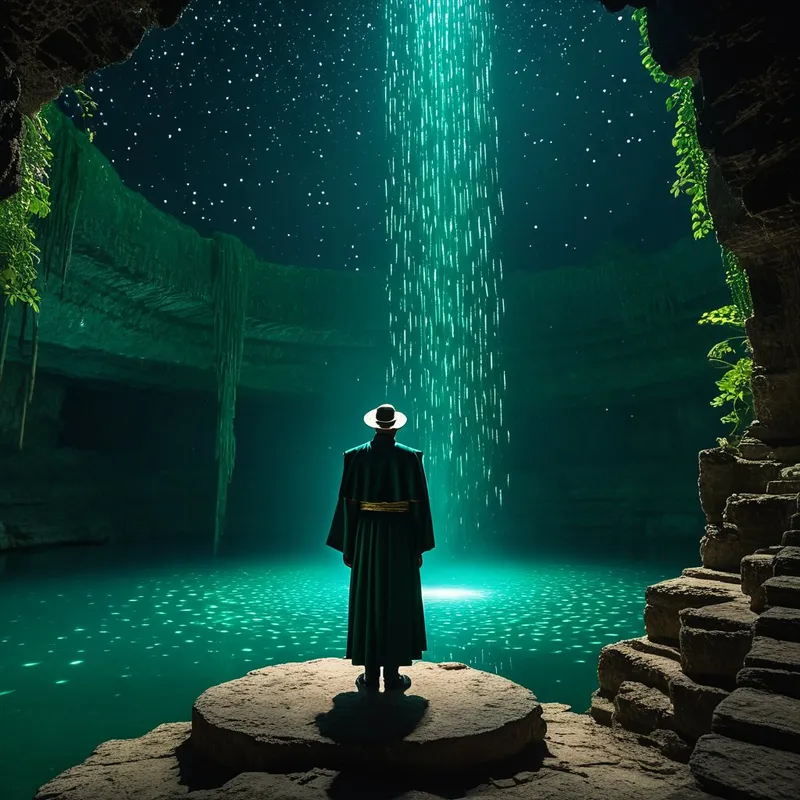
Listen. The world is dry. The sun, Kinich Ahau, hangs like a hammer of brass in a white sky. The earth cracks, a great serpent of thirst coiling through the maize fields. The people of Uucil-abnal gather at the edge of the great wound in the world—the cenote. Its water is dark, a pupil staring into the underworld of Xibalba. They have prayed. They have burned copal until the air wept resinous tears. But the rains do not come.
The High Priest, his body a canvas of jade and scars, raises his arms. The silence is a living thing. He speaks not to the people, but to the k'uh within the stone, within the water, within the very air. "Hear us, Kukulkan! The axis of the world tilts. The balance is broken. The waters of life retreat into the belly of the Earth Monster."
From the temple atop the great pyramid, a figure descends. Not a man, but an embodiment. He wears the mask of the Feathered Serpent, a cascade of quetzal feathers merging with the scales of a serpent. He is the bridge between earth and sky, matter and spirit. He approaches the cenote's stony lip. The crowd holds its breath. This is not a sacrifice given; it is a sacrifice undertaken.
He does not leap. He descends, a deliberate step into the void. The dark water accepts him without a splash. Down he sinks, past the roots of the world tree, past the realm of the Chaac, into the cold silence of Xibalba. Here, in the absolute dark, the Lords of Death mock him. They offer him illusions of water—vessels that shatter, springs that are dust. They show him the decay of all things, the inevitable victory of the dry bone.
But the heart of Kukulkan is a spark of celestial fire. He does not fight the darkness; he remembers the light. He remembers the wind that brings the rain, the seed that cracks the stone. He offers not his strength, but his very essence—a piece of his divine vitality—to the parched heart of the world. It is a bargain in the silent language of the cosmos.
And in the depths, something stirs. Not a monster, but a response. A reciprocal offering. From the abyssal springs, a cool, clear current begins to flow. It touches his feet, then his body, carrying him upward. He rises, not as he descended, but transformed. The serpent scales gleam with moisture; the feathers are heavy with the promise of storm.
Above, at the cenote, the people see the still water shiver. Then, a bubble breaks the surface. Then another. A green shoot, impossibly, pierces the water's skin. And then he emerges, not drowning, but reborn, water streaming from his form. As he steps onto the land, the first drop of rain strikes the limestone. Then another. A drumbeat on the dry earth becomes a roar. The sky opens. The Feathered Serpent has journeyed into the belly of lack and returned with the waters of renewal. The world breathes again.
Cultural Origins & Context
This narrative is not a single, codified myth from a forgotten scroll, but a tapestry woven from the archaeological bones, colonial chronicles, and enduring oral traditions surrounding Chichen Itza. The city itself, meaning "At the mouth of the well of the Itza," is a testament to the central mythic reality: the sacred cenote was a portal to the otherworld. The mythic pattern described is a synthesis of the known cosmological functions of the site.
The story was likely enacted, not just told. It was performed by the priestly class and ruling elite, particularly those claiming descent from or union with Kukulkan. The "High Priest" or divine king became the avatar of the god, especially during periods of drought or at key calendrical junctions like the equinox, when the serpent of shadow descends the pyramid's staircase. The societal function was one of cosmic maintenance. The sacrifice—whether of precious objects, animals, or in extreme times, human life—was not mere brutality but a profound act of energetic reciprocity. It was the payment of a sacred debt (nextlahualli) to the gods and ancestors to ensure the continuation of the cosmic cycle: rain, maize, and life itself. The myth justified the social order, validated the ruler's divine mandate, and provided a cosmological explanation for the terrifying necessity of offering precious things back to the source.
Symbolic Architecture
At its core, this is a myth of the necessary descent. The cenote is the ultimate symbol: a natural well that is also a mouth, a wound, a vagina, and a grave. It represents the unconscious, the underworld of the psyche (Xibalba), where all that is repressed, feared, and decayed resides. It is not evil, but it is the realm of shadow, stagnation, and potential death.
Kukulkan is the archetypal unifier. The serpent is earth, instinct, the winding path into the depths. The quetzal feathers are sky, spirit, and transcendent awareness. He is the conscious ego that must voluntarily engage with the unconscious, not to conquer it, but to negotiate with it.
The sacred is not found by escaping the depths, but by making the darkness itself holy through a willing descent.
The "drought" is psychic aridity—a state of depression, meaninglessness, or creative block. The "rain" is the life-giving libido, the emotional and creative energy that restores vitality. The myth teaches that this energy cannot be seized from above; it must be retrieved from below, through a sacrifice of one's current state, one's pride, or a cherished illusion. The hero does not slay a dragon in the cenote; he gives a part of himself to it, and in return, the dragon (the unconscious) gives him the treasure of renewed life.

The Dreamer's Resonance
When this myth stirs in the modern dreamer, it often manifests as dreams of deep wells, dark pools, basement floods, or descending into subterranean places. One might dream of standing at the edge of a vast, dark body of water, feeling both dread and a compelling pull. The somatic sensation is one of weight, of sinking, or of cold immersion.
Psychologically, this signals a call from the unconscious. The psyche is in a state of "drought"—perhaps a relationship has ended, a career path has dried up, or an old identity has become a cracked shell. The conscious mind has exhausted its solutions. The dream is an invitation, or a demand, to engage with the shadow material. The figure of the priest or the Feathered Serpent in the dream may represent a part of the dreamer's own psyche capable of making this sacred journey. The process is one of surrendering the ego's need for control and allowing oneself to "sink" into the feelings, memories, or fears that have been walled off. The terror in the dream is the terror of the dissolution of the known self. But if the dreamer can, like Kukulkan, hold a spark of conscious intention ("I will see what is here"), the dream often shifts toward emergence, being carried upward, or finding a hidden source of water—symbolizing the unexpected insight or emotional release that follows true introspection.

Alchemical Translation
The alchemical process mirrored here is solutio—dissolution. In the laboratory of the soul, the rigid, dried-out matter of the personality (the terra deserta, or desert earth) must be dissolved in the aqua permanens, the eternal water, which is found only in the depths. The modern individual's journey of individuation requires this stage.
First, one must acknowledge the "drought"—the life that has become sterile, repetitive, or devoid of meaning. This is the nigredo, the darkening. Then, one must consciously choose to descend: to enter therapy, to engage in deep journaling, to confront a long-buried grief or trauma, to voluntarily step into the discomfort of not knowing. This is the sacrifice of the ego's comfort. In the depths (the confrontation with the shadow), one will meet the "Lords of Decay"—our own inner critics, our shame, our nihilistic thoughts. The alchemical triumph is not to defeat them, but to offer them something. One offers honest acknowledgment, compassionate witness, or the simple, painful truth of one's experience.
The treasure guarded by the shadow is always the piece of soul-energy we had to bury in order to survive.
By making this offering, a transmutation occurs. The stagnant water of repressed emotion begins to flow as genuine feeling. The insight that seemed like death becomes the seed of renewal. The individual surfaces, not the same, but with a new fluidity between conscious and unconscious. The Feathered Serpent is the symbol of the integrated Self—no longer rigidly earth-bound (serpent alone) or ungroundedly spiritual (bird alone), but a living, moving synthesis of both. One becomes a conduit, like the pyramid itself, channeling the waters of the deep into the structures of daily life, bringing creativity, empathy, and authentic vitality back to a world perceived as dry.
Associated Symbols
Explore related symbols from the CaleaDream lexicon: