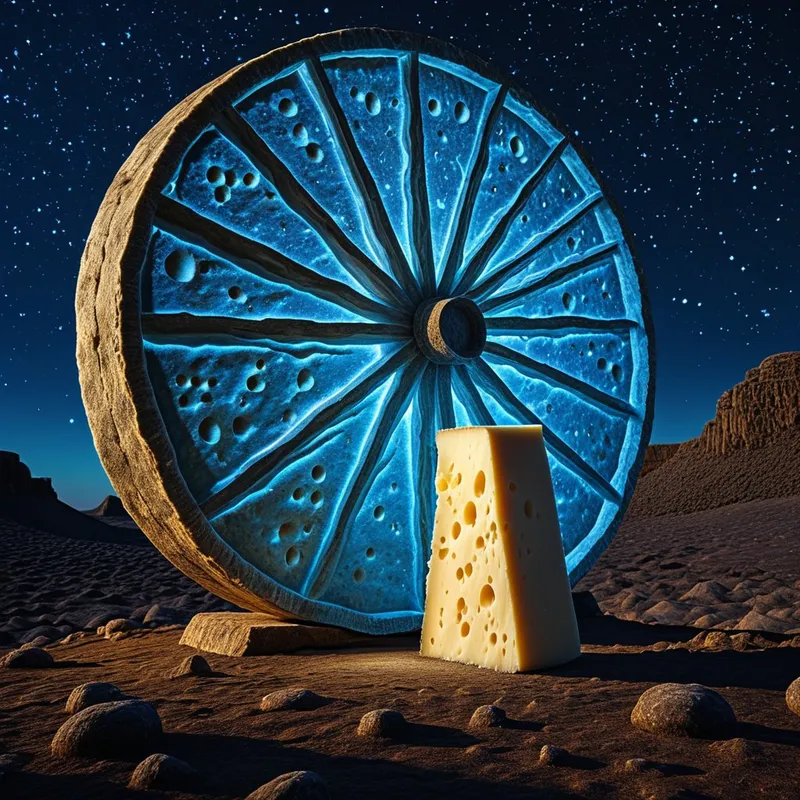
Cheese Moon Myth Meaning & Symbolism
A cosmic thief steals the moon, a celestial wheel of cheese, to feed a starving world, sparking a divine chase that reshapes the heavens and human desire.
The Tale of Cheese Moon
Listen, and hear the tale of the Hungry Sky.
Before the first fire, when the world was young and thin, the night was a vast, empty bowl. The sun fled each evening, leaving only a cold, black silence. The people huddled in the dark, their bellies growling not just for food, but for light, for a sign in the void. They were a people of shadow, their stories whispered, their hopes unlit.
Then, from the great beyond, the Sky Shepherd brought forth his flock. Not of wool, but of light. He placed a great, gentle lamp in the heavens—a perfect, luminous wheel of the finest celestial curd, pocked with soft craters and veined with gentle blue mold. This was the Cheese Moon. Its cool, milky light poured over the sleeping earth, silvering the grass, guiding the lost fox, giving the night a face. The people slept easier. They had a companion in the dark.
But in the deepest valley lived a man known only as The Gaunt One. While others looked up in wonder, he looked up and saw a feast. His people were starving, their children’s ribs like ladders against their skin. The moon’s light was beautiful, but beauty could not be chewed, could not fill a hollow belly. A terrible, blasphemous hunger awoke in him—not for the moon’s light, but for its substance.
One night, when the wind howled like a pack of wolves, The Gaunt One began to climb. He did not climb a mountain, but the very ladder of shadows and starlight, a path known only to the truly desperate. His fingers bled, his breath came in ragged gasps of frost, but his eyes were fixed on that glowing wheel. After an age of ascent, he reached the celestial shelf. The Cheese Moon hummed with a soft, creamy energy. Without a prayer, without a second thought, he put his shoulder to it and pushed.
The moon groaned on its axis. With a shudder that echoed through the constellations, it broke free from its appointed path and began to roll, tumbling down the starry slopes toward the earth. The Gaunt One rode it down, a silent scream in his throat, a thief astride his stolen treasure.
On earth, chaos. The world plunged into true, absolute darkness for the first time. The Sky Shepherd roared, a sound of thunder and shattered crystal. The chase was on. The moon, now a careening wheel of cheese, crashed through forests, flattened hills, and finally came to rest in a vast, muddy plain. The Gaunt One, broken but alive, scrambled to his feet. He drew a flint knife and began to cut great, glowing wedges from the moon, hurling them to his people who emerged from the darkness, their hands outstretched.
They ate. They ate the light. It was rich and strange, filling them with a warmth that was both of the body and of the soul. But as they ate, the Sky Shepherd descended, his form a tempest of righteous fury. He seized the remains of his moon, now less than half its original size, and hauled it back into the sky. The theft was undone, but the deed was done.
The Cheese Moon was restored, but forever changed—a crescent, then a half-wheel, growing and shrinking as if nibbled by an invisible hunger. And The Gaunt One? He was not struck down. The Sky Shepherd looked at the sated, glowing people, and then at the broken thief, and saw not just rebellion, but a need so profound it could move heavens. He set The Gaunt One in the sky as well, not as a star, but as the dark shape that forever seems to chase, or be chased by, the moon he dared to taste.

Cultural Origins & Context
The myth of the Cheese Moon is a foundational narrative found in scattered fragments across pastoral and agrarian societies, from the high steppes of Central Asia to the isolated valleys of the Caucasus. It belongs not to a single "Various" culture, but to a shared psychological stratum of early human communities whose survival was intimately tied to the cycles of livestock, lactation, and the night sky.
It was not a tale for formal temples, but for the hearth. It was told by grandmothers and herdsmen during the long winter nights, its telling often coinciding with the new moon—the time of greatest darkness and anxiety. The societal function was multifaceted: it was an etiological myth explaining the lunar phases, a cautionary tale about overreach, and, most importantly, a narrative of justification. It gave sacred context to the act of taking, of using the resources of the world (and even the cosmos) to stave off extinction. It framed desperation not as a moral failing, but as a force potent enough to engage the divine in negotiation.
Symbolic Architecture
At its core, the myth is a profound allegory for the nourishment of the soul. The Cheese Moon is not merely a food source; it is the numinous sustenance that the conscious world (the day, the sun) cannot provide.
The moon is the psyche's larder, stocked with the aged, complex, and sometimes mold-veined memories, dreams, and instincts that sustain us in the dark nights of the soul.
The Gaunt One represents the ego in a state of existential hunger. He is the part of the psyche that recognizes a deeper famine—a lack of meaning, of connection to the numinous—and, driven by the survival instinct, raids the unconscious (the sky) to bring its contents to light. His theft is the necessary, violent act of consciousness seeking to integrate the nourishing but distant contents of the unconscious. The Sky Shepherd is the ordering principle, the archetype of structure and law. The chase is the inevitable psychic conflict that arises when the ego disrupts the established cosmic (or psychological) order for what it perceives as a higher need.
The eternal, cyclical chase in the sky post-resolution is the master symbol. It represents the perpetual, dynamic tension between the conscious and the unconscious. We are always both the thief, consuming the mysteries to live, and the authority, seeking to restore order. The moon's phases visually chart this process of consumption (the waning moon) and renewal (the waxing moon).
The Dreamer's Resonance
When this myth pattern surfaces in modern dreams, it often signals a phase of profound psychic hunger. Dreaming of stealing something celestial, of finding food in unlikely or forbidden places, or of being chased for taking what you needed, points to an active process of "soul retrieval."
The somatic experience can be one of deep, gnawing emptiness in the gut, coupled with a restless, almost manic energy. Psychologically, the dreamer is likely in a state where conventional sources of meaning (career, relationships, status) have ceased to nourish. The unconscious is presenting an image of a vast, available resource (the Cheese Moon)—often a forgotten talent, a repressed emotion, or a spiritual calling—that feels tantalizingly close yet cosmically forbidden. The dream captures the anxiety and exhilaration of reaching for it, knowing it will disrupt one's current life (the Sky Shepherd's order). The chase in the dream is the ego's fear of the consequences of becoming whole, of becoming someone new and unfamiliar.

Alchemical Translation
The myth models the alchemical nigredo, the blackening, which is the necessary first step of individuation. The "black night" of the world before the theft is the stagnant, unfulfilled life. The Gaunt One's desperate hunger is the spark of the Self, demanding change.
His act is the sacrilegium—the sacred crime. In psychological alchemy, one must "steal" the gold from the unconscious; it is never simply given. By consuming the moon, the people perform the coniunctio on a mass scale: they internalize the celestial (transcendent) substance, marrying it with their earthly (immanent) bodies. They are literally illuminated from within.
Individuation requires digesting the light of the unknown. We must become thieves of our own divinity, breaking the perfect, distant image we worship to make it part of our flesh and bone.
The final, eternal chase is the achieved state of dynamic equilibrium. The individuated person does not live in static peace, but in a creative tension. They are forever "consuming" new insights from the unconscious (nibbling the moon) and forever being "reintegrated" into a new, larger order (pursued by the Shepherd). The myth teaches that wholeness is not a destination where hunger ends, but a state where hunger itself becomes the engine of a sacred, cyclical dance with the cosmos. The Cheese Moon is forever being eaten, and is forever whole—a perfect symbol for the psyche that is both perpetually transforming and eternally itself.
Associated Symbols
Explore related symbols from the CaleaDream lexicon: