
Chawan Myth Meaning & Symbolism
A myth of a celestial bowl, shattered and made whole, embodying the sacred vessel that holds the universe and the self.
The Tale of Chawan
Listen, and hear the tale whispered by the wind through the ancient cedars, a story not of gods who stride the mountains, but of a vessel that holds the sky.
In the time before time was measured, when the Kami still breathed the same air as mortals, there existed a bowl. This was no ordinary vessel. It was born from the sigh of Amaterasu as she first peered into the mirror of creation, and from the tear of the primordial ocean kami as land first rose. They called it Chawan, and it was perfect. Its curve held the dome of the heavens; its depth, the mystery of the sea. To gaze into it was to see not one's reflection, but the slow dance of stars being born.
Chawan resided in the silent groves of the world, a sacred trust. It was the cup from which the mountain spirits drank moonlight, the basin where the river kami laid their jewels. It held the first rain, the first rice, the first breath of a newborn—all without ever filling, without ever emptying. It was the still point, the container of potential.
But a shadow grew, a spirit of lack named Utsuroi. Utsuroi saw not the infinite within Chawan, but only its own hollow reflection. Consumed by a hunger to possess the vessel's wholeness, to fill its own void, Utsuroi descended upon the grove in a whirlwind of envy. A great struggle ensued—not of clashing swords, but of grasping hands against serene curvature. In the tumult, Chawan was wrenched from its place of rest and dashed upon the bones of the earth.
The sound was not a crash, but a sigh that echoed through all realms. Chawan shattered into eight fragments, scattering to the eight directions. Where each piece fell, a different quality of the world dimmed. In the north, silence became absolute and chilling. In the south, warmth grew feverish and unstable. The world, once held in graceful balance, now teetered, its harmony broken.
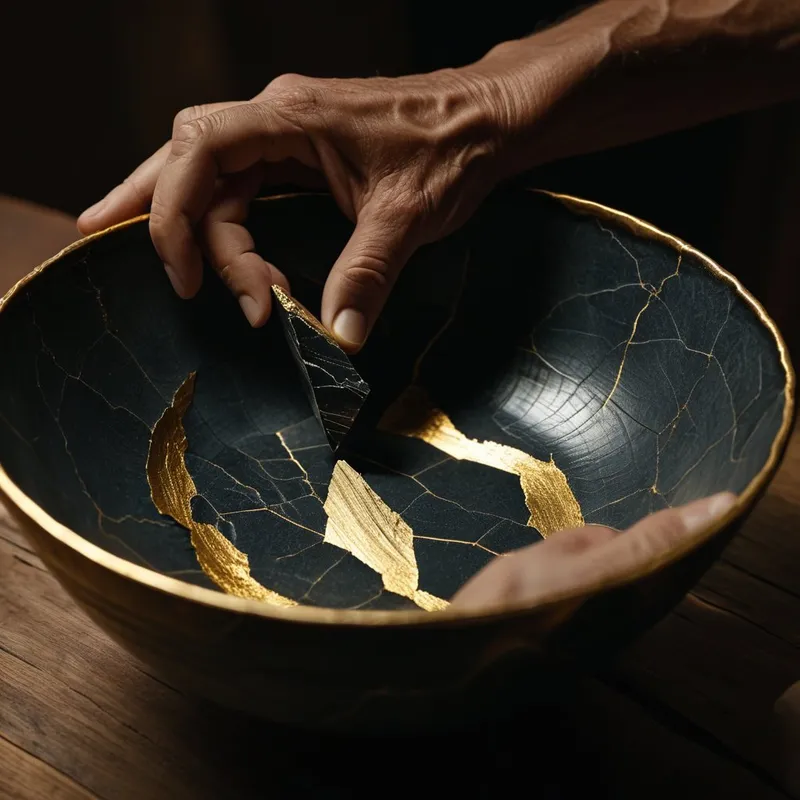
The kami mourned. To remake the bowl with their power alone was impossible, for its perfection was born of a moment that could not be recreated. The solution came not from the high plains of heaven, but from the humble earth. A mortal potter, guided by a dream of the whole, journeyed to gather the eight fragments. He did not seek to erase the break. Instead, he mixed lacquer with the finest gold dust, and with a reverence deeper than prayer, he began to join the pieces. He filled each crack not to hide it, but to adorn it, tracing the lines of fracture with rivers of luminous gold.
When the last seam was sealed, the potter placed the mended bowl upon a bed of moss. Moonlight touched it. The golden seams blazed like captured sunlight, and the eight fragments, now united, began to hum with a deeper, more complex harmony than before. The bowl was whole again, but it was no longer the untested perfection of the cosmos. It was the tested, resilient wholeness of the world—a vessel that had known fracture and chosen integration. It became more sacred than ever, for its story was now written in gold upon its very form.
Cultural Origins & Context
The myth of Chawan is woven from the deep spiritual fabric of Japanese animism and craftsmanship. It is not a myth chronicled in the Kojiki or Nihon Shoki, but one that lived in the oral traditions of artisans—potters, lacquer workers, and tea masters. It was a story told by firelight in kiln sheds, a philosophical underpinning to the arts of kintsugi and chanoyu.
Its societal function was multifaceted. For the craftsman, it sanctified the act of repair, elevating it from mere utility to a spiritual practice of reconciliation with flaw and accident. It provided a cosmological reason for the Japanese aesthetic principles of wabi and sabi. The myth taught that breakage and subsequent mending were not disasters to be hidden, but transformative events that added to an object's history, character, and ultimately, its soul. It was a narrative that applied equally to pottery, communities, and the individual spirit, offering a model for resilience that honored the scars of experience.
Symbolic Architecture
At its core, the Chawan myth is a profound allegory for the psyche. The celestial bowl represents the original, potential wholeness of the Self—the integrated vessel meant to contain the totality of one's experience. It is the pristine, yet untested, state of psychic integrity we are born with, or which we glimpse in moments of perfect peace.
The vessel is not defined by what it holds, but by its capacity to hold. Its truest beauty is its unbroken interior space, even when its exterior bears the marks of time.
The shattering by Utsuroi symbolizes the inevitable trauma, loss, or fragmentation that life brings. Utsuroi is the psychological force of envy, lack, and the insatiable ego that, in seeking to possess wholeness, ironically destroys it. The scattering of the eight fragments represents the diaspora of the self—parts of our personality, memory, or potential that become dissociated, lost, or repressed.
The mortal potter is the active, conscious ego, guided by the transcendent function (the dream of the whole). His act of kintsugi is the central symbolic act of the myth. It models the process of psychotherapy, integration, and conscious self-repair. The gold is not a disguise; it is the value and attention we bring to our wounds. It signifies that the process of mending—the conscious work of understanding, accepting, and integrating our fractures—adds a unique and luminous quality to the soul that was not present in the original, naive state of wholeness.
The Dreamer's Resonance
When this myth stirs in the modern unconscious, it often manifests in dreams of vessels: bowls, cups, skulls, or rooms that are cracked, leaking, or impossibly fragile. One might dream of trying to carry water in a sieve, or of a precious heirloom vase that has shattered. The somatic sensation is often one of acute vulnerability—a feeling of being "spilled," uncontained, or unable to hold one's emotional life.
These dreams signal a process of psychic reorganization. The dream ego is confronting a recent or ancient fracture in its sense of self. It is the feeling after a betrayal, a failure, a loss of identity, or a period of burnout. The dream is not merely reporting the damage; it is presenting the raw material (the fragments) and the existential problem (the broken container). The presence of gold, glue, or a careful hand in the dream points directly to the active, healing process of kintsugi beginning in the psyche. It is the unconscious affirming that the break can be the source of a new, more resilient beauty, if one has the courage to attend to it with precious care.

Alchemical Translation
The alchemical journey modeled by the Chawan myth is the opus contra naturam—the work against nature—which in psychological terms is the work against mere disintegration. The first matter (prima materia) is the shattered self, the state of depression, confusion, or post-traumatic stress. The goal is not to return to a naive, pre-fractured state (an impossibility), but to achieve the lapis philosophorum, the philosopher's stone, which here is the integrated, golden-seamed vessel.
The alchemical gold is not found in the ore of perfection, but is forged in the furnace of fracture, through the patient labor of mindful attention.
The process follows the classic stages: Nigredo (blackening) is the shattering, the descent into the darkness of Utsuroi's envy and the grief of loss. Albedo (whitening) is the gathering of the fragments—the conscious inventory of one's pains, losses, and disowned parts. The crucial, transformative stage is Citrinitas (yellowing), symbolized by the application of the golden lacquer. This is the slow, often painful, work of therapy, reflection, and creative expression that draws meaning and value from the wound itself. Finally, Rubedo (reddening) is the completed, radiant vessel—the Self that has transmuted suffering into wisdom, fragility into resilient capacity, and isolation into a deeper connection to the human condition.
For the modern individual, the myth instructs us to cease hiding our cracks. It invites us to become the artisan of our own soul, to mix the gold of our conscious attention and apply it with care to the very seams of our brokenness. Our wholeness, it says, will not be a smooth, featureless perfection, but a map of recovery written in light, holding the universe within more beautifully for having known the break.
Associated Symbols
Explore related symbols from the CaleaDream lexicon: