Chaturanga Myth Meaning & Symbolism
The myth of a primordial being, divided into four parts, whose separation creates the world and whose reunion is the ultimate quest for wholeness.
The Tale of Chaturanga
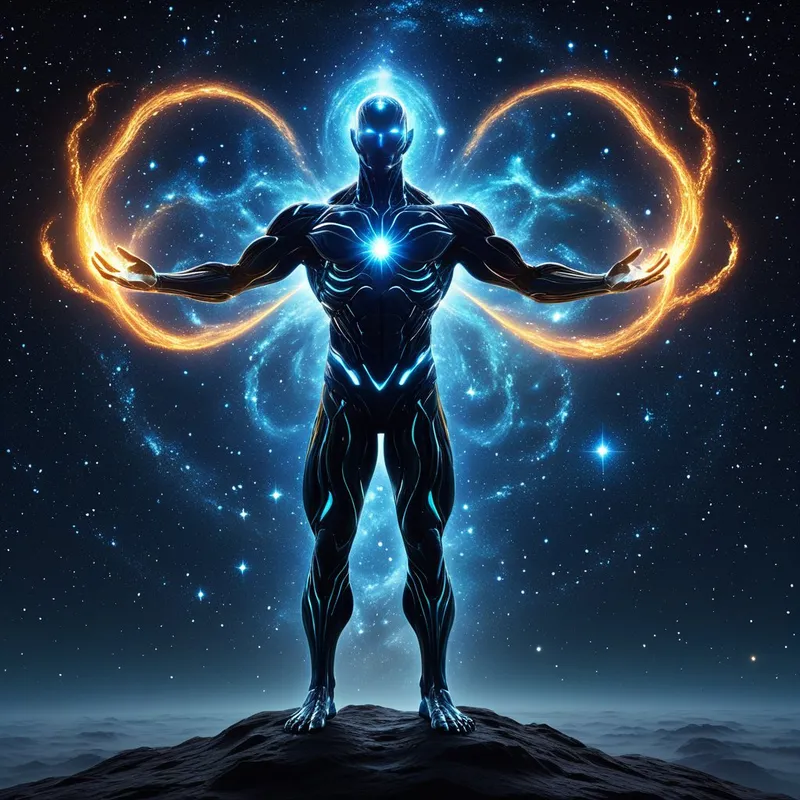
In the time before time, when the universe was a single, silent breath held in the darkness, there existed only the One. Not a god, not a man, but a being of pure potential. The sages, in their deepest meditations, perceived it and named it Chaturanga.
It was a form of impossible harmony. Four powerful limbs, not of flesh and bone, but of solidified essence, moved in a slow, eternal dance. One arm was the patient strength of the mountain, another the flowing wisdom of the river. A third blazed with the transformative fury of the forge-fire, and the fourth whispered with the boundless freedom of the storm-wind. These were not separate things, but one being. Chaturanga’s consciousness was a single, radiant point of awareness, knowing itself as complete. The void was its body; silence, its song.
But within that perfect stillness stirred a thought. A question, subtle as the first ripple on a still pond: "What am I, if I am only this?" From that question, a desire was born—not a selfish desire, but a creative yearning. The being wished to know itself not just as unity, but through relationship. It wished to see its own strength, to hear its own wisdom, to feel its own power, and to dance with its own freedom. To do so, it would have to let go.
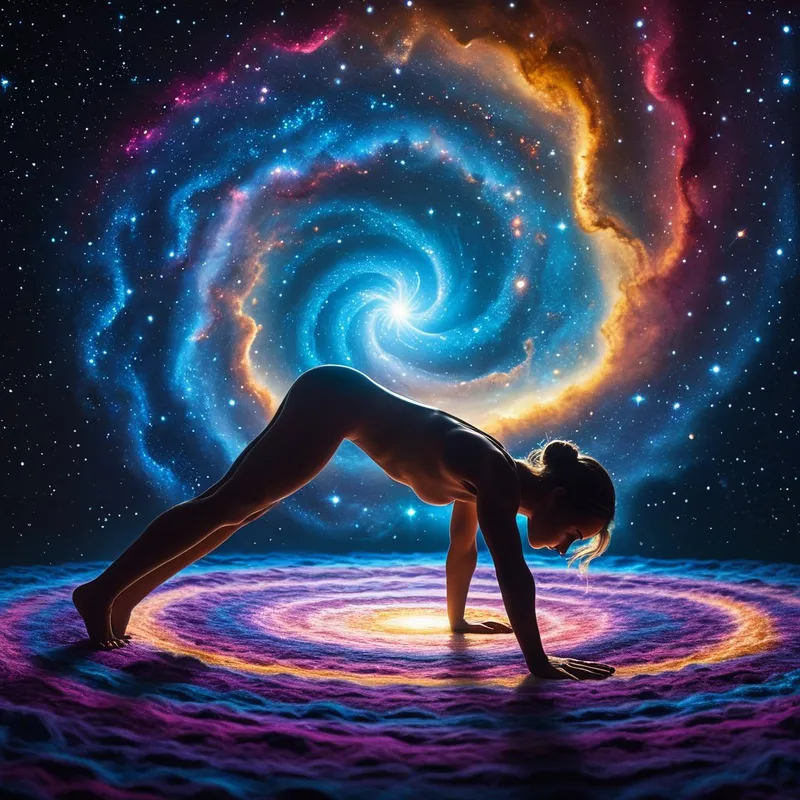
And so, Chaturanga performed the first and greatest act of will: it consented to its own division. There was no violence, only a profound, deliberate parting. A silent flash, brighter than a billion suns yet utterly soundless, illuminated the void. The four limbs separated, drifting apart like continents breaking from a single landmass.
The arm of the mountain fell and became the solid earth, the crust of the world, teeming with latent life. The arm of the river flowed out and became the oceans, the rains, the blood in the veins of all creatures. The arm of the forge-fire scattered into a billion sparks, becoming the sun, the stars, the metabolic heat in every living heart. The arm of the storm-wind expanded, becoming the atmosphere, the breath of life, the carrier of sound and scent.
Where once there was one being, now there was a cosmos. The world was born from this sacred sacrifice. But the single point of awareness, the central consciousness of Chaturanga, did not vanish. It fragmented, seeding itself into every stone, every drop, every flame, and every gust. The One became the Many. The harmony was now a symphony of separate notes, beautiful but longing, unconsciously, for the original chord from which they came.
Cultural Origins & Context
The concept of Chaturanga is not a single, canonical myth from a text like the Mahabharata or Rigveda. It is a metaphysical idea, a philosophical mythos woven from the threads of Advaita Vedanta and the symbolic language of Puranic cosmology. It finds its echoes in the Purusha Sukta hymn, where the cosmic being is sacrificed to create the world, and in the philosophical understanding of the Purusharthas.
This was a teaching myth, passed down not by bards in royal courts, but by gurus in forest ashrams and through the contemplative verses of philosopher-poets. Its function was not to chronicle history, but to map the architecture of reality and the psyche. It served to answer the profound human questions: Why are we here? Why do we feel separate? What is the origin of the world's diversity? And is there a way back to a state of peace? It provided a cosmic model for the human condition—our experience of being fragmented selves in a world of separate objects, all born from an original, forgotten unity.
Symbolic Architecture
At its heart, the myth of Chaturanga is a grand metaphor for the process of emanation and the structure of the self. The four limbs represent the fundamental aspects of existence and consciousness that must be integrated to achieve wholeness.
The world is not a place you are in; it is the dismembered body of your own deepest self, waiting to be remembered.
The Earth-limb symbolizes the physical body, stability, materiality, and the grounded reality of the senses. The Water-limb represents the emotional body, the unconscious, fluid intuition, and the flow of life energy (prana). The Fire-limb is the mental body, intellect, will, transformation, and the burning drive of purpose. The Air-limb signifies the spiritual body, consciousness itself, freedom, connection, and the breath that links all things.
Psychologically, we are all born as Chaturanga—a potential whole. Yet, through the trauma of incarnation, socialization, and personal history, we experience a psychic dismemberment. We identify with only one "limb": perhaps the thinker (Fire), neglecting the feeler (Water). We become the achiever (Earth/Fire) and lose touch with the dreamer (Air/Water). The myth tells us that our experience of conflict, alienation, and longing is not a mistake, but the inherent condition of a universe—and a psyche—that has chosen to know itself through separation.
The Dreamer's Resonance
When this myth stirs in the modern unconscious, it does not appear as a four-armed giant. It manifests as dreams of profound fragmentation or searching integration.
You may dream of a house with four wings, where you can only occupy one at a time, feeling anxious about the others falling into disrepair. You may dream of a vehicle with four flat tires, or a task that requires four identical keys you must scour the dreamscape to find. More directly, you might dream of your own body dividing—a limb detaching, or seeing multiple versions of yourself in a mirror, each representing a different life role (the professional, the parent, the artist, the child) that feel irreconcilable.
Somatically, this process can feel like being pulled in different directions, a literal tension in the joints or the diaphragm. Psychologically, it is the acute awareness of inner conflict: the part of you that wants security versus the part that craves adventure; the mind that criticizes versus the heart that yearns. This is the Chaturanga complex active within—the orphaned parts of the self calling out, not for dominance, but for recognition and reunion.
Alchemical Translation
The journey from fragmented Chaturanga to integrated being is the alchemy of individuation. It is not about returning to a blank, undifferentiated unity—that would be spiritual regression. The fire of experience has transformed the raw material. The goal is a complexio oppositorum, a complex unity that includes and transcends the four separated elements.
Individuation is not becoming a perfect, seamless whole. It is becoming the skilled conductor of your own inner quartet, where every instrument—earth, water, fire, air—is heard, valued, and played in harmony.
The first step is Recognition. To see the four "limbs" within: your physical habits and health (Earth), your emotional patterns and depths (Water), your core beliefs and will (Fire), and your spiritual intuitions and connections (Air). This is shadow work—reclaiming the parts you have disowned.
The second is Relationship. Allowing the Earth of your body to inform the Air of your spirit (grounding your spirituality). Letting the Water of your emotion temper the Fire of your intellect (compassionate thought). This is internal diplomacy.
The final stage is Reunion. This is not a violent forcing together, but a conscious re-orchestration. In meditation, in creative act, in moments of profound love or crisis, the four aspects suddenly align. The individual feels, perhaps for a fleeting moment, like the primordial Chaturanga—not as it was before the division, but as it was always meant to be: a conscious cosmos in miniature. The world is no longer "out there," but is experienced as the living, breathing expression of your own reintegrated self. The search ends where it began, but everything—including the seeker—has been utterly transformed.
Associated Symbols
Explore related symbols from the CaleaDream lexicon: