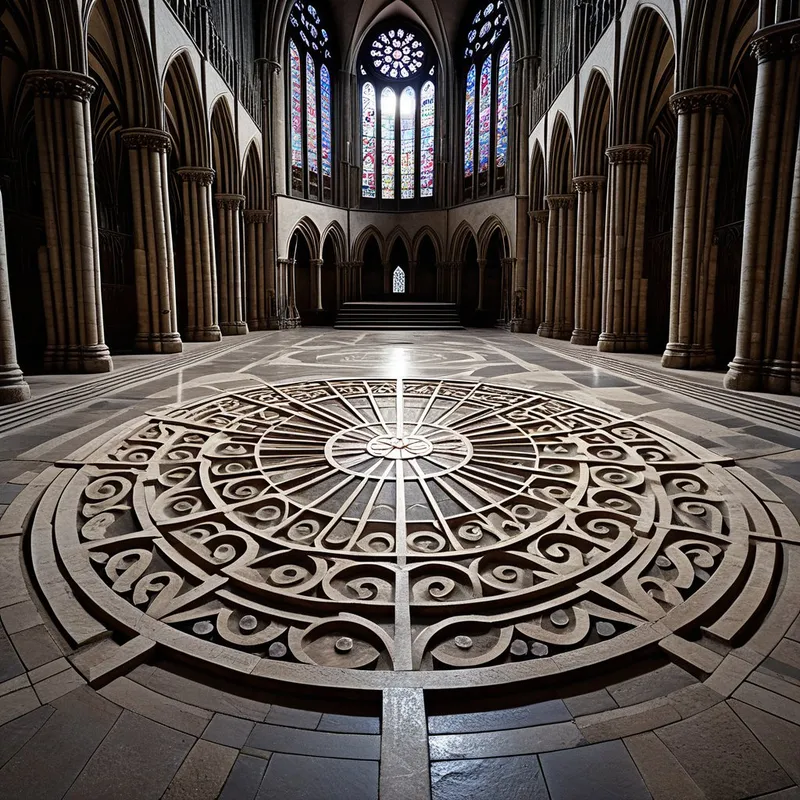
Chartres Cathedral Labyrinth Myth Meaning & Symbolism
A sacred stone path within a Gothic cathedral, offering not a puzzle to be solved, but a pilgrimage to be walked, guiding the soul to its own center and back.
The Tale of the Chartres Cathedral Labyrinth
Listen. In the heart of stone, in the womb of the mountain that is not a mountain but a forest of pillars reaching for God, there lies a secret written in the floor. It is not written in Latin, nor in the language of kings. It is written in a single, unbroken line.
This is the tale of that line.
In the age when faith was hewn from quarries and lifted by calloused hands toward heaven, the great church of Chartres rose. Its walls were stories in glass, its spires were prayers in stone. And upon its cold floor, the master builders laid a mystery: a circle, vast as a kingdom, containing a path that turns back upon itself eleven times. It has no walls, no hedges to confuse. Its borders are the faith of the walker. They call it a labyrinth, but it is not. It is a unicursal path. A promise.
The pilgrim arrives, dust of the road on their cloak, the world’s cacophony still ringing in their ears. They stand at the mouth, the entrée. The path stretches before them, a river of pale stone in a sea of dark. They take the first step. The cathedral falls away—the murmur of prayers, the scent of incense, the chill of the air. There is only the path. It leads them east, then west, in great, sweeping arcs. They walk toward the center, only to be turned away, sent to the outermost rim. Hope rises as they curve inward, then is deferred as the line spins them out again.
The journey is the teacher. With each reversal, the pilgrim’s breath slows. The frantic seeking of the mind—Are we there yet? Is this the way?—grows quiet. The feet learn what the heart has always known: the path is certain. It cannot be wrong. You cannot be lost. You can only be impatient. You walk the four quadrants of the world, tracing a cosmic pattern older than the cathedral itself. You pass through stations unseen, a calendar of turns.
And then, a final turn. The tight coil of the last circuit releases you, not with a fanfare, but with a gentle unfolding, into the rosette at the heart. The center. It is not a chamber of gold or a blinding light. It is a space of profound, resonant silence. Here, you meet not a deity in effigy, but the deity within the silence of your own walked journey. You have carried your Self to this altar. You stand in the axis mundi.
But the tale does not end in arrival. The myth demands return. The same path that brought you in now leads you out. You walk the same turns, but you are not the same walker. You carry the center with you. The journey out is the integration, the bearing of that silent revelation back into the world of noise and form. You step from the labyrinth’s edge, the sortie, back onto the common floor. The cathedral returns—the light, the sound, the stone. But the path is now inscribed upon your soul. You have walked the map, and the map has walked you.
Cultural Origins & Context
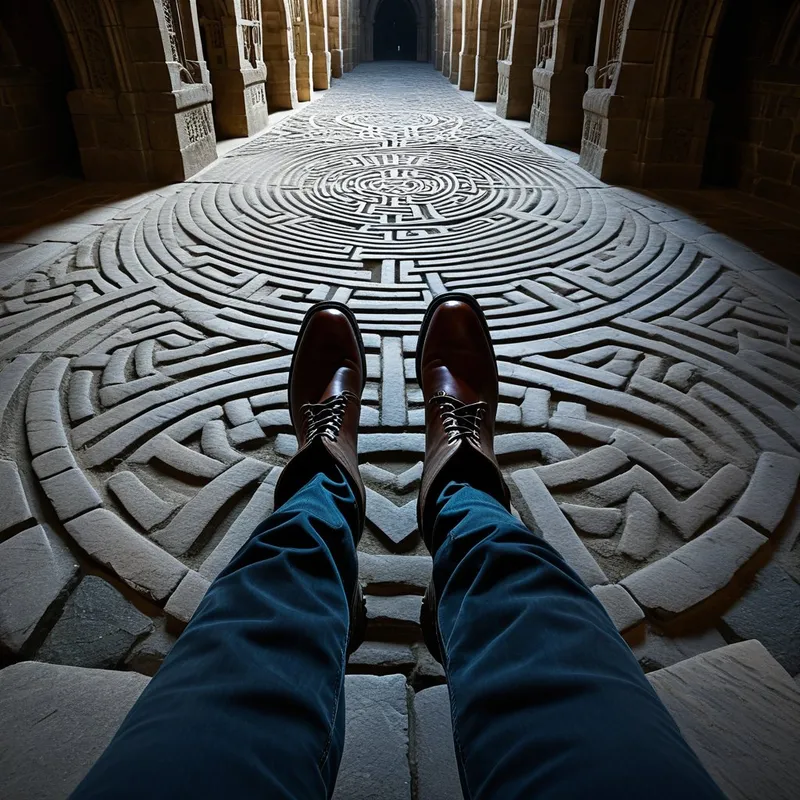
The labyrinth inlaid in the nave floor of Chartres Cathedral, laid around the year 1200, exists at a potent crossroads of cultural streams. It is a distinctly medieval Christian artifact, yet its form whispers of older tongues. It served not as a mere decoration, but as a functional, theological landscape.
For the medieval pilgrim, the journey to a holy site like Chartres was a literal acting-out of the soul’s journey to God—an arduous, penitential, and transformative ordeal. For those who could not make the perilous pilgrimage to Jerusalem, the Church designated certain cathedrals as “pilgrimage churches.” Chartres, housing the sacred Sancta Camisa, was one such destination. The labyrinth, often called “La Lieue de Jérusalem” or “Le Chemin de Jérusalem,” provided a substitute pilgrimage. By walking its 261-meter path on their knees, often while reciting prayers, pilgrims could symbolically complete the journey to the Holy City, earning indulgences and enacting their devotion.
Its custodians and interpreters were the clergy, but its “myth” was lived, not recited. It was a silent, somatic story told by the body in motion. There were no bards for this tale; the teller was the walker, and the audience was their own soul. Societally, it functioned as a container—a safe, sanctioned space within the rigid hierarchy of the Church for a direct, personal, and physically demanding encounter with the divine. It modeled the Christian life as a certain but winding path toward salvation, requiring patience, humility, and trust in the divine architect’s design.
Symbolic Architecture
The Chartres labyrinth is a masterwork of symbolic compression. Its geometry is its gospel.
The labyrinth does not ask you to solve it; it asks you to surrender to it. In that surrender, you find not passivity, but a deeper agency—the will to follow the path that is also your own nature.
First, its unicursality. Unlike a maze, it offers no choices, no dead ends. This represents divine providence, the idea that God’s plan, though inscrutable and full of switchbacks, is singular and leads unfailingly to the center. Psychologically, this mirrors the archetype of the individuation process—the journey to the Self is not a random wandering but follows an innate, organic pattern unique to the individual.
Second, its quadripartite structure. The path moves through four distinct sectors before reaching the center, often associated with the four seasons, the four elements, the four stages of life, or the four gospels. This represents the necessity of experiencing the totality of existence—the cycles of loss and return, the integration of opposites—to achieve wholeness.
Finally, the center and return. The six-petaled rosette is rich with meaning: the six days of creation, a flower (a common symbol for the Virgin Mary, to whom Chartres is dedicated), or a mandala of the Self. Reaching it is only half the work. The mandatory return path signifies that enlightenment or integration is meaningless if not brought back and applied to the shared world. The goal is not eternal residence in the center, but the transformation of the one who walks.
The Dreamer's Resonance
When the Chartres labyrinth appears in a modern dream, it rarely manifests as a stone floor in a cathedral. More often, it is felt as a process—a compelling, inevitable pattern that the dream-ego must navigate. It might be a twisting road through a night forest, a complex circuit board, or the grooves on a vast, spinning record.
To dream of walking this path signifies a psyche engaged in a profound somatic and psychological process. The body in the dream is often heavy, deliberate, mirroring the somatic grounding of the original pilgrim’s walk. This is the psyche insisting on embodiment, on feeling its way through a transition rather than thinking its way out.
The emotional tone is key. Anxiety or frustration suggests resistance to the path’s necessary turns—a clinging to linear, goal-oriented consciousness. A sense of calm surrender, even amidst the twists, indicates a trusting engagement with the unconscious process. Reaching the center in a dream can feel like a moment of immense peace, clarity, or encounter with a numinous figure (a guide, an animal, a light). This is a direct experience of the Self archetype. The dream often ends here, but if the return journey is present, it points to a phase of life focused on integration—taking an inner revelation and beginning the work of structuring one’s outer life around it.

Alchemical Translation
The myth of the Chartres labyrinth is a perfect model for the alchemy of the psyche, the opus of individuation. It maps the process of psychic transmutation from leaden, fragmented ego-consciousness to the golden, integrated Self.
The alchemist’s vessel was sealed; the labyrinth’s path is bounded. Both create the necessary container for the heat and pressure of transformation to work without the spirit escaping into distraction.
The first step onto the path is the nigredo, the blackening. It is the conscious decision to engage with the unconscious, to enter the dark, confusing, and often depressive initial phase of self-confrontation. The long, outward arcs toward the periphery represent encounters with the shadow—those rejected aspects of oneself that must be acknowledged and integrated.
The middle circuits, moving closer yet still turning back, mirror the albedo, the whitening. Here, one engages with the soul’s images, with anima and animus, and begins to purify intentions. It is a phase of reflection and increasing clarity, but not yet union.
Arrival at the rosette is the citrinitas, the yellowing, and the glimpse of the rubedo, the reddening. It is the conjunction of opposites, a sacred marriage (hieros gamos) within the psyche. The ego momentarily aligns with the Self, experiencing a state of wholeness and meaning. This is the philosopher’s stone discovered within.
But the alchemical work is not done until the stone is used. The return journey is the final, and most crucial, stage of the rubedo: the projection of the achieved wholeness back into life. The transformed substance—the now-conscious individual—must be applied to the world. The path out is the creation of a life that reflects the inner center. The walker emerges, not as a pilgrim who has escaped the world, but as a sage who carries the sacred pattern within, able to walk the labyrinth of daily existence with the calm certainty learned in the heart of the stone.
Associated Symbols
Explore related symbols from the CaleaDream lexicon: