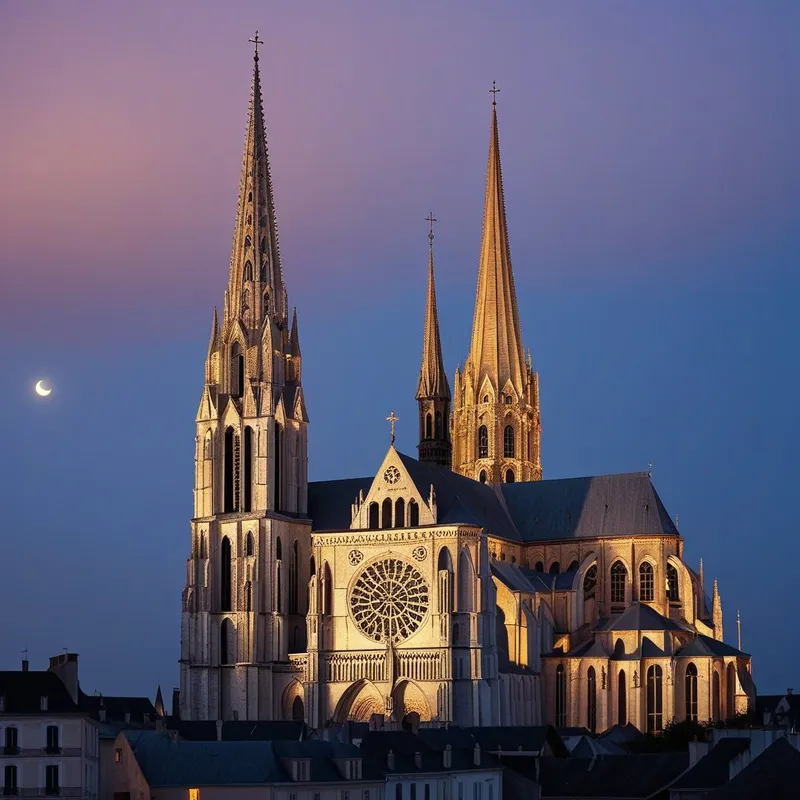
Chartres Cathedral Myth Meaning & Symbolism
A sacred mountain of glass and stone built to house a holy relic, embodying humanity's quest to bring heaven to earth through geometry, light, and devotion.
The Tale of Chartres Cathedral
Listen. In the land of the Franks, on a hill older than memory, a sacred fire was kept. It was a hill of the Druids, then of the Romans, then of the first Christians who raised a simple church. But the fire was not of wood or oil. It was the fire of a longing—a longing to build a vessel worthy of a holy secret.
The secret was the Sancta Camisia. A veil, it was said, woven from the very moment of the Incarnation, a thread connecting heaven and earth. It rested in the old church, a quiet ember. Then, in the year of our Lord 1194, a great conflagration descended. Flames roared through the town, consuming the old cathedral, licking at the very reliquary that held the Veil. The people despaired. Their holy house was ash. Their treasure was surely lost.
But from the smoke and despair, a miracle was breathed. When the ashes cooled, priests ventured into the smoldering crypt. And there, untouched, pristine amidst the charcoal and ruin, lay the Sancta Camisia. The fire had not taken it. The secret had survived. This was not an end, but a divine command. The Veil had chosen its hill. It demanded a new house, a robe of stone to match its celestial cloth.
And so the people rose. Not just lords and bishops, but all the people. From every corner of the land they came—nobles and peasants, merchants and artisans. They became a single body with one will. They harnessed themselves to carts, men and women alike, to drag the immense blocks of limestone from the quarries. The air rang with the song of chisels and the chant of prayers. The forest of scaffolds grew towards heaven.
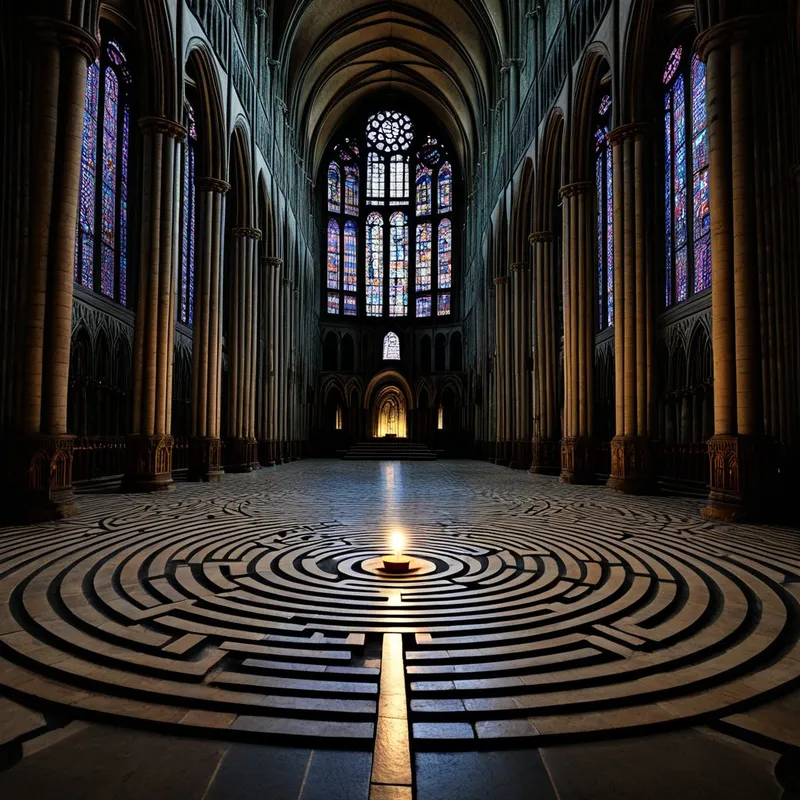
They built not just a church, but a mountain of light. They conceived a skeleton of stone so daring it seemed to defy gravity, allowing walls to become windows. And into these vast windows they set pieces of colored glass—sapphire, ruby, emerald—melting sand and metal into translucent skin for the building. They told the entire story of salvation in this frozen light, from the Adam of the earth to the Apocalypse. At the western face, they carved a royal portal, a stone Bible where saints and kings stood in silent sermon. And on the floor, they laid a secret path: a labyrinth, a journey in stone for the feet of pilgrims.
For decades they labored, a generation passing the dream to the next. Until, one day, it was complete. The new cathedral stood, not as a replacement, but as a phoenix, a glorious resurrection. It was a cage for light, a geometric hymn, a vaulted womb holding the ancient Veil at its heart. The sacred fire of longing had been transmuted into colored glass and soaring stone. The hill was crowned. The secret was home.
Cultural Origins & Context
The "myth" of Chartres is not a single narrative with gods and monsters, but a living story woven from history, devotion, and collective endeavor. Its origins are deeply layered. The site itself was a numinous locus long before Christianity, a telluric power point. The Christian mythos grafted onto this with the story of the Sancta Camisia, a relic that anchored the divine feminine—the Virgin Mary—in that specific spot.
The primary tellers of this myth were the anonymous thousands who built it and the medieval theologians who conceived its symbolic program. It was passed down through the stones themselves, through the liturgical drama performed within it, and through the pilgrim guides who interpreted its windows and sculptures. Societally, it functioned as the ultimate communal project. It was an act of civic pride, religious devotion, and economic enterprise. It transformed a town into a destination, placing it on the map of Christendom. More profoundly, it served as a summa—a total summation—of medieval knowledge: theology, philosophy, natural science, and craft, all integrated into a single, comprehensible (though sublime) form. It was a school for the illiterate and a university for the learned, teaching the path to God through beauty and order.
Symbolic Architecture
Chartres Cathedral is a supreme act of symbolic thinking made manifest. It is a model of the cosmos and a map of the soul.
The cathedral is the psyche turned inside out, its vaults the cranium of God, its labyrinth the coiled path of the seeking self.
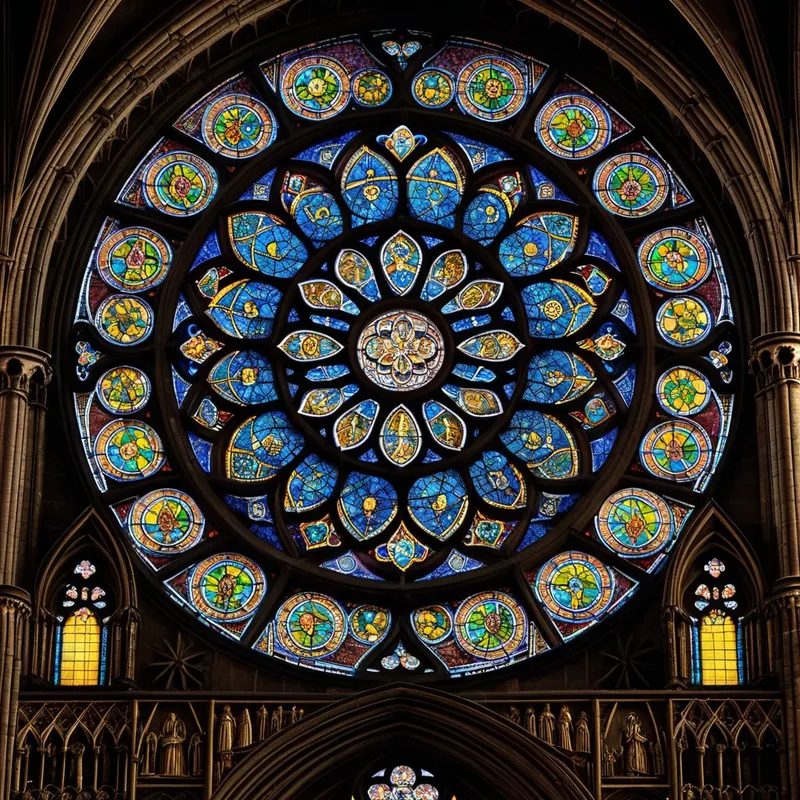
Its primary symbol is Light. The Gothic architecture, perfected here, is engineered to dematerialize stone into luminosity. The stained glass windows are not mere decoration; they are the building’s essence. They transmute the raw, blinding light of the sun into a fractured, narrative, sacred glow that fills the interior. This is the alchemy of spirit: the transformation of undifferentiated divine energy (the sun) into the patterned, story-filled wisdom (the colored light) that illuminates human consciousness.
The Labyrinth set into the floor is the counter-symbol to the vertical spire. It is the inward, horizontal journey. Walking its unicursal path to the center and back out is a pilgrimage in miniature, a mandala for the feet, representing the soul’s circuitous journey through life and its return to the source. The West Front, with its deep portals and sculpted hierarchies, represents the structured, doctrinal face of faith—the Law. The Nave, flooded with light, represents Grace—the direct, immersive experience of the divine.
The building itself is the hero—or rather, the vessel for the hero, which is the human soul. It represents the constructed Self, built consciously over a lifetime (the decades of construction) to house the ultimate sacred value (the relic/Self). Its resilience through fire symbolizes the psyche's ability to endure catastrophe and rebuild itself around its core, indestructible truth.
The Dreamer's Resonance
To dream of Chartres Cathedral is to dream of the Self in its most complete, aspirational form. It is a dream of synthesis and order emerging from chaos.
If one dreams of lost in the labyrinth, the dreamer may be navigating a complex life transition, feeling the frustration of a path that seems to double back on itself, yet trusting an inherent design. The somatic sensation might be one of deliberate, slow pacing, a grounded searching.
A dream of standing beneath the rose window, bathed in its colored light, suggests a moment of profound insight or revelation. The fragmented pieces of one’s understanding (the individual pieces of glass) are suddenly integrated by a unifying pattern (the rose design), illuminating the inner world. This can feel like a somatic warmth or a sense of awe and expansion in the chest.
Dreaming of the cathedral on fire, yet surviving, speaks directly to a process of radical transformation. The old structures of belief, identity, or relationship are being consumed. The dream asks: what is your Sancta Camisia? What core, essential part of you remains untouched, pristine, and ready to be the foundation for a glorious rebuild? This dream often accompanies a somatic feeling of heat, panic, followed by a deep, cool calm.
Alchemical Translation
The myth of Chartres models the entire alchemical Opus of individuation. The fire of 1194 represents the necessary stage of nigredo—the burning away of the old, outworn personality, the reduction to ash and despair. This is the dark night of the soul.
The discovery of the intact Veil in the crypt is the finding of the Self amidst the ruins of the ego. It is the scintilla, the divine spark that survives all trials. This begins the albedo.
The building that follows is the conscious, lifelong work of rubedo—constructing a new, durable vessel around this discovered Self.
The collective labor mirrors how individuation, while a personal journey, is supported by the "psychic species"—the internalized voices of tradition, wisdom, and community (the artisans, the theologians). The fusion of Romanesque solidity (the crypt, the past) with Gothic aspiration (the new nave, the future) represents the reconciliation of opposites—earth and heaven, body and spirit, darkness and light—within the individual.
For the modern seeker, Chartres is an external blueprint for an internal process. It instructs us to first endure the necessary fires that cleanse. Then, to identify the one true, incorruptible thing within us—our personal "relic" of meaning. And finally, to devote our life's energy to building a structure of consciousness—through discipline, art, relationship, and understanding—magnificent enough to house it. We are called to become the architect, mason, and glazier of our own soul, transforming the raw light of experience into the stained-glass wisdom of a life lived in depth. The cathedral, in the end, is not a place we visit, but a state of being we strive to inhabit.
Associated Symbols
Explore related symbols from the CaleaDream lexicon: