Chanunpa Myth Meaning & Symbolism
A sacred woman brings the Chanunpa, the holy pipe, to the people, establishing a covenant between earth and sky through profound sacrifice and ceremony.
The Tale of Chanunpa
Listen. In a time when the people were scattered, hungry in spirit, a great shadow lay upon their hearts. They had forgotten the song of the earth and the language of the sky. Their prayers were whispers lost in the wind. From the great mystery, Wakan Tanka saw their disconnection. And so, a messenger was chosen.
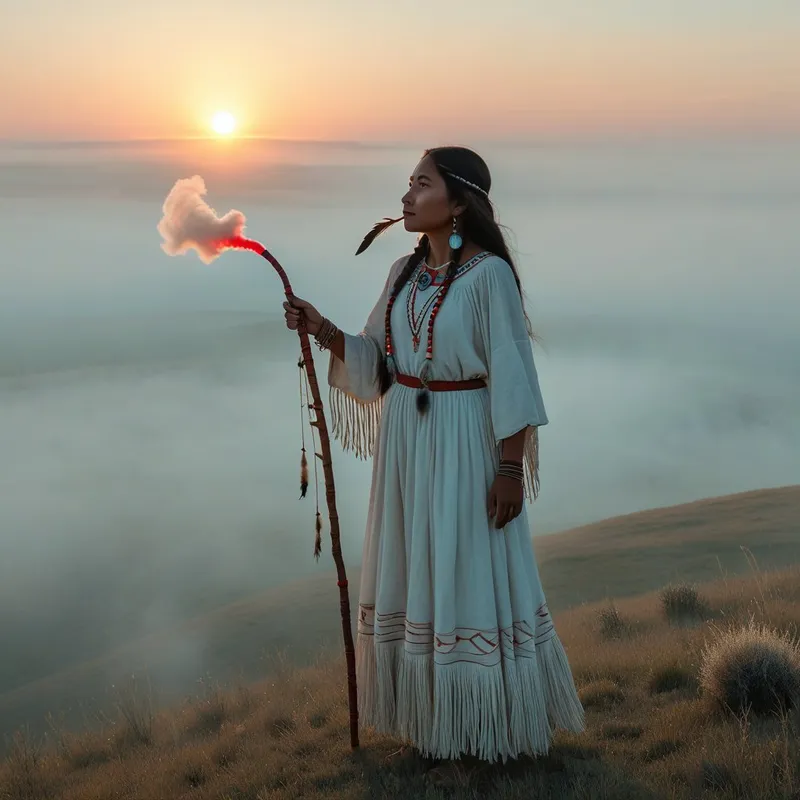
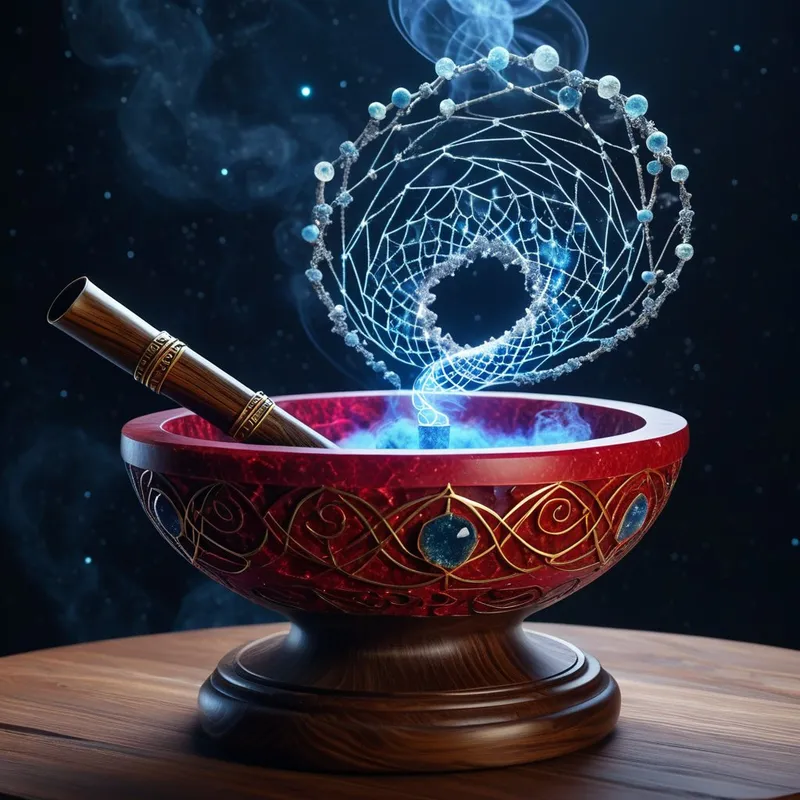
She came walking from the south, a woman of profound and silent beauty, clad in a dress of white buckskin. In her hands, she carried something wrapped in sage. The people watched her approach, a stillness falling over the camp. She did not speak to the hunters or the warriors. She walked directly to the lodge of a holy man. Unwrapping her bundle, she revealed it: a beautifully carved bowl of red stone, and a long wooden stem. Separately, they were simple objects. Together, they were a key.
“Behold the Chanunpa,” she said, her voice like water over stones. “With this, your prayers will be heard. The bowl is the earth, your grandmother. The stem is all that grows upon her, your relatives. When joined, they are the entire universe, and the smoke that rises is your visible breath, your very spirit, carried to Wakan Tanka.”
She taught them the solemn ceremony. How to fill the bowl with cansasa, the sacred herb. How to offer it to the six directions—west, north, east, south, to the earth, and to the sky. She showed them how the pipe was not a thing to be owned, but a living being to be respected, a relative. As she smoked with them for the first time, a profound peace descended. The air itself seemed to listen.
But the teaching was not complete. The holy man, seeing her power and her beauty, felt a stirring of human desire, a thought unbecoming of the sacred moment. The woman, perceiving this shadow in his heart, knew her time in this form was ending. Her mission required a final, ultimate gift.
“My body is no longer for this world,” she said. “But my spirit will remain with the pipe, to guide you.” She began to walk away from the camp, towards the rising sun. With each step, she transformed. Her form softened, shifted, and melted into the earth. Where she walked, a new, sacred plant sprang up: timpsila. Her body became the very sustenance of the people. And from that place, it is said, the PtesanWi departed, leaving behind not a corpse, but a covenant made flesh in the Chanunpa and in the land itself. The people were no longer separate from the sacred. They were woven into it, through prayer, through ceremony, through the visible breath of the pipe.

Cultural Origins & Context
The narrative of the Chanunpa’s bringing is among the most central and sacred teachings of the Lakota, part of the larger cycle of PtesanWi. This is not merely a “story” in a Western sense, but a wicozani, a narrative that establishes the foundational principles of life, relationship, and spirituality. It was and is transmitted orally, not casually, but within specific ceremonial contexts or as profound instruction by spiritual leaders, known as wicasa wakan.
Its societal function is constitutive. The pipe is the physical and spiritual center of Lakota society. It sanctifies agreements, from personal vows to historic treaties (which were often signed with pipe ceremonies, a fact later ignored by colonizers to catastrophic effect). It opens and closes important councils, prayers, and healing rites. The myth provides the ontological “why”: the pipe is sacred because it was given by the sacred, in a specific, relational way. It models the ideal state of being: connected, respectful, and in a constant, conscious dialogue with all of creation. The myth is the spiritual constitution of the people.
Symbolic Architecture
The symbolism of the Chanunpa is a complete cosmological map. The bowl of red stone represents the feminine, the earth, the blood of life, the physical world, and the human heart. The wooden stem represents the masculine, the plant world, the spine, the path of growth, and the connection to all living things.
The joining of bowl and stem is the sacred marriage of heaven and earth, matter and spirit, the individual and the cosmos. It is the act of making whole.
The act of smoking is alchemical. The sacred tobacco (cansasa) is the offering, the sacrificed plant. Fire transforms it. The smoker’s breath (spirit/wind) gives it life as smoke. This smoke—visible breath—carries the prayer, the thought, the gratitude, or the plea from the tangible world into the intangible realm of Wakan Tanka. The pipe is thus a transformer, a mediator. Psychologically, it represents the ego’s capacity to consciously offer its contents (thoughts, emotions) to the larger Self, to be transformed and released, creating a channel between conscious intention and the deep unconscious.
The messenger’s transformation into timpsila is the ultimate symbol of nourishment through sacrifice. She does not die; she becomes sustenance. The sacred is not abstract; it feeds the body. The spiritual covenant has a physical, life-giving result.
The Dreamer's Resonance
When this mythic pattern stirs in the modern dreamer, it often signals a profound crisis of connection and a call to establish an inner altar. One might dream of a lost or broken object of great personal significance that must be mended, or of being given a simple, humble item with the instruction that it is “for speaking.” There is a somatic quality of constriction in the chest or throat—the un-prayed prayer, the unvoiced truth.
The dream may present a guiding figure—often feminine, calm, and authoritative—who offers a tool or a ritual. Accepting it in the dream brings immense relief, a feeling of “rightness.” Conversely, dreams where one is offered such an item and refuses, or tries to use it for selfish gain, result in its disappearance and a deep sense of spiritual desolation. The psychological process is one of recognizing the need for a sacred container: a reliable, respectful method to process the raw material of one’s life (suffering, joy, confusion) and offer it up for transmutation. It is the psyche seeking its own Chanunpa.

Alchemical Translation
For the individual on the path of individuation, the myth of the Chanunpa models the process of creating a conscious relationship between the personal psyche and the transpersonal Self. The “scattered, hungry” people represent the ego-state of fragmentation, where instincts, thoughts, and feelings are disconnected and lack a unifying principle.
The arrival of the sacred messenger is the emergence of a unifying symbol from the Self. This symbol (the pipe) is not invented; it is received. The first alchemical step is humility and receptivity to this inner directive. The instruction—“join the bowl and stem”—is the labor of integration. One must consciously connect the earthy, embodied, instinctual self (the bowl) with the aspirational, spiritual, and intellectual self (the stem). This creates a channel, a spine of consciousness.
The smoking of the pipe is the daily practice of inner sacrifice. One takes the raw “tobacco” of experience—anxiety, a memory, a hope—places it in the vessel of awareness, applies the fire of attention, and with the breath of acceptance, lets it transform and rise, offering it to a meaning greater than oneself.
The final sacrifice of the messenger is the most challenging translation: the dissolution of the ego’s identification with the process itself. One must become the nourishment. The inner work is not for self-aggrandizement but must, in the end, feed the world in some humble way—through compassion, through creation, through simple presence. The pipe remains; the ritual remains. The individual becomes a vessel for the sacred process, and in doing so, fulfills the covenant of wholeness, where no part of the self or the world is outside the circle of respectful relationship.
Associated Symbols
Explore related symbols from the CaleaDream lexicon: