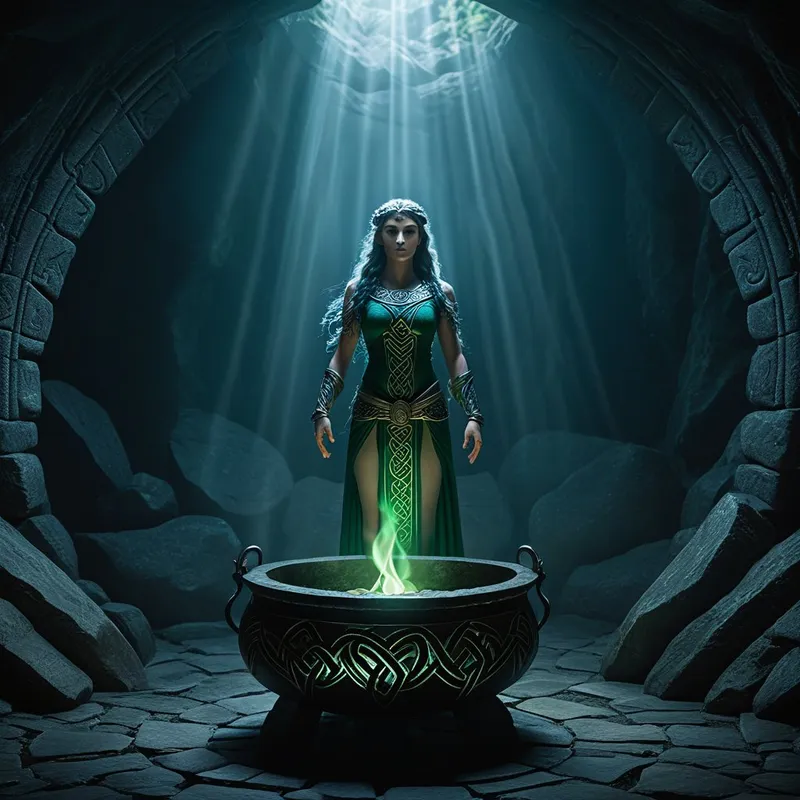
Cerridwen's Cauldron Myth Meaning & Symbolism
A goddess brews a potion of ultimate wisdom for her son, but a servant boy drinks it instead, triggering a shapeshifting chase of profound transformation.
The Tale of Cerridwen's Cauldron
Listen, and let the mist of Cymru gather around you. In a time when the veil between worlds was thin as a spider’s silk, there lived a goddess of formidable power and deep, abiding sorrow. Her name was Cerridwen. She dwelled on an island in the middle of Llyn Tegid, its waters dark and still, holding secrets in their depths.
Cerridwen had a son, Morfran, whose face was not blessed by the Aos Sí. To compensate for this, the goddess resolved to brew for him the ultimate gift: the Awen. This was not mere knowledge, but the fiery spark of poetic genius, prophecy, and ultimate wisdom itself. To craft it required a year and a day, and ingredients gathered from the corners of the world and the edges of spirit. She set her great iron cauldron to boil, a vessel as old as the hills, and appointed a blind man to tend the fire and a young boy, Gwion Bach, to stir the brew.
For three seasons, Gwion stirred. The cauldron bubbled and steamed, its scent shifting from the rot of autumn leaves to the sharpness of winter frost, then to the fertile promise of spring soil. The liquid within thickened, becoming a dark, roiling elixir. Three drops of this precious, scalding liquid—the essence of the entire year’s labor—spattered onto Gwion’s thumb. Instinctively, he thrust his thumb into his mouth to cool the burn.
In that instant, the universe poured into him. The past, the present, and all possible futures unfolded in his mind. He knew the language of the stones and the songs of the stars. And with that knowledge came a terrible understanding: Cerridwen would know, and her wrath would be absolute. He fled into the gathering twilight.
Cerridwen, sensing the shift in fate, let out a cry that shook the reeds at the lake’s edge. She gave chase. What followed was a chase of shapes and essences, a primal dance of transformation. Gwion, feeling the goddess’s will upon him, became a hare, swift and desperate. Cerridwen became a greyhound, lean and relentless. He reached a river and became a fish, slipping into the cool, shadowed water. She became an otter, sleek and deadly. He burst into the air as a bird; she followed as a hawk, a dark speck against the sun.
Exhausted, seeing a barn below filled with golden grain, Gwion fell from the sky and transformed himself into a single grain of wheat, hoping to lose himself in the multitude. Cerridwen, landing in the barn, shook her feathers and became a sleek, black-hen. She peered with a predator’s eye, picked out that one specific grain, and swallowed it whole.
And in her womb, the grain did not die. It grew. Nine months later, Cerridwen gave birth to a son so radiant she could not bear to kill him. She cast him into the sea in a leather bag. He was found and raised, becoming the greatest bard of the Isles: Taliesin, whose songs could soothe kings and stir the hearts of mountains.

Cultural Origins & Context
This myth survives primarily in the Hanes Taliesin, a later medieval manuscript that captures a far older, oral tradition. It is a cornerstone of the Brythonic mythological cycle, not the more widely known Irish cycles. The story was likely preserved and told by bards and druids (or their later successors), for whom the figure of Taliesin was the ultimate archetype of inspired artistry.
Its function was multifaceted. On one level, it was an aetiological myth, explaining the origin of the greatest bard. On a deeper level, it served as an initiatory narrative for the poetic class. It illustrated that true inspiration (Awen) was not a gentle gift but a dangerous, transformative force, stolen from the divine realm at great personal cost. It encoded the idea that wisdom comes through ordeal, through being broken down and remade—a process literally enacted in the chase and the cauldron’s brew.
Symbolic Architecture
The myth is a dense symbolic map of the psyche’s journey toward wholeness. Cerridwen herself is a complex figure: the Great Goddess in her transformative, dark aspect. She is the womb and the tomb, the one who creates the elixir of life and demands a death for its consumption. Her cauldron is the vas Hermeticum of Celtic cosmology, a container for the chaotic, primal soup of potential from which new consciousness is born.
The cauldron is the psyche itself, where the raw materials of experience—memory, trauma, hope, instinct—are stewed into the elixir of self-knowledge.
Gwion Bach represents the unprepared ego, the "small self" who stumbles into a process far greater than he intended. His ingestion of the three drops is the accidental, yet fateful, engagement with the Self. The subsequent chase is the necessary dissolution of that old, limited ego-identity. Each transformation—hare, fish, bird, grain—is a shedding of a former way of being, a desperate attempt by the conscious mind to escape the consuming, transformative power of the unconscious (Cerridwen).
The final ingestion and rebirth as Taliesin is the core of the mystery. The ego is not destroyed; it is assimilated by the greater archetypal force and returned to the world reborn, gifted with a voice that can speak for the soul.
The Dreamer's Resonance
When this myth stirs in modern dreams, it signals a profound initiation underway in the dreamer’s psyche. To dream of a boiling pot or cauldron, especially one that feels ominous or overwhelmingly potent, points to a "brewing" period. Unconscious contents are being heated, mixed, and prepared for integration. It is often a time of intense emotional fermentation, anxiety, or creative frustration with no clear outlet.
Dreams of being chased, particularly while transforming or trying to hide, mirror Gwion’s flight. The dreamer may be avoiding a powerful insight, a necessary but frightening life change, or the demands of their own nascent creativity. The pursuer, often a dark, feminine, or animalistic figure, is not merely a threat but the embodiment of the transformative process itself, insisting on completion.
To be swallowed in such a dream is not a nightmare’s end, but the beginning of its deepest work. It signifies the ego’s surrender to a process of psychic gestation.
The somatic experience upon waking is often one of exhaustion, a deep fatigue that speaks of subterranean labor. The psyche is engaged in the hard, alchemical work of rendering base experience into the gold of meaning.
Alchemical Translation
The myth of Cerridwen’s Cauldron is a perfect allegory for the Jungian process of individuation. The initial state is one of lack (Morfran’s plight), prompting a heroic, willful act by the maternal archetype (Cerridwen’s plan). This sets the stage for the central, involuntary ordeal.
The stirring of the cauldron is the long, often monotonous work of self-reflection and engaging with the unconscious—the opus of analysis or deep introspection. The accidental tasting of the brew is the critical moment of insight, the eruption of the unconscious into consciousness that cannot be undone. This "poisonous" wisdom initially disintegrates the familiar personality (Gwion).
The chase is the nigredo, the dark night of the soul, where one feels pursued by one’s own shadow contents. Each transformation is an attempt by the ego to re-stabilize in a new form, but each is inadequate until the final reduction to the essential grain—the core of being, stripped of all pretension.
The ultimate transmutation occurs not through escape, but through being fully consumed by the transformative principle. The ego (grain) must be dissolved in the womb of the unconscious (hen) to be reborn as the Self (Taliesin).
For the modern individual, this translates to the painful but necessary journey where our cherished identities are broken down by life’s crises, grief, or creative demands. We are chased by our own unlived lives. The promise of the myth is that if we endure this psychic digestion—if we allow ourselves to be cooked in the cauldron of our own experiences—we do not emerge merely repaired, but fundamentally reconstituted. We gain not just knowledge, but Awen: the inspired, authentic voice that can sing our unique existence into the world. The bard is not born; he is forged in flight, swallowed by darkness, and delivered by the sea.
Associated Symbols
Explore related symbols from the CaleaDream lexicon: