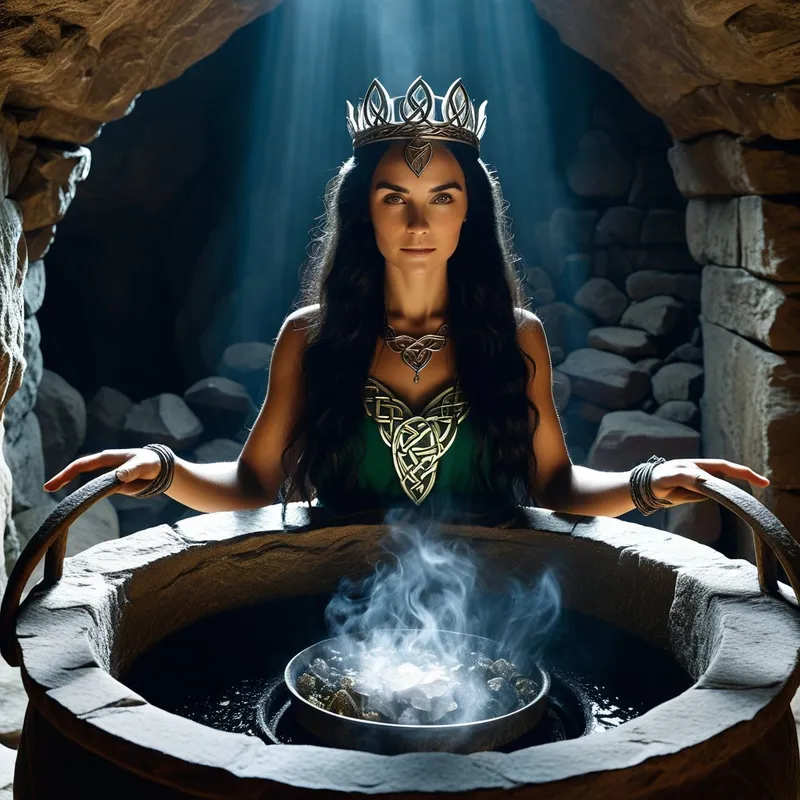
Cerridwen Myth Meaning & Symbolism
A goddess brews a potion of ultimate wisdom. Her servant tastes it, triggering a shapeshifting chase that births a new form of poetic inspiration.
The Tale of Cerridwen
Listen, and let the mist of Cymru gather. In a time when the world was younger and magic was a thread in the cloak of reality, there lived a goddess of the deep earth and the dark womb of inspiration. Her name was Cerridwen. She dwelt on an island in the middle of Llyn Tegid, a lake of glassy stillness that mirrored the moods of the sky.
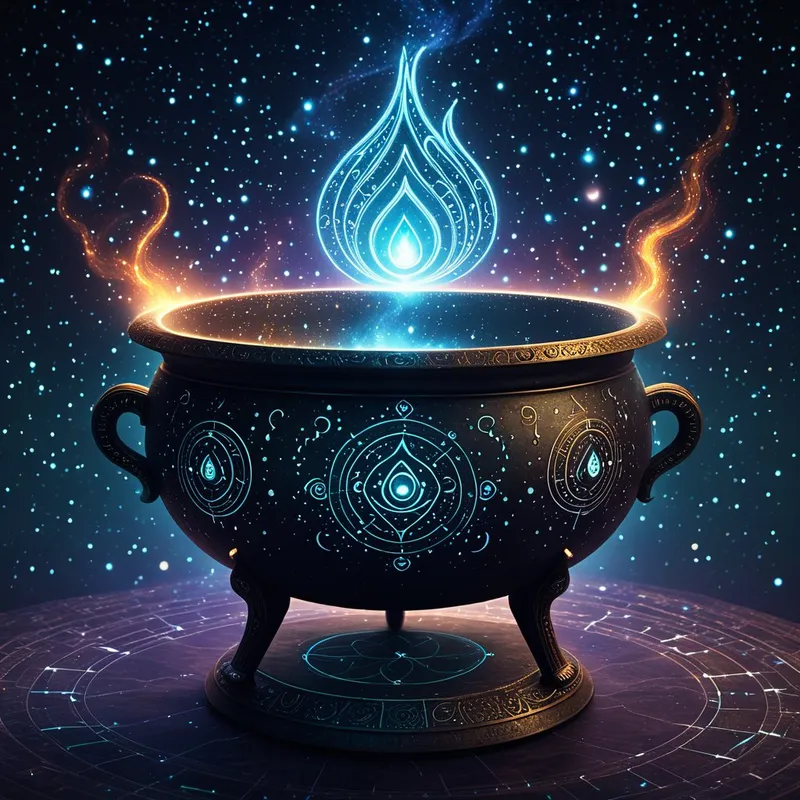
Cerridwen had a son, Morfran, whose face was not blessed with beauty or grace. To compensate for this, his mother resolved to brew for him the ultimate gift: the Greal. This was no simple tonic. It was the essence of Awen itself, a liquid that would grant him all knowledge of the past, present, and future. To craft it required a year and a day, the watching of the stars, and the gathering of rare charms from the world's secret corners. The ingredients were placed in her great Cauldron of Inspiration, which must boil without cease.
For this sacred vigil, she set two to tend the fire: a blind man named Morda, and a young boy named Gwion Bach. For the full turning of the seasons, they fed the oak-wood fire, and Cerridwen stirred the brew with her sacred ladle. The air in the hut grew thick with the scent of herbs and earth, with promise and latent power.
As the final moments of the year and a day approached, three blessed drops of the potion, hotter than the sun and brighter than thought, flew from the cauldron and landed upon Gwion Bach’s thumb. Scorched, he instinctively put his thumb to his mouth. In that instant, the entire power of the Greal flooded into him. He saw everything—the weave of fate, the song of the stars, the secret names of all things. And with that knowledge came terror, for he knew Cerridwen’s wrath would be swift and absolute.
The cauldron, now holding only poison, cracked in two with a sound like a breaking world. Hearing this, Cerridwen knew what had transpired. A roar of fury shook the island. Gwion fled.
What followed was the great chase, the Hunt of Transformation. Gwion, with his new wisdom, transformed himself into a hare and sped across the land. Cerridwen became a greyhound, swift and relentless. He plunged into a river as a fish; she became an otter, sleek and deadly in the current. He took to the air as a bird; she followed as a hawk, a shadow against the sun. Finally, in a barn, he turned himself into a single grain of wheat, lost among thousands on the threshing floor. Cerridwen, in her ultimate form, became a sleek, black hen. She pecked and searched, and at last, she found that one grain and swallowed it.
But the story was not ended by the swallow. From that grain, Cerridwen conceived and bore a child. Though she intended to destroy him, when he was born he was so radiantly beautiful that she could not bring herself to do it. Instead, she placed him in a leather bag and set him adrift on the waters of Llyn Tegid. He was found and raised, and grew to become the greatest of all bards, Taliesin. The wisdom he had tasted as Gwion Bach now flowed from him as sublime poetry, and he sang the mysteries of the world.

Cultural Origins & Context
The story of Cerridwen comes to us primarily from the Hanes Taliesin, a narrative embedded within the wider corpus of medieval Welsh literature. While recorded in the post-Christian era, its bones are deeply pagan, echoing the oral traditions of the Druids. This was not a myth for common entertainment, but a sacred narrative likely preserved by the bardic orders. Its function was multifaceted: it was an etiological myth explaining the origin of poetic genius (Awen), a teaching story about the dangers and responsibilities of power, and a map of transformative initiation.
The societal role of the bard was paramount in Celtic culture; they were the keepers of history, law, and lineage, their words possessing near-magical power. The myth of Cerridwen served as the divine precedent for this role, framing the bard not as a mere craftsman, but as one who had undergone a terrifying, alchemical ordeal of pursuit, ingestion, death, and rebirth. The tale legitimized the bardic profession by rooting it in a cosmic drama of theft, wrath, and ultimate, unexpected redemption.
Symbolic Architecture
At its heart, this is a myth of unintended consequence and the indestructibility of inspiration. The Cauldron of Inspiration is the womb of the unconscious itself, where raw potential—ideas, talents, psychic contents—simmers until it is ready to be born. Cerridwen is the archetypal Great Mother in her dual aspect: the nurturing creator who brews a gift for her child, and the terrifying destroyer who pursues the thief of that gift with single-minded fury.
The gift of wisdom is never given lightly; it must always be stolen from the gods, and the theft demands a chase that remakes the thief.
Gwion’s tasting of the three drops symbolizes the accidental, yet fated, moment of illumination—the spark of genius, the sudden insight, the calling that chooses the individual, not the other way around. The subsequent shapeshifting chase represents the psyche’s frantic attempt to evade the full consequences of that illumination. Each transformation is an attempt to hide in a different form of being, but the pursuing shadow (Cerridwen) knows every form. There is no escape from the totality of what has been ingested.
The final transformation into the grain and Cerridwen’s consumption as the hen is the critical moment of symbolic death and integration. The old, ignorant self (Gwion) is utterly destroyed, but the essence of the Awen is not. It is taken back into the body of the Goddess, gestated, and reborn in a new, radiant, and sanctioned form: Taliesin. The wisdom is no longer stolen property; it has been alchemically transmuted through the vessel of the very force that sought to destroy it.
The Dreamer's Resonance
When this myth stirs in modern dreams, it often signals a profound psychic initiation is underway. To dream of being pursued relentlessly by a powerful, often maternal or feminine force suggests a confrontation with what Jung termed the Shadow or the overwhelming power of the unconscious itself. The dreamer may be fleeing from a newly awakened talent, a frightening insight about themselves, or a calling that feels too large to hold.
The somatic experience in such dreams is one of primal urgency—the pounding heart, the desperate search for a new form of escape. Each transformation in the dream (becoming an animal, an object) reflects the ego’s attempt to disguise or minimize the emerging content. The chase does not end until the dreamer experiences a moment of surrender, of being “swallowed” or consumed. This is not a dream of literal threat, but of psychic digestion. The dreamer is being pursued by the very wholeness they are resisting, and the process, though terrifying, is one of necessary disintegration. The birth of Taliesin in the myth is the promise on the other side of such dreams: a new, more authentic identity, forged in the belly of the ordeal.
Alchemical Translation
For the modern individual, the myth of Cerridwen is a precise model of individuation. The process begins with a conscious intention (Cerridwen’s plan for her son) that activates the deep unconscious (the cauldron). From this brewing, a fragment of divine potential—a talent, a creative spark, a piece of self-knowledge—erupts into consciousness (the three drops). The ego (Gwion), unprepared and frightened, immediately tries to claim it and run.
The cauldron must crack for the poet to be born. The planned future must shatter for the destined one to emerge.
What follows is the nigredo, the dark chase. Every aspect of the psyche that is opposed to this new consciousness rises up in pursuit. Old identities, fears, and self-doubts (the shapes of the pursuer) give chase. The individual may try on new roles, hide in work, or rationalize the insight away (the shapeshifting). This phase feels like chaos and persecution. The alchemical key is the final surrender: the grain being eaten. This is the moment of allowing the old, small self to be dissolved in the greater psychic substance. The ego is consumed by the Self.
The gestation in Cerridwen’s womb is the silent, invisible period of integration. Finally, the rebirth as Taliesin represents the emergence of a new center of personality. The once-stolen insight is now the core of one’s authentic voice. The gift is no longer an alien possession but the very essence of the reborn self, capable of singing its own world into being. The myth teaches that true wisdom is not merely acquired; it is a fate endured, a death survived, and a song earned from the heart of the darkness that sought to silence it.
Associated Symbols
Explore related symbols from the CaleaDream lexicon: