
Cedars of Lebanon Myth Meaning & Symbolism
A sacred grove of immense cedars, guarded by a primordial spirit, is felled by a king to build a temple, embodying a pact between heaven and earth.
The Tale of Cedars of Lebanon
Hear now of the trees that touched the heavens, the Cedars of Lebanon. They did not merely grow; they ascended. Their roots gripped the bones of the mountain, and their crowns drank the morning mist before it could become cloud. Their fragrance was the breath of the earth itself, ancient and resinous, a scent known to the gods. This was no mere forest. It was a temple not built by human hands, a pillar holding up the corner of the sky.
And it was guarded. Not by walls, but by a spirit as old as the stone—the Lord of the Wild Things, who dwelt in the deepest shade and the loudest storm. He was the soul of the place, and the cedars were his children. To harm one was to wound him. The grove stood in a profound silence, a peace that was not passive but powerful, a covenant between the high place and the firmament.
Then came the sound of ambition. The ring of bronze, the creak of rope, the murmur of ten thousand men. A king, Solomon, whose wisdom was a gift and a burden, had sworn an oath to his god. He would build a house, a dwelling place for the divine name. But no common timber would do. Only the cedars, with their straight grain and incorruptible heart, could serve as pillars for such a house. He sent word to Hiram, King of Tyre, whose men knew the mountains. A pact was struck: food for wood, a trade between kingdoms.
And so the axes entered the sacred grove. The first bite into that legendary bark echoed like a crack of fate. The Lord of the Wild Things watched, his realm violated not by malice, but by a sacred purpose. Each groan of a falling giant was a seismic event, a mountain sighing. The laborers, their muscles straining, felt the awe and the terror of the act. They were not destroying; they were translating. They were taking the vertical aspiration of the tree and laying it horizontal, preparing it for a new kind of ascent.
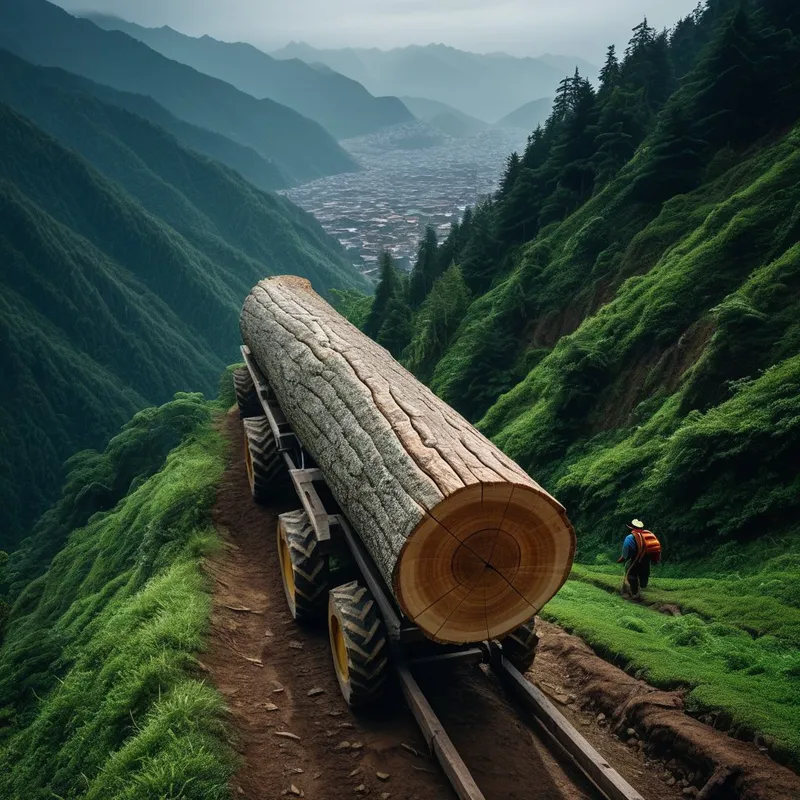
The logs, vast as sea monsters, were dragged from the heights, down to the coast, lashed into rafts, and floated south. The journey of the cedars was a funeral procession and a coronation march all at once. They left the wild, silent majesty of Lebanon and journeyed toward the clamor of Jerusalem, toward the chisel and the square, toward the dream of a king and the promise of a god. In the end, the spirit of the mountain was not defeated, but consulted; the price was paid, and the wood passed from one sacred order to another.
Cultural Origins & Context
This is not a single myth from a singular text, but a resonant motif woven throughout the Hebrew scriptures. The Cedars of Lebanon appear as the ultimate symbol of majesty, stability, and divine blessing. They are referenced in poetry (the Psalms, the Song of Songs), in prophecy (Isaiah, Ezekiel), and in historical narrative (the Books of Kings and Chronicles). The most famous narrative is the logistical account of Solomon’s temple construction in 1 Kings 5.
The story functioned on multiple levels for its ancient audience. Historically, it celebrated a pinnacle of Israel’s power and international diplomacy under Solomon, showcasing a grand, cooperative project with the sophisticated Phoenicians. Religiously, it underscored the belief that the God of Israel deserved a dwelling made from the finest materials of creation, legitimizing the temple’s awe-inspiring authority. Poetically and prophetically, the cedar became a metaphor for the righteous individual, the proud kingdom, or, in its fallen state, the humbled arrogant. The tale was passed down by scribes, priests, and storytellers, serving as a foundational memory of national identity, a lesson in the cost of glory, and a testament to humanity’s role as a collaborator—for better or worse—with the raw materials of a sacred creation.
Symbolic Architecture
At its core, the myth presents a profound dialogue between two realms: the Wild and the Sanctified. The cedar tree is the living axis between them.
It is the World Tree in a specific landscape. Its roots are in the dark, fertile earth (the unconscious, the instinctual), its trunk rises through the world of manifest reality, and its crown brushes the heavens (the spiritual, the transcendent). It is complete in itself, a perfect embodiment of natural divinity.
The felling of the cedar is the necessary violence of consciousness. The unconscious wholeness of nature must be broken apart to be reconstituted into a vessel for meaning.
Solomon, the ruler, represents the human ego with a divine mandate. His desire to build a temple is the psyche’s urge to create a structured, conscious center—a Self. But this center cannot be built from the ego’s own substance. It requires material from the primordial, untouched parts of the soul—the deep, ancient groves of the inner Lebanon. The Lord of the Wild Things is the guardian of this inner territory, the instinctual spirit that resists the ego’s colonization. The negotiation—the paying of a price—symbolizes the essential pact: consciousness cannot simply plunder the unconscious; it must offer something of value (energy, attention, respect) in return.
The Dreamer's Resonance
When this myth stirs in the modern dreamer, it often manifests as dreams of cutting down a great tree, of being in a majestic but threatened forest, or of hauling a heavy, sacred burden. The somatic feeling is crucial: it is often a mix of awe, profound grief, and determined purpose. There is a weight in the chest, a strain in the shoulders.
This dream pattern signals a critical phase of inner work. The psyche is engaged in the difficult, sacred task of harvesting resources from its own primordial depths to build or rebuild a central structure in one’s life. This could be a new identity, a marriage, a career, a creative project, or a spiritual practice. The grief is for a wholeness that must be sacrificed—the end of a naive, unconscious state (the untouched grove). The determination is for the new synthesis to come (the temple). The dreamer is the laborer, the king, and the guardian spirit all at once, feeling the conflict and the necessity of the act. It is the pain of growth, where something deeply rooted and beautiful must be transformed to serve a higher integration.
Alchemical Translation
The journey of the cedar from mountain to temple is a perfect map of the alchemical and Jungian process of individuation. The prima materia—the raw, divine substance—is the living cedar in its natural state (the unconscious, latent potential). The felling is the nigredo, the blackening, the necessary death and deconstruction of an old form. There is darkness, mourning, and the feeling of committing a sacred violation.
The hauling and floating is the albedo, the whitening. The material is separated from its original context, cleansed by its journey (the sea), and prepared. This is the stage of reflection, analysis, and coming to terms with what has been done.
Finally, the construction into the temple is the rubedo, the reddening, and the coniunctio oppositorum. The wild wood is joined by the craftsman’s skill, the mountain’s strength is married to the city’s plan, and the vertical aspiration of the tree is realized horizontally as a roof that shelters the divine. The individual timber loses its isolated, natural perfection to become part of a greater, conscious order.
The temple is not built instead of the forest, but because of it and from it. The goal of individuation is not to live in the wild grove forever, nor to live in a sterile city devoid of nature, but to build an inner temple using the sacred timber of one’s own deepest nature.
For the modern individual, the myth asks: What are your Cedars of Lebanon? What ancient, majestic, but untamed part of your soul are you being called to respectfully harvest—to pay a price for, to laboriously transport, and to skillfully incorporate into the conscious structure of your life? The struggle is not to conquer the wild, but to enter into a sacred contract with it, so that its towering strength might become the enduring pillar of your own holy of holies.
Associated Symbols
Explore related symbols from the CaleaDream lexicon: