Cauldron of Plenty Myth Meaning & Symbolism
A magical cauldron that endlessly provides nourishment, guarded by otherworldly forces, symbolizing the soul's capacity for infinite renewal through sacrifice.
The Tale of Cauldron of Plenty
Listen now, and let the hearth-fire dim. The wind carries a tale from the time when the world was younger, when the veil between the land of the living and the Sídhe was thin as morning mist.
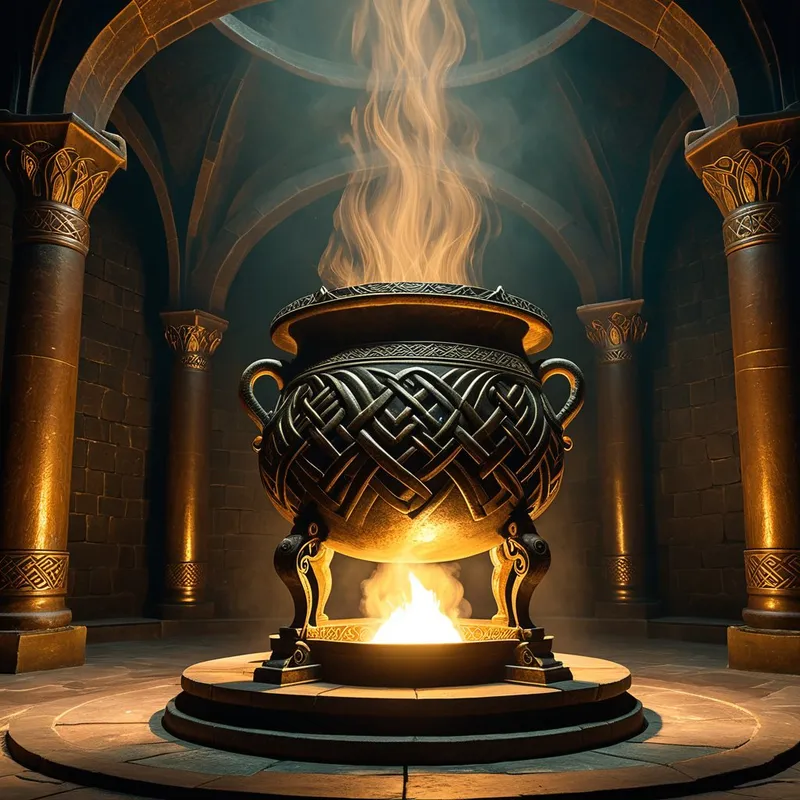
In the hall of the Dagda, the Good God, a treasure rested. It was not a sword, nor a crown of gold, but a cauldron. This was the Coire Ansic. From the cold, dark iron of its belly, no man ever went away hungry. It answered the virtue of the heart; for the coward, it yielded only thin gruel, but for the brave and the generous, it would boil a feast fit for a hundred kings, its bounty never ceasing. The scent of roasting meat and sweet mead perpetually hung about the Dagda’s dwelling, a promise that in his care, the people would never know want.
But treasures attract shadows. Far across the sea, in the cold, glass fortress of Bres the Beautiful and his cruel father, Balor of the Poisonous Eye, a hunger grew—not for food, but for dominion. They desired the cauldron not to feed, but to bind. To own the source of plenty is to own the will of all who hunger. So came the clouds of war, the Fomorians rising from the waves like a tide of nightmares to claim the treasure of the Tuatha Dé Danann.
The battle was fierce, a clashing of magic and iron on the plain of Mag Tuired. The Dagda fought with his great club, but even his strength was tested. In the chaos, the cauldron was seized, dragged toward the Fomorian ships. Yet the cauldron itself had a will. It was a vessel of life, and it would not serve a heart dedicated to blight.
The tale then turns to a different vessel, a quieter magic. In the hidden crannogs and forest pools, the Cailleach, the ancient hag of the land, kept her own watch. To the warrior who came to her shore, wounded not just in body but in spirit—parched from the salt of betrayal or the dust of despair—she would offer a drink from her simple cup. This was no grand cauldron, but a humble wooden bowl. To drink from it was to drink the land itself, to have one’s own inner dryness flooded with the deep, cold waters of renewal. It asked for no coin, only the courage to accept sustenance from the raw, untamed heart of the world.
And so the myth whispers: Plenty is not a prize to be won, but a state to be received. It flows from the guarded hall of the chieftain and the still pool of the hag. It demands a heart aligned with its purpose. When the battle was done and the Fomorians cast back into the sea, the Dagda’s cauldron was recovered, its promise intact. But those who remembered knew the deeper truth. The true Cauldron of Plenty was the land, the tribe, the welcoming heart—and it would forever refuse to fill a closed hand.

Cultural Origins & Context
The motif of the inexhaustible vessel is ancient, appearing across Indo-European traditions. Within the Celtic sphere, it is most famously enshrined in the early Irish textual cycle known as the Mythological Cycle, particularly in the saga Cath Maige Tuired (The Battle of Mag Tuired). Here, the Coire Ansic is listed as one of the Four Treasures of the Tuatha Dé Danann, brought from their four legendary cities.
These stories were preserved and shaped by the filid, the elite poet-seers of early medieval Ireland, who acted as the custodians of history, genealogy, and sacred lore. The cauldron myth was not mere entertainment; it functioned as a foundational narrative about sovereignty and reciprocity. A rightful king, like the Dagda, was one under whom the land was fertile and the people prosperous. The cauldron was a symbol of his sacred duty to ensure abundance, a duty contingent on his just rule. Its theft by the chaotic Fomorians represents the collapse of this cosmic and social order. The myth thus served as a divine blueprint for kingship and a warning of the famine—both literal and spiritual—that follows when the vessel of leadership is corrupted.
Symbolic Architecture
At its core, the cauldron is an archetypal symbol of the feminine vessel, the womb of the world that gives form to the formless. It is the container where raw potential is transformed into nourishing substance.
The cauldron does not create; it reveals. It shows a person what they have brought to the fire—their courage or their fear, their generosity or their lack.
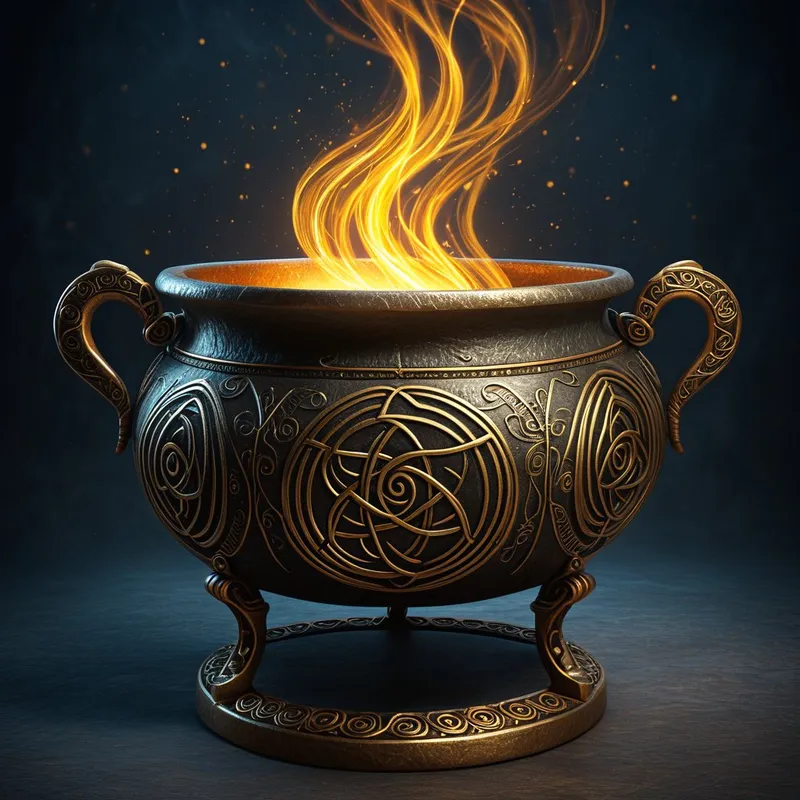
The Coire Ansic specifically symbolizes the psyche’s innate capacity for endless self-renewal. Its condition—that it will not nourish the cowardly—indicates that this inner abundance is not automatic. It must be activated by psychological courage, by the willingness to face one’s own “Fomorian” shadows of greed, scarcity, and despair. The Dagda, as its guardian, represents the integrated Self, the inner chieftain who manages and distributes these psychic resources wisely.
Conversely, the Cailleach’s cup represents a more direct, unmediated connection to the source. It bypasses the grand hall of the ego and offers sustenance directly from the deep unconscious—the cold, dark, yet infinitely fertile waters of the soul. One must go to her in a state of need, of wounding, to receive it. This is the symbolism of humble surrender as a path to renewal.
The Dreamer's Resonance
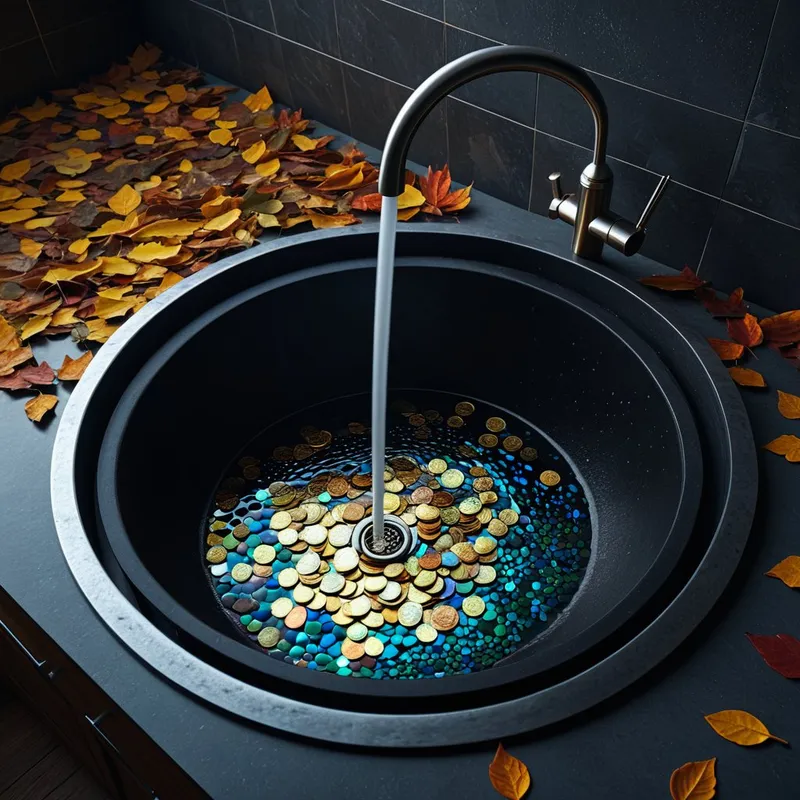
When the Cauldron of Plenty appears in modern dreams, it rarely manifests as a literal iron pot. Instead, one might dream of a kitchen sink that overflows with precious gems, a refrigerator that is perpetually full of strange, wondrous food, or a wallet that continues to produce money no matter how much is spent.
These dreams often surface during periods of perceived scarcity—not just financial, but emotional or creative. The psyche is presenting an image of its own underestimated abundance. The somatic feeling accompanying such a dream is crucial. If the dreamer feels anxiety or guilt about the endless flow, it points to a deep-seated belief that they do not deserve sustenance, that their inner “Fomorian” is poisoning the well. If the feeling is one of awe and gratitude, it signals an emerging alignment with the inner Dagda, a growing trust in the psyche’s regenerative powers. The dream is an invitation to examine what one is truly hungry for, and what virtues of heart one must cultivate to receive it.
Alchemical Translation
The myth’s journey is a perfect map for the alchemical process of individuation—the transformation of the base lead of a fragmented personality into the gold of the integrated Self.
The initial state is one of latent abundance (the cauldron in the Dagda’s hall). Then comes the nigredo, the blackening: the Fomorian assault, representing the eruption of shadow contents—greed, envy, a sense of lack—that seem to steal away our inner resources. We feel our plenty has been plundered. The battle is the painful but necessary separatio and mortificatio, where these shadow elements must be confronted and fought.
The treasure is always recovered, but never unchanged. It returns having been tempered by the struggle, its magic now understood not as a passive possession, but as an active relationship.
The humble drink from the Cailleach’s cup represents the albedo, the whitening. This is the moment of grace, of receiving sustenance directly from the Self when the ego is wounded and exhausted. It is the realization that true renewal comes not from heroic conquest alone, but also from humble surrender to a wisdom deeper than our own.
Finally, the recovered cauldron, now guarded with hard-won wisdom, symbolizes the rubedo, the reddening, and the creation of the philosopher’s stone. The individual achieves a state of conscious abundance. They become their own Dagda, the wise steward of an inner kingdom that endlessly regenerates. They understand that the cauldron’s magic works only when they are in right relationship with themselves and the world—when they offer their courage to the fire, so that it may, in turn, feed the soul.
Associated Symbols
Explore related symbols from the CaleaDream lexicon: