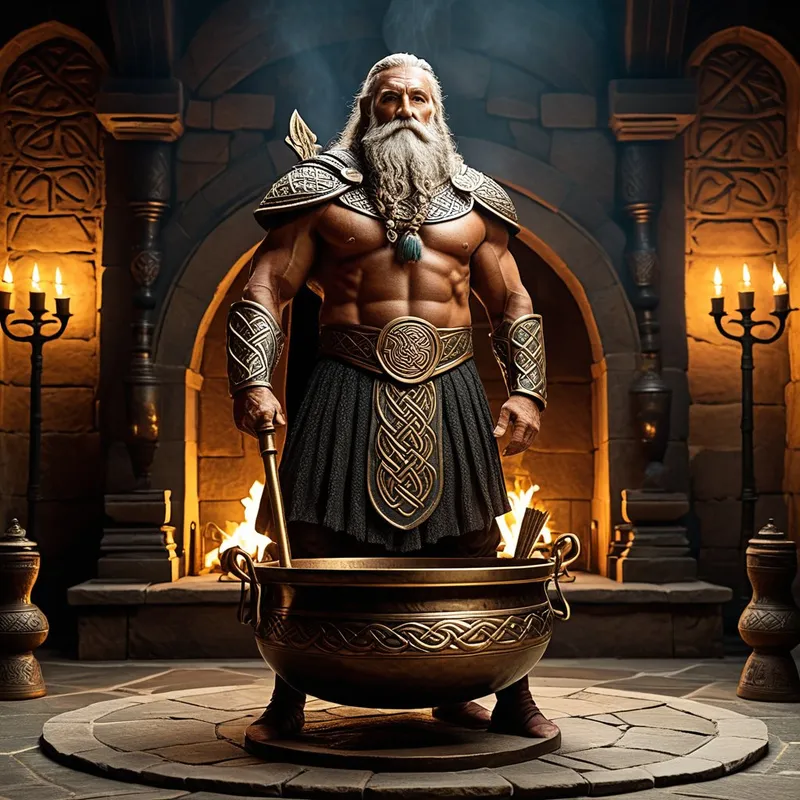
Cauldron of Dagda Myth Meaning & Symbolism
The myth of the Dagda's bottomless cauldron, a vessel of inexhaustible plenty and restoration, symbolizing the boundless generosity of the divine.
The Tale of Cauldron of Dagda
Listen, and let the firelight carve the shadows as I tell of a time when the world was younger, and the Tuatha Dé Danann walked the green hills of Éire. The air then was thick with magic, and the greatest among them was the Dagda. He was no slender youth, but a giant of a being, his belly a drum of laughter, his heart as wide as the sky. He carried a club so heavy one end could slay nine men, while the other could restore them to life.
But of all his treasures, none was more beloved than his Cauldron.
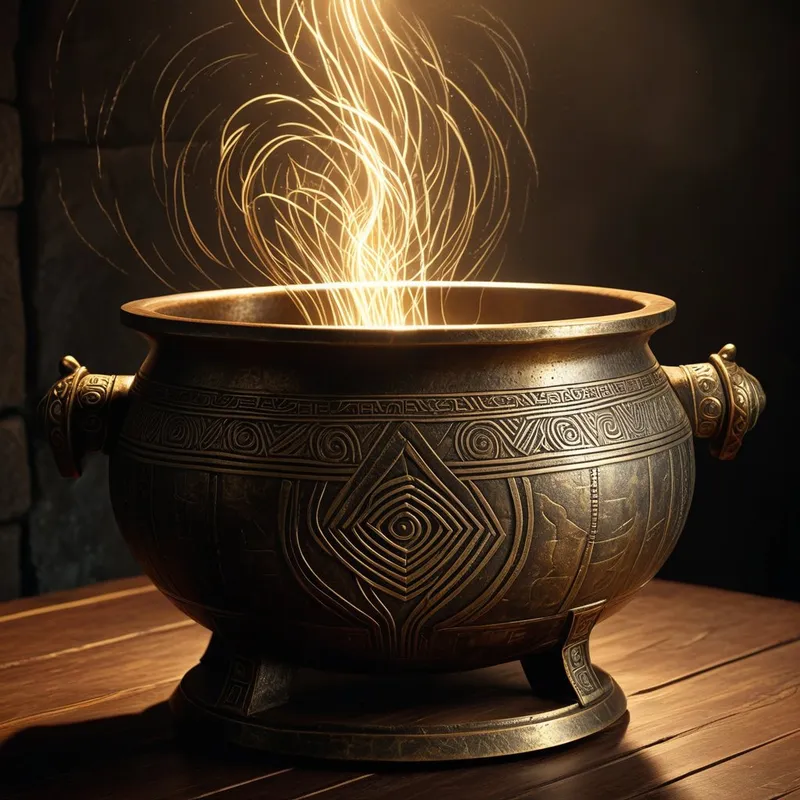
It was no ordinary pot. It was the Coire Ansic, the “Undry,” the Cauldron that was never empty. It rested in his great hall, a vessel of ancient bronze, wide and deep. Its surface held the memory of countless fires. No one was ever turned away from the Dagda’s hearth. When the hosts of the Tuatha Dé gathered, weary from shaping the land or skirmishing with the Fomorians, they came to his fire.
And what a sight it was! The Dagda, with his great ladle, would stir the depths. The steam that rose was not mere vapor; it was the scent of earth after rain, of ripe barley, of roasting pork and simmering herbs—all scents at once. From that cauldron, he would ladle out a rich, sustaining stew. Warrior and poet, smith and seer, each would receive a portion. And no matter how many came, no matter how deep the ladle plunged, the cauldron’s bounty never diminished. It gave until all were satisfied, until hunger was a forgotten ghost, and companionship was the true feast.
It was more than food. A warrior, wounded in spirit from battle, could drink from its brim and feel a warmth seep into his bones, not just mending flesh but soothing the frayed edges of his courage. It was a vessel of absolute abundance, a promise carved in bronze: in this hall, under this king’s care, you will not want. You will be filled. You will be whole.

Cultural Origins & Context
This myth emerges from the rich oral tradition of early Ireland, preserved by the filid, the poet-seers who were the keepers of history, law, and sacred story. The Dagda’s cauldron is listed among the Four Treasures of the Tuatha Dé Danann, artifacts that symbolize the sovereignty and divine right of this tribe of gods. These stories were not mere entertainment; they were the psychic and social bedrock of a culture deeply intertwined with the land, cycles of plenty and scarcity, and the responsibilities of kingship.
The cauldron myth functioned on multiple levels. Societally, it modeled the ideal of the rí, the king whose generosity ensured the fertility and stability of his people. A true ruler was a “cauldron” for his tribe. Spiritually, it spoke to a worldview where the Otherworld—the realm of the Aos Sí—was a place of eternal feasting and youth, a direct contrast to mortal limitations. The cauldron was a tangible link to that inexhaustible realm of divine grace, brought into the mortal world by a god who embodied paternal, nurturing strength.
Symbolic Architecture
The Cauldron of the Dagda is a supreme symbol of the vessel. It is the womb of the world, the crucible of transformation, and the hearth of the community all in one. Psychologically, it represents the boundless, unconditional aspect of the Self—the part of the psyche that can hold, contain, and transform all experiences without being depleted.
The true cauldron is not what is consumed, but the endless capacity to give form to nourishment.
The Dagda himself embodies the archetype of the nourishing father, a counterpoint to the distant, sky-father tyrant. His power is not in domination, but in provision; his club destroys only to make way for restoration. The cauldron’s “bottomlessness” symbolizes a psychic state beyond the economy of scarcity—the fear that there is not enough love, time, energy, or worth. It is the mythic answer to the anxiety of lack, asserting that at the core of being is a generative, replenishing source.
Furthermore, the cauldron’s act of restoration is key. It doesn’t just feed; it heals. This points to the symbolic function of imbas, the sacred wisdom or inspiration that “re-cooks” the fragmented soul, returning it to a state of integrity.
The Dreamer’s Resonance
When the image of this cauldron surfaces in modern dreams, it often appears during a period of profound emotional or spiritual depletion. The dreamer may be experiencing burnout, a sense of inner poverty, or a longing to be cared for at a fundamental level. The cauldron in a dream is rarely dramatic; it is often a quiet, potent presence—a simple pot on a stove, a bowl in a empty room, a forgotten well.
Somatically, this dream pattern correlates with a deep need for containment and nurturance. The body may be signaling exhaustion, a craving for wholesome sustenance, or a feeling of being “un-fed” by one’s own life. Psychologically, the dream is an intervention from the unconscious, presenting the symbol of the undepletable source. It asks: Where have you been drawing from a shallow well? What part of you believes you must earn your right to be filled? The cauldron dream invites the dreamer to identify and reconnect with their own inner Dagda—the part capable of self-nourishment and unconditional self-regard.

Alchemical Translation
The alchemical journey is one of transmutation: turning leaden despair into golden consciousness. The Cauldron of Dagda is the vas philosophorum, the philosophical vessel, in which this work occurs. For the modern individual pursuing individuation—the process of becoming a whole, integrated Self—the myth models a crucial stage: the cultivation of inner abundance.
The first step is recognizing one’s own “Fomorian” forces: the inner critics, the fears of scarcity, the poverty mindset that plunders one’s energy. The conflict is internal. The Dagda’s response is not to battle these forces with the club’s deadly end, but to use its restorative end. That is, the work is not annihilation of the “negative” parts, but their invitation to the hearth. The alchemical process requires bringing all parts of the psyche—the wounded, the greedy, the ashamed—into the containing space of the cauldron (awareness and compassion).
Individuation is the art of becoming your own cauldron-keeper, learning to stir the depths of your experience until every exiled part of you is fed and welcomed home.
The “food” that is endlessly produced is the substance of self-acceptance and meaning. The act of continual ladling out is the practice of generosity towards oneself and others, which paradoxically refills the source. The triumph of the myth is not a heroic conquest, but a sustained state of gracious plenty. To integrate this myth is to move from a psychology of scarcity to one of soul-deep sufficiency, where one’s core identity is not the hungry seeker, but the generous, unshakable vessel from which life itself is continually replenished.
Associated Symbols
Explore related symbols from the CaleaDream lexicon: