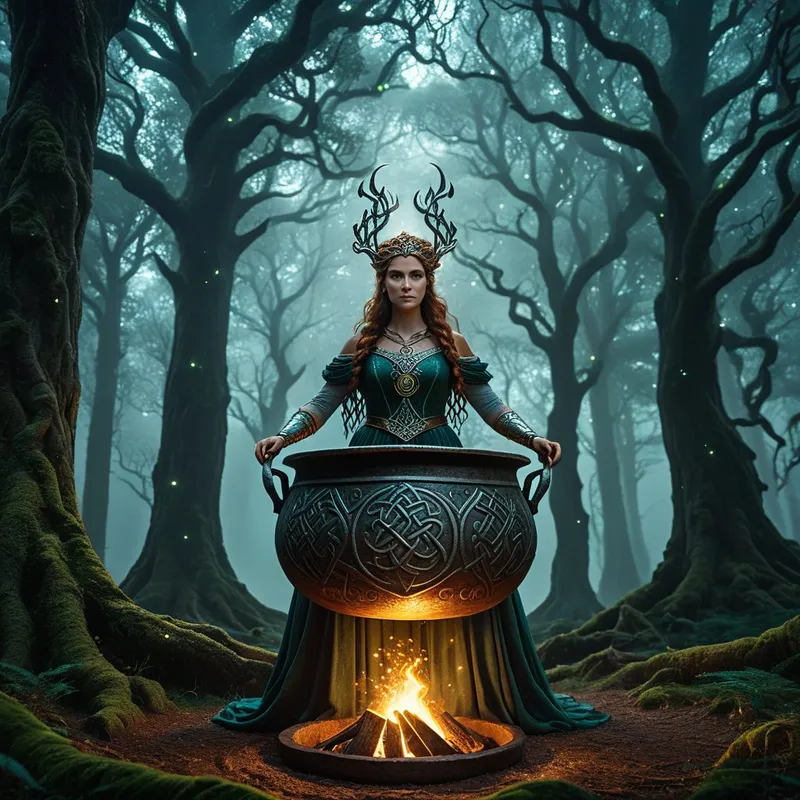
Cauldron of Cerridwen Myth Meaning & Symbolism
A goddess brews a potion of ultimate wisdom for her son, but a servant boy tastes it instead, triggering a chase of profound, shapeshifting transformation.
The Tale of Cauldron of Cerridwen
Listen, and let the mist of Gwynedd gather around you. In a time when the world was younger and the veil between the seen and unseen was thin as a spider’s silk, there lived a goddess of the deep earth and the dark moon. Her name was Cerridwen, and her heart held a mother’s fierce, desperate love for her son, Morfran. He was not blessed with fair form or a quick mind, and in a world that prized both, Cerridwen resolved to brew for him the ultimate gift: the gift of Awen.
She gathered the rarest herbs, plucked at specific phases of the moon, and waters from sacred springs that remembered the first dawn. For a year and a day, the great iron Cauldron must bubble over a fire stoked with the breath of intent. Three drops alone, she knew, would hold the concentrated essence of all wisdom, all knowledge, and the spirit of prophecy. To tend this sacred fire and stir the potent brew, she set a blind man named Morda to the fire, and a young boy, Gwion Bach, to stir the cauldron without cease.
The air in the hidden hut grew thick with the scent of loam, ozone, and something older than names. Gwion’s arms ached, his eyes stung from the steam that coiled like serpents from the cauldron’s mouth. The brew hissed and spat, a universe of potential contained in blackened iron. At the precise moment the year and a day ended, the potion erupted. Three blazing drops, hotter than the sun’s heart, leapt from the cauldron and landed upon Gwion’s thumb. Instinctively, he thrust his thumb into his mouth to cool the burn.
In that instant, the world shattered and reassembled. The past, present, and future unfolded before him like a vast, living tapestry. He heard the songs of the stars and the whispers of stones. He knew. He knew he had consumed the Greal, and he knew the wrath of Cerridwen would be swift and terrible. Fleeing the hut, he felt the new power surge within him—the first gift of the Awen was the gift of shapeshifting.
And so the great chase began. Hearing his crime, Cerridwen’s fury shook the roots of the mountains. Gwion became a hare, swift and desperate across the hills. Cerridwen became a greyhound, faster than the north wind. He plunged into a river as a salmon, sleek and silver. She dove after him as an otter, relentless. He took to the air as a tiny wren. She followed as a sharp-eyed hawk. Exhausted, seeing a barn piled high with winnowed wheat, Gwion transformed one last time—into a single grain among millions.
Cerridwen, the hawk, landed on the threshing floor. In her final, terrible transformation, she became a sleek, black hen. She pecked and scratched, grain by grain, until she found him. She swallowed the grain that was Gwion Bach.
But the story does not end in digestion; it ends in gestation. Within her, the seed of Gwion, now imbued with the Awen, grew. Nine months later, Cerridwen gave birth to a radiant, beautiful boy. She could not kill him, for his beauty was a light she could not extinguish. Instead, she placed him in a leather bag and set him adrift on the sea. He was found, raised, and would become the greatest of all Welsh bards: Taliesin, whose songs would shape history and whose wisdom would flow from him like an endless spring.

Cultural Origins & Context
This myth comes to us from the late-medieval Welsh text, the Hanes Taliesin (“The Tale of Taliesin”). While recorded in a Christian era, its bones are palpably older, echoing the oral traditions of the pre-Christian Brittonic Celts. It is a bardic tale, meant to be performed, to explain the origin of the supreme poetic genius. In a culture where the bard held a position akin to priest, historian, and law-keeper, the myth served a crucial societal function: it sacralized the source of inspiration (Awen). It declared that true wisdom is not merely learned; it is stolen from the divine, paid for with a terrifying ordeal of transformation, and ultimately requires a symbolic death and rebirth. The tale legitimized the bard’s authority, framing him not just as a skilled poet, but as one who has undergone a mystical, initiatory journey.
Symbolic Architecture
At its heart, this is not a simple morality tale but a profound map of the psyche’s journey toward wholeness. The Cauldron is the womb of the unconscious, where raw, undifferentiated potential—the prima materia of the soul—is cooked into conscious form. Cerridwen is the Great Mother in her dual aspect: the nurturing creator who initiates the process for love of her child (the undeveloped self), and the devouring, transformative force that pursues the ego (Gwion) when it presumes to take the treasure for itself.
The wisdom that transforms the soul is never given freely; it must be taken, and the taking incites the necessary crisis.
Gwion’s ingestion of the three drops represents the ego’s accidental, yet fateful, encounter with the Self—the totality of the psyche. This forbidden knowledge shatters his old, servile identity. The shapeshifting chase is the psyche’s desperate attempt to flee the integrating power of the unconscious (Cerridwen) through a series of personas and disguises (the animals). Each transformation is an attempt to outrun the inevitable assimilation. His final form as a grain signifies a reduction to the essential seed, the core identity, which is then swallowed by the very force from which he fled. This is not destruction, but the ultimate containment within the transformative vessel.
The Dreamer’s Resonance
When this myth stirs in modern dreams, it often signals a profound initiatory crisis. To dream of being pursued by an immense, feminine force through changing landscapes suggests the dreamer’s conscious attitude is being hunted by contents of the unconscious that demand integration. The chase is somatic—it feels urgent, visceral, inescapable.
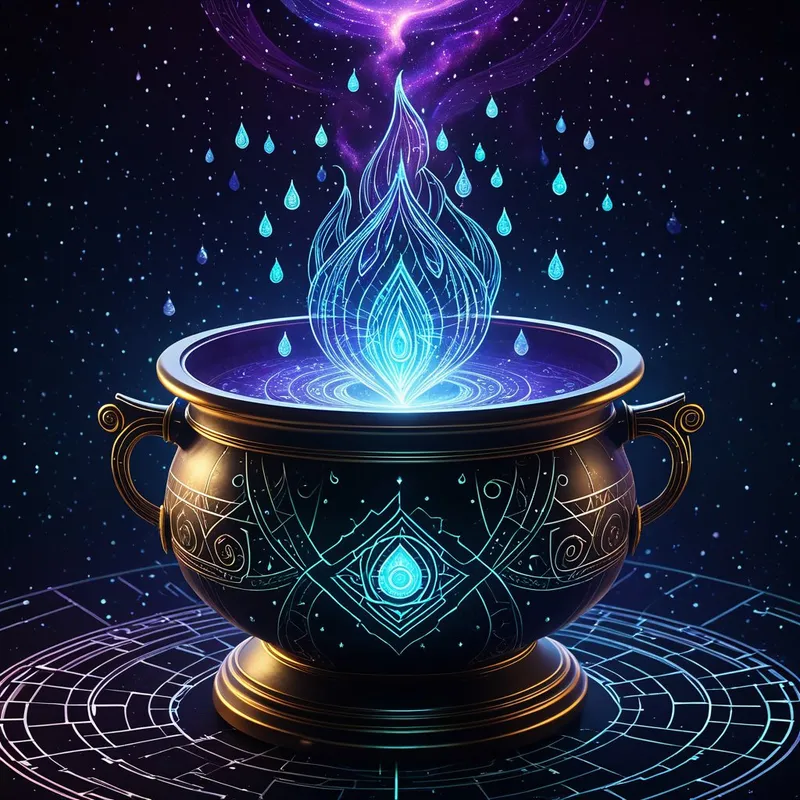
Dreaming of a bubbling pot, a transformative brew, or accidentally consuming something forbidden points to an unconscious process nearing completion. A new understanding, a “wisdom,” is preparing to erupt into consciousness, and the dream-ego is both its destined recipient and its terrified victim. The shapeshifting reflects a felt sense of identity instability, where old roles (the hare, the salmon, the wren) no longer hold, and the psyche is fluidly searching for a new form. The dream may culminate in a sense of being consumed or enclosed in a dark, tight space—the leather bag or the belly of the goddess—which, upon waking, is not recalled with horror, but with a strange, solemn sense of necessity. It is the somatic signature of a psychic death preceding rebirth.
Alchemical Translation
The myth of Cerridwen’s Cauldron is a perfect allegory for the alchemical process of individuation. The initial gathering of ingredients is the nigredo—the confronting of one’s base nature and shadow. The year and a day of brewing is the albedo, a long, patient purification in the white heat of introspection and suffering.
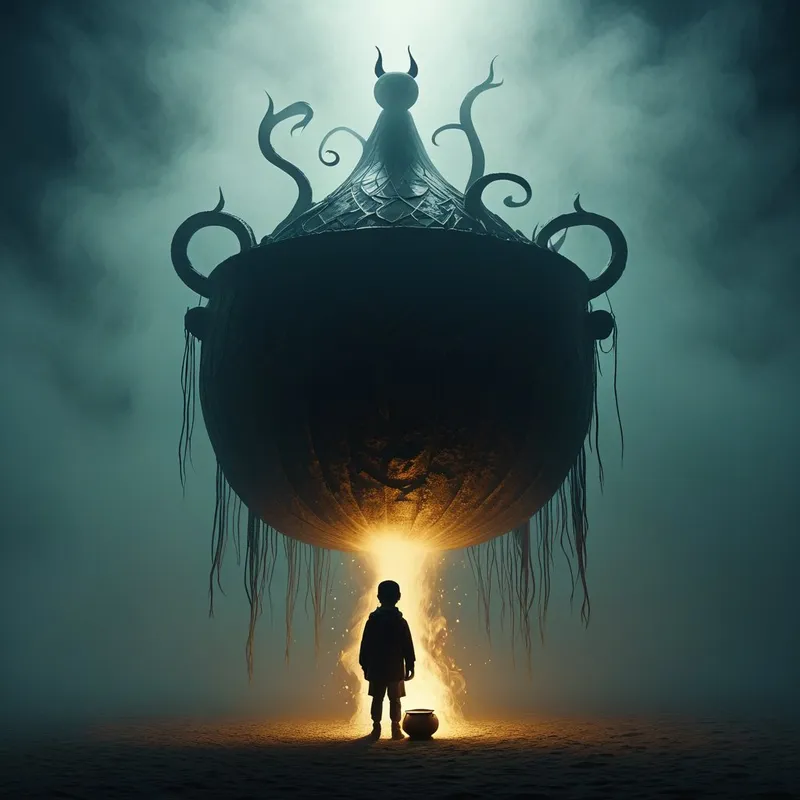
Gwion’s tasting of the drops is the citrinitas, the dawning of the “yellowing” or illumination, where a flash of Self-knowledge strikes the ego. This immediately triggers the chase, the rubedo or reddening, which is the fierce, passionate struggle where the ego is broken down and reconstituted. The ego’s resistance (the shapeshifting) is a necessary part of the work.
The servant must be consumed by the goddess to be reborn as the bard. The ego must surrender to the Self to gain its true voice.
Finally, the gestation and rebirth as Taliesin is the creation of the lapis philosophorum, the philosopher’s stone. The flawed, ignorant boy (the lead of the unexamined life) has, through a terrifying ordeal of being pursued, consumed, and gestated by the transformative feminine principle, been transmuted into the radiant, eloquent bard (the gold of the realized individual). The modern individual walking this path does not seek to become a literal poet, but to speak from a place of authentic, hard-won wisdom. The cauldron’s brew is the transformative agony and ecstasy of becoming who one truly is, a process that always feels, at some point, like a theft from the gods, a desperate flight, and a glorious, singing rebirth.
Associated Symbols
Explore related symbols from the CaleaDream lexicon: