Castle of Otranto Myth Meaning & Symbolism
A tyrant's usurped castle is haunted by a colossal ancestral specter, demanding the restoration of a true heir and the collapse of a corrupt lineage.
The Tale of Castle of Otranto
Hear now the tale of stone and sigh, of a house built upon a lie. In the land of Otranto, a fortress clawed at the sky, its towers like accusations, its halls echoing with the silence of a stolen throne. Its lord was Manfred, a prince of poisoned blood, whose lineage was a rusted chain linking back to a crime of usurpation. His grandfather had stolen the castle, and now Manfred sought to secure his stolen reign by wedding his sickly son, Conrad, to the fair Isabella, daughter of a neighboring lord.
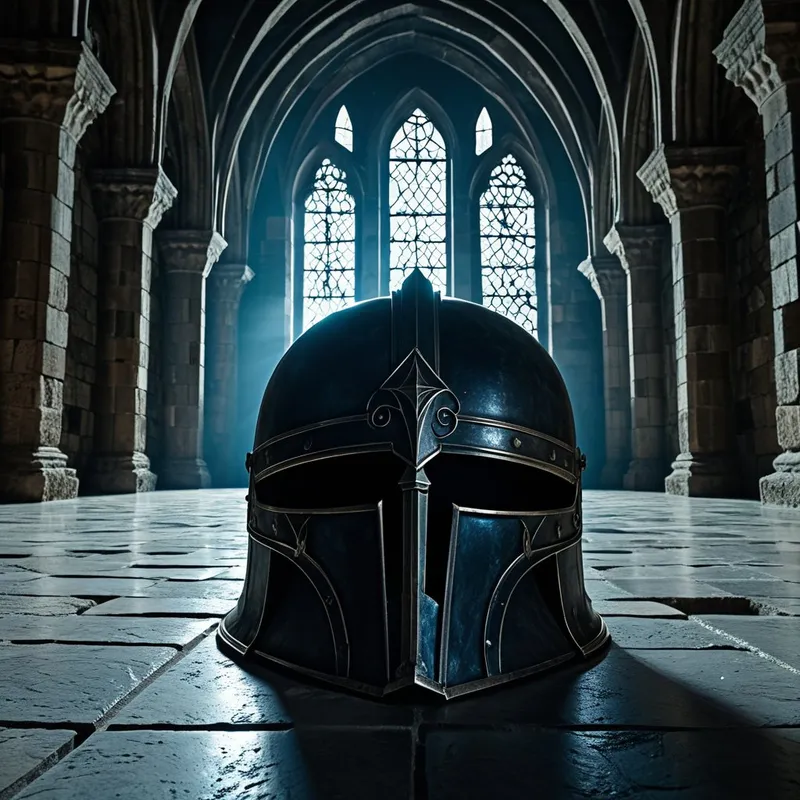
But on the very day of the wedding, as the cold sun climbed, fate delivered a portent of stone. Conrad was found in the courtyard, crushed beneath a monstrous helmet of black iron, fallen from the sky—or so it seemed—a helmet so vast it belonged to a giant of legend. Manfred’s ambition, brittle as old bone, did not break but twisted. In his terror and greed, he cast aside his pious wife, Hippolita, and declared he would wed Isabella himself, to beget a new heir and seal his claim with fresh, living mortar.
Thus began the haunting. The great castle itself became a living antagonist. Doors groaned shut of their own accord. A portrait of Manfred’s grandfather sighed and stepped down from its frame. From the depths of the fortress, a humble peasant, Theodore, emerged, his noble bearing belying his rags, his very presence a thorn in Manfred’s side. As Manfred pursued the fleeing Isabella through vaults and secret passages, the very stones conspired against him. The giant helmet reappeared, a silent judge. The colossal statue of the castle’s true founder, Alfonso the Good, wept tears of stone.
The air grew thick with the past’s unquiet breath. Manfred’s daughter, Matilda, whose heart was pure and whose love for Theodore was a gentle flame in the pervasive gloom, became entangled in her father’s web of sin. In a final, tragic confusion within the shadowy chapel, Manfred, believing he struck at Isabella, plunged a dagger into his own daughter’s heart. As Matilda’s life bled out upon the sacred floor, the great walls of Otranto shook to their foundations.
From the ruins of his own making, the final revelation thundered. The giant spectral form of Alfonso the Good materialized, shattering the castle’s battlements. His voice was the sound of crumbling mountains. He proclaimed Theodore, the peasant youth, as his true descendant and heir. The usurper’s line was ended. Manfred, broken, renounced his stolen crown and retreated to a monastery, his worldly power dust. The castle of Otranto, its corrupt shell broken, yielded to its rightful lord, its haunting ceased, and the colossal specter dissolved into the light of a dawn long delayed.
Cultural Origins & Context
This foundational myth sprang not from ancient oral tradition, but from the quill of Horace Walpole in 1764. Its "culture" is the nascent world of Gothic Literature, a literary movement born in an age of Enlightenment reason that consciously reached back into the shadows of the medieval, the supernatural, and the emotionally extreme. Walpole presented the tale as a discovered manuscript, a "found myth," tapping into a burgeoning fascination with the past as a place of mystery and terror.
The societal function of this new myth was complex. It served as a thrilling escape from the rigid order and rationality of the 18th century, offering a sanctioned space to explore forbidden emotions—terror, awe, hysterical grief. Furthermore, it acted as a narrative pressure valve for anxieties about lineage, property, and legitimacy in a still-feudalistic society. The crumbling castle became a potent symbol for the perceived decay of old aristocratic orders and the terrifying, awe-inspiring return of repressed historical truths. It was passed down not by bards, but by printers and circulating libraries, creating a new, reading public hungry for sensational, soul-stirring narrative.
Symbolic Architecture
The myth of Otranto is not a ghost story, but a story of being haunted by the structural sins of the past. The castle is the primary symbol—it is the psyche itself, built upon a faulty foundation. Manfred represents the usurping ego, a personality structure founded on a lie (the repressed crime of the ancestor). His desperate attempts to fortify his position—through forced marriage, tyranny, and violence—are the psyche’s neurotic defenses, which only summon the haunting more powerfully.
The ancestral crime is the unlived life, the disowned truth, of the lineage. It grows in the dark, until it assumes colossal proportions and demands recognition.
The colossal helmet and the spectral Alfonso are manifestations of the shadow and the archetype of the True King. They are not external ghosts, but the psychic reality of usurped order, which will eventually erupt with tectonic force. Theodore symbolizes the legitimate, integrated Self, hidden in plain sight (the peasant disguise), who can only be restored after the corrupt, conscious structure (Manfred’s rule) is utterly broken. Matilda’s death is the tragic sacrifice of innate purity and potential (the anima) required when the tyrannical ego acts in blind, defensive panic.
The Dreamer's Resonance
When this myth patterns a modern dream, the dreamer is undergoing a profound somatic and psychological process of confronting a "haunted legacy." This is not literal ancestry, but the inherited psychic structures—family narratives, core beliefs, traumatic patterns—upon which one’s identity castle is built.
Dreaming of endless, collapsing corridors (Isabella’s flight) speaks to a feeling of being trapped in labyrinthine defense mechanisms, fleeing a pursuing force of oppressive, outdated self-concepts. The appearance of a gigantic, out-of-place artifact (the helmet) in a familiar setting signals the intrusion of a massive, previously unconscious truth or trauma into conscious life, threatening to crush the current, fragile identity. The dreamer may feel the walls of their reality literally shaking—a somatic experience of deep anxiety as the foundational lies of the psyche are challenged. This dream state is the psyche’s initiation into its own Gothic novel, where the only way out is through the complete deconstruction of the false self.
Alchemical Translation
The alchemical process modeled here is nigredo, followed not by a gentle synthesis, but by a cataclysmic shattering. The myth charts the individuation journey of confronting a personality built on usurpation—of one’s own true nature, of another’s place, of a denied truth.
- The Recognition of the Haunting (Calcinatio): The falling helmet. The conscious life is struck by a symptom—anxiety, depression, a repeating failure—that reveals the structure is unsound. The "stone" of the hardened ego is heated by the fire of suffering.
- The Descent and Pursuit (Mortificatio): The flight through the vaults. The ego (Manfred) desperately pursues the elusive, life-giving force (Isabella/animus, or the true Self) deeper into the unconscious, trying to possess it for its own ends. This leads only to greater entanglement and shadow-work.
- The Tragic Sacrifice (Separatio): The death of Matilda. The cherished, innocent self-image or a pure but naive potential must be sacrificed. This is the most painful stage, where the ego’s final, violent defense results in the loss of something precious, creating the necessary void.
- The Cataclysmic Revelation (Sublimatio): The apparition of Alfonso and the castle’s collapse. The repressed archetypal truth erupts, destroying the old, corrupt structure entirely. This is not a gentle integration, but a forceful restoration of right order from the rubble.
- The Renunciation and Restoration (Coagulatio): Manfred’s retreat, Theodore’s ascension. The usurping ego, its energy spent, must renounce its illegitimate authority. From the ruins, the latent, authentic Self (Theodore) is recognized and empowered to rule the reconstructed inner kingdom. The haunting ceases because the truth is now conscious, and the psyche is aligned with its own legitimate sovereignty.
The castle must crumble for the true king to be crowned. Individuation is not a renovation, but often a necessary ruin.
Associated Symbols
Explore related symbols from the CaleaDream lexicon: