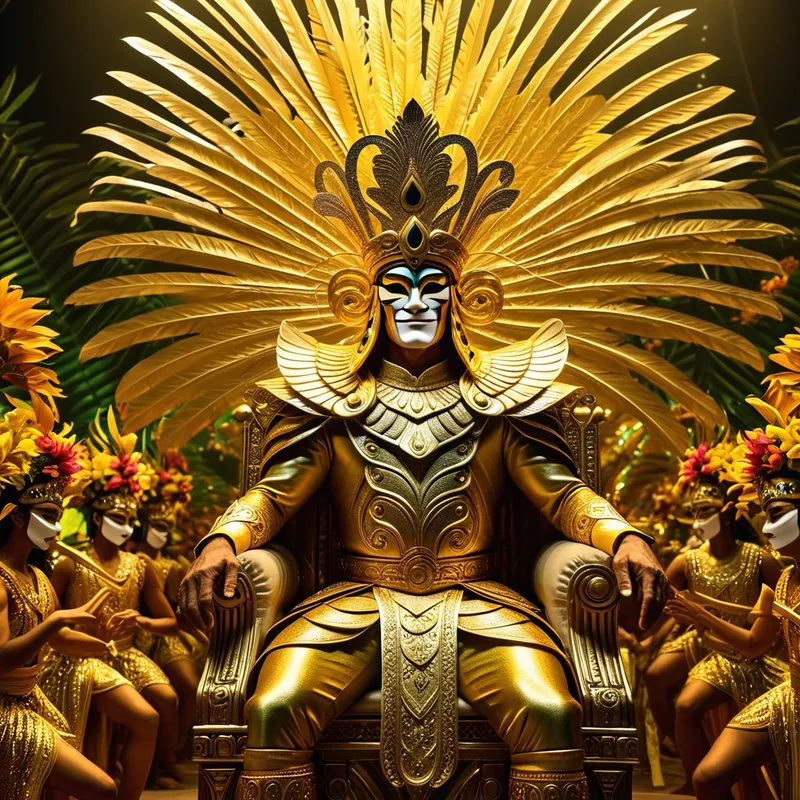
Carnaval Myth Meaning & Symbolism
A mythic tale where the world dissolves into a sacred, chaotic dance of masks, only to be reborn through a single, authentic heartbeat.
The Tale of Carnaval
Listen. There is a time that is not a time, a space between the breaths of the world. It is the three days when the great clockwork of the cosmos winds down, and the gears of fate grow still and silent. In this pregnant pause, the King of Chaos awakens.
He is called Rei Momo, and his throne is not of stone, but of the collective sigh of a year’s burdens. With a laugh that shakes the foundations of the everyday, he lifts his scepter—a giant golden pineapple—and strikes the ground. The blow does not crack the earth; it cracks reality. The rigid lines between slave and master, pauper and king, man and woman, human and beast, begin to blur and run like wet paint.
From this crack pours the music. It is not a single rhythm, but the primordial heartbeat of the world itself, born from the fusion of thundering Atabaques, the mournful cry of the Berimbau, and the soaring promise of brass. The sound is an invocation. It calls the people from their homes, not as they are, but as they dream to be. They do not walk; they are pulled by the current of the beat into the streets, which have become the arteries of a waking, dancing god.
And here, the sacred act: the donning of the Mask. Not to hide, but to reveal. The shy woman becomes a glittering Iara, her movements fluid and commanding. The tired laborer straps wings to his back and becomes a majestic Galo de Campina, strutting with pride he never shows by daylight. The stern judge dances as a sly, grinning Saci-Pererê, causing gentle mischief. For three days and nights, the world is a grand, cosmic masquerade where every suppressed laugh, every stifled tear, every secret desire is given a costume and a dance step.
But as the final night deepens, a strange fatigue seeps into the bones of the revel. The laughter grows ragged. The glitter on the masks begins to flake away. The relentless beat, once liberating, now feels like a demand. The chaos that was freedom threatens to become a vortex of exhaustion. The world hangs in balance, a beautiful, spinning plate on the verge of shattering.
Then, in the grey light of the fourth dawn, as the last note fades into the hum of the city, a singular event transpires. No one sees who does it first. Perhaps it is the woman who was Iara, or the man who was the Galo. One by one, in the littered silence of the avenue, they reach up. With a touch that is neither triumphant nor sad, but profoundly tender, they remove their masks. They lay them gently on the ground—a sea of papier-mâché, feathers, and sequins staring blankly at the rising sun. The naked face revealed is not the old face from three days past. It is softer, wearier, but with a quiet light in the eyes that was not there before. In that collective, unmasked breath, the world clicks back into place—not as it was, but renewed. Order returns, but it is an order that has remembered the taste of chaos. The King of Chaos, Rei Momo, smiles in his sleep, his work complete until the gears of time wind down once more.
Cultural Origins & Context
The myth of Carnaval is not inscribed on ancient papyrus but is written annually on the streets of Brazil, a living narrative woven from a triple-helix of cultural memory. Its deepest roots tap into the pre-Lenten Carnevale traditions of Portuguese colonizers—a final burst of feasting before the austerity of Lent. Yet, this European seed was planted in fertile, complex soil.
It was irrevocably transformed by the profound cosmologies of enslaved Africans, particularly the Yoruba, who saw in the inversion of roles and the ecstatic dance not mere revelry, but a sacred state of being. The drum, the circle, the possession by rhythm—these were pathways to the divine, to the Orixás. The indigenous Tupi-Guarani peoples contributed their own sense of ritualistic adornment, connection to animal spirits, and ceremonies of communal renewal. Carnaval became the great Brazilian synthesis: a societal pressure valve, a sacred parody of power structures, and a breathtaking act of cultural resilience. It was told not by a single bard, but by millions of feet moving in samba, by hands sewing costumes, by voices raised in marchinha songs full of social satire. Its function was, and is, cathartic—a scheduled, spectacular dissolution that prevents a more dangerous, unscheduled one.
Symbolic Architecture
At its core, the myth of Carnaval is a grand ritual of enantiodromia—the Jungian principle where an extreme state inevitably generates its opposite. The rigid, structured "world" must, for its own health, plunge into its antithesis: chaos, fluidity, and disguise.
The mask is not a lie told to the world, but a truth told by the soul in a language the waking self has forgotten.
The Rei Momo represents the archetypal force of the Trickster and the Jester. He is the necessary psychic function that dismantles calcified ego structures. The "three days" symbolize a liminal space—a temenos or sacred container—where normal rules are suspended for the purpose of transformation. The music is the irresistible call of the unconscious, the libidinal energy that cannot be permanently suppressed.
The central symbol, the Mask, holds profound duality. It is both a liberation and a confrontation. It allows the wearer to safely project a disowned part of themselves—the seductress, the warrior, the trickster (the Shadow). By dancing as this shadow, one dialogues with it, integrates its energy, and drains its compulsive power. The climactic unmasking is not a return to a "true" self, but the creation of a new, more whole self that has acknowledged and experienced its hidden facets.
The Dreamer's Resonance
When the myth of Carnaval erupts in modern dreams, it signals a psyche at a threshold. To dream of being swept into a chaotic, magnificent parade suggests the unconscious contents are rising, demanding expression. The dreamer may feel overwhelmed by emotions or impulses they normally keep tightly managed.
Dreaming of frantically searching for a mask, or of a mask that won't come off, points to a rigid persona—the social face has become a prison. The dream-ego feels it cannot show its authentic face to the world, or perhaps even to itself. Conversely, dreaming of wearing a mask that feels "more real" than one's own face indicates a powerful, emerging aspect of the personality seeking recognition.
The most potent resonance is the dream of the aftermath: standing alone in the quiet, littered street at dawn. This somatic state is one of post-cathartic integration. The psyche has undergone a necessary storm. The dreamer is in a state of fragile, raw openness, having shed an old skin. The feeling is not of happiness, but of poignant clarity and deep fatigue—the fertile ground from which a new attitude toward life can slowly grow.
Alchemical Translation
The Carnaval myth is a perfect map for the alchemical process of Individuation. It models the terrifying and necessary journey from persona to Self.
The first stage, Nigredo (the blackening), is represented by the dissolution of ordinary order by Rei Momo. In our lives, this is the crisis, the depression, the feeling that everything solid is melting. It is the invitation—often forceful—to descend into our personal chaos.
The parade itself is the Albedo (the whitening). Here, in the dance of masks, we consciously engage with our fragments. We "try on" our anger as a fierce warrior, our sensuality as a deity, our foolishness as a clown. This is not random escapism, but a sacred play with the contents of the unconscious, allowing them conscious expression in a contained space.
The ultimate goal is not to live in the endless parade, but to internalize its music so thoroughly that you can hear its rhythm in your own, unmasked heartbeat.
The final unmasking at dawn is the Rubedo (the reddening), the culmination. It is the integration. One does not become the mask; one assimilates its essence. The energy of the warrior, the deity, the clown is withdrawn from the external costume and brought inward. The revealed face is new—it carries the memory of the dance but is no longer possessed by it. The individual returns to the structured world, but now that structure is inhabited by a soul that has tasted its own boundless, chaotic potential. The order they now uphold is chosen, conscious, and resilient, because it has willingly passed through the fire of its own opposite. The myth teaches that wholeness is not achieved by avoiding chaos, but by ritually, courageously, dancing with it.
Associated Symbols
Explore related symbols from the CaleaDream lexicon: