Caput Mortuum Myth Meaning & Symbolism
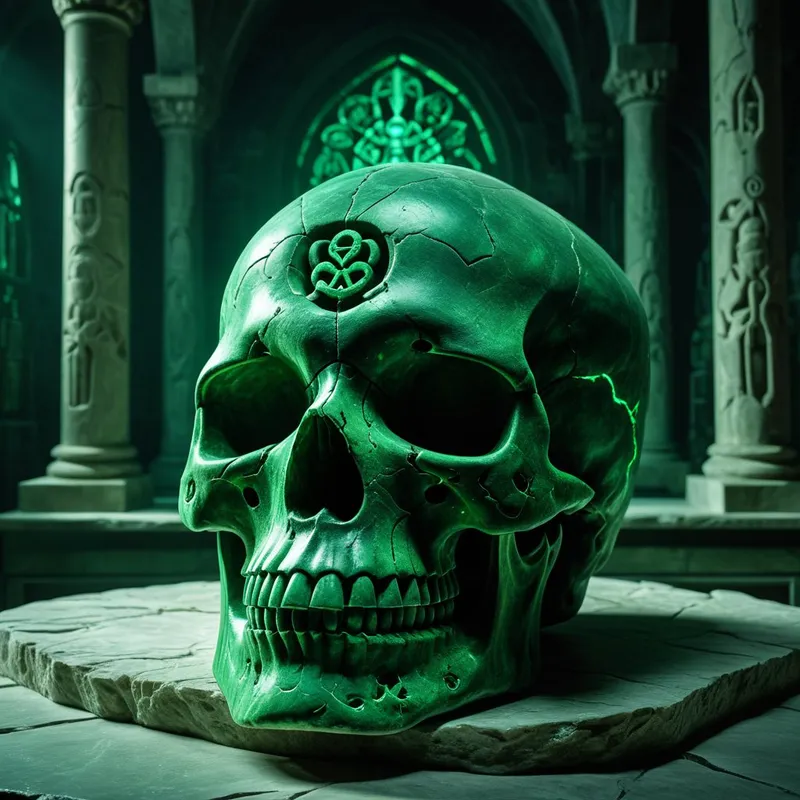
The myth of the death's head, the worthless residue left after the prima materia's initial dissolution, representing the necessary death of the old self.
The Tale of Caput Mortuum
Listen, and hear the tale not of a beginning, but of an ending. In the silent heart of the oratory, where the air is thick with the scent of salt and sorrow, the Work begins. The Prima Materia—once a thing of potential, a seed containing all worlds—rests in the crucible. It is not noble, not gold, but the raw stuff of being itself, heavy with forgotten dreams and unshaped longings.
The fire is lit. Not a blaze of passion, but the slow, relentless heat of Nigredo. Watch now. The matter does not glow, does not transform into something beautiful. It sweats a black, acrid smoke. It convulses. It weeps strange, metallic tears that sizzle on the furnace floor. The alchemist, face drawn in the hellish light, does not turn away. They must witness the unmaking. Days bleed into nights as the substance rots from within, its colors fading to a uniform, dreadful grey, then to a black so deep it seems to swallow the firelight itself.
This is the death. The promise of the seed is broken open, and what pours out is not life, but cessation. The once-potent materia shrivels, cracks, and finally settles into a cold, silent heap. The fire dies down. In the ashes of the furnace lies only a lump of worthless, carbonized residue. It is inert. It is dead. It is the Caput Mortuum—the death’s head. The alchemist reaches into the cooling ashes and lifts this skull of the process. It is light, porous, and crumbles at the edges. A profound despair fills the chamber, for this was not the goal. This was the price. The Work, it seems, has ended in absolute, irrevocable failure. The first and greatest secret is learned in that silence: before the phoenix can rise, it must first be rendered to ash and forgotten.
Cultural Origins & Context
The myth of the Caput Mortuum is not a story told in taverns or sung by bards. It is a silent, practical truth passed between initiates in the oratory, encoded in the cryptic emblems of alchemical manuscripts like the Rosarium Philosophorum and the writings of figures such as Hermes Trismegistus. Its cultural function was initiatory and psychological. Alchemy was never merely proto-chemistry; it was a Ars Magna, a spiritual discipline for the transformation of the soul.
The tale served as a dire warning and a necessary comfort. It warned the novice against the expectation of quick, glorious results. The societal function was to inculcate the virtue of patientia. To witness the creation of the Caput Mortuum was to pass the first gate of the Work. It separated the dilettante, who would abandon the project in disgust at this "failure," from the true adept, who understood this death as the foundational, non-negotiable first step. It was a myth lived, not just heard, in the cold dawn after a long night of labor that yielded only blackened dross.
Symbolic Architecture
The Caput Mortuum is the ultimate symbol of Nigredo, the blackening. Psychologically, it represents the complete and often devastating deconstruction of the conscious personality—the ego. It is the residue left after our cherished identities, our inflated self-images, our compulsive behaviors, and our outdated life narratives are subjected to the inner fire of honest self-reflection or unavoidable crisis.
The Caput Mortuum is the proof of a death that has actually occurred. Without this worthless residue, no true transformation is possible; one has only rearranged the furniture in the old house.
The "death's head" is not the enemy, but the evidence. It symbolizes the spent husk of the old self, the psychic complexes that have been burned out and rendered inert. It is depression made concrete, the feeling of being a hollow, worthless shell after a profound loss or failure. Yet, in its very inertness lies its secret purpose: it is the sterile ground from which nothing of the old can ever grow again, creating the necessary vacuum for the new. It represents the materia prima in its state of maximum humility, which is the only state from which the divine seed can germinate.
The Dreamer's Resonance
When this myth stirs in the modern unconscious, it manifests in dreams not of monsters, but of profound emptiness and decay. One may dream of their childhood home reduced to a shell, full of dust and rotten floorboards. They may dream of brushing their teeth only to have them crumble into black powder, or of looking in a mirror to see their reflection fade into a featureless, grey stone.
Somatically, this process feels like a heavy inertia, a "dark night of the soul" where all motivation and meaning drain away. The dreamer is psychologically undergoing the Nigredo. The ego-structure is dissolving. The conscious mind interprets this as failure, depression, or existential crisis—the creation of the personal Caput Mortuum. The dreams are the psyche's way of presenting the evidence of this inner death. The critical task for the dreamer is not to "fix" it or resurrect the dead form, but to learn, as the alchemist did, to sit with the ashes. To acknowledge the death without rushing to bury it or declare a premature rebirth.
Alchemical Translation
The myth of the Caput Mortuum models the first and most terrifying phase of individuation: the confrontation with the Shadow and the voluntary sacrifice of egoic control. The modern individual seeks wholeness, but the path does not begin with adding light, skills, or positive attributes. It begins with a subtraction. It begins with allowing the hidden, rejected, and decaying parts of the self to come to the surface and be "cooked" in the vessel of awareness.
The alchemical operation shows us that our initial efforts at self-improvement often produce only this "death's head"—a sense of worse-than-uselessness. We try to change and end up feeling like a fraud, surrounded by the blackened residue of failed attempts. The myth instructs us that this is not deviation from the path; it is the path.
The gold is not hidden within the Caput Mortuum; it is made possible because of it. The death's head is the guarantee that the old, leaden state of being is truly finished.
The transmutation occurs when we stop trying to polish the dead skull and instead accept its finality. This acceptance is the ablutio that follows the Nigredo. From the sterile ground of the Caput Mortuum, washed by the waters of acceptance, the first tender shoots of the authentic self—the anima or animus—can finally emerge. The death’s head, therefore, is not a grave marker, but the first foundation stone of the true inner temple. It is the proof that one has had the courage to stand in the fire and let something die, which is the only beginning that matters.
Associated Symbols
Explore related symbols from the CaleaDream lexicon: