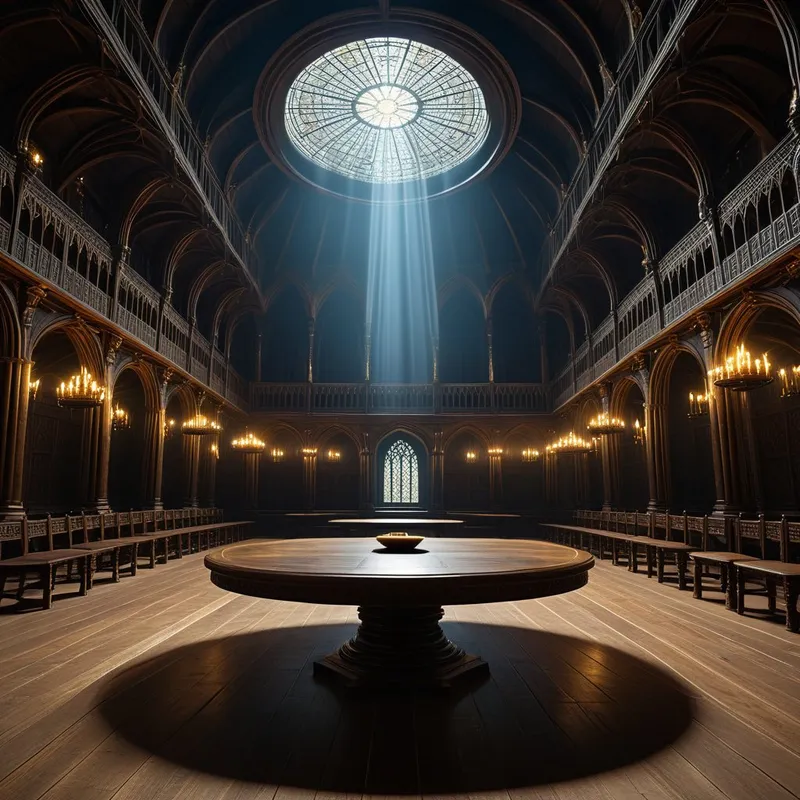
Camelot's Round Table Myth Meaning & Symbolism
A mythic symbol of unity and sovereignty, where knights gather as equals to pursue a sacred code, embodying the struggle for a perfected kingdom and self.
The Tale of Camelot’s Round Table
Hear now a tale not of a single hero, but of a fellowship forged in light and shadow. In [the mist](/myths/the-mist “Myth from Celtic culture.”/)-wrapped isle of Logres, there rose a citadel of impossible grace: [Camelot](/myths/camelot “Myth from Arthurian culture.”/). Its spires pierced the low-hanging clouds, and within its heart, a king dreamed a dream of order. He was Arthur Pendragon, born of [dragon](/myths/dragon “Myth from Chinese culture.”/)’s breath and human sorrow, his right to rule proven by [the sword in the stone](/myths/the-sword-in-the-stone “Myth from Global/Universal culture.”/). Yet a sword alone does not make a kingdom. A crown is but cold metal without a [covenant](/myths/covenant “Myth from Christian culture.”/).
The covenant was the Table. It came not from Arthur’s forges, but as a dowry of profound mystery from his queen’s father, a gift echoing with the wisdom of the old world. It was a vast disk of ancient oak, its surface polished by time to a deep, silent sheen. It had no head. It had no foot. Its geometry was a revolution. Here, Arthur gathered his champions—the flawed and the fierce, the pious and the passionate. [Sir Lancelot](/myths/sir-lancelot “Myth from Arthurian culture.”/) of the Lake, whose heart was a battlefield between love and loyalty. [Sir Galahad](/myths/sir-galahad “Myth from Arthurian culture.”/), whose eyes held the unearthly light of a destination. [Sir Gawain](/myths/sir-gawain “Myth from Arthurian culture.”/), bound by a code of courtesy that was both his armor and his shackle.
They came in clanking steel, their cloaks smelling of rain and road. They took their seats, not by rank or birth, but by the invisible gravity of their pledged souls. The air in the hall was thick with the scent of beeswax candles and ambition. The conflict was not one enemy at the gates, but the slow, insidious seep of human frailty into a perfect idea. The quest for the [Holy Grail](/myths/holy-grail “Myth from Arthurian culture.”/) was born here, a divine fever that would scatter the fellowship, testing each knight not against monsters, but against the reflection of his own soul in [the Grail](/myths/the-grail “Myth from Arthurian culture.”/)’s elusive glow.
The resolution was not a victory, but a resonance. The Table held them in unity even as their paths diverged into forest and wasteland. It was the fixed point in their turning world, the silent witness to oaths sworn and, tragically, broken. When the final darkness fell—borne on the wings of betrayal and kin-strife—the Table was emptied. But the echo of its shape, that perfect circle of intended equality, did not vanish. It passed into the breath of storytellers, a ghost of a possibility: that for a fleeting season, a company of men tried to build a world where [justice](/myths/justice “Myth from Tarot culture.”/) was round, and no one sat above another.
Cultural Origins & Context
The myth of [the Round Table](/myths/the-round-table “Myth from Arthurian culture.”/) is a relatively late, yet profoundly central, accretion to the Arthurian cycle. Its roots are not in the early Welsh chronicles of a war-chief named Arthur, but blossom in the 12th-[century](/myths/century “Myth from Biblical culture.”/) works of Wace and, most significantly, Chrétien de Troyes. It was a Norman-French refinement, transforming a band of warrior companions into a formalized chivalric order.
This was not folklore from the peasant hearth; it was literature for the court and the aristocracy. The Table functioned as a powerful social and political symbol. In an era of rigid feudal hierarchy, the image of a table with no head challenged the very architecture of power, proposing an idealized model of fellowship where loyalty to a shared code (chivalry) and a common sovereign superseded petty rivalries. It served as a mirror for medieval nobility, reflecting back an exalted image of their own potential purpose: not merely as landed brutes, but as sacred guardians of order. The storytellers were [bards](/myths/bards “Myth from Celtic culture.”/) and clerics, weaving Christian piety, Celtic otherworldliness, and feudal fantasy into a compelling narrative of a lost [golden age](/myths/golden-age “Myth from Universal culture.”/).
Symbolic Architecture
The Round [Table](/symbols/table “Symbol: Tables in dreams often symbolize stability, social interactions, and a platform for discussions, negotiations, or decisions in our waking life.”/) is not merely [furniture](/symbols/furniture “Symbol: Furniture in dreams often symbolizes comfort and the state of one’s identity and personal space.”/); it is a symbolic organism, a [mandala](/symbols/mandala “Symbol: A sacred geometric circle representing wholeness, the cosmos, and the journey toward spiritual integration.”/) of the collective [psyche](/myths/psyche “Myth from Greek culture.”/).
The circle contains the paradox of the individual and the collective: a boundary that defines the whole, within which every unique point on the circumference is equidistant from the center.
The Table itself is the [Senex](/symbols/senex “Symbol: The wise old man archetype representing spiritual authority, ancestral wisdom, and the integration of life experience into transcendent knowledge.”/) principle—[structure](/symbols/structure “Symbol: Structure in dreams often symbolizes stability, organization, and the framework of one’s life, reflecting how one perceives their environment and personal life.”/), law, and conscious order. Its roundness negates [linear](/symbols/linear “Symbol: Represents order, predictability, and a direct, step-by-step progression. It symbolizes a clear path from cause to effect.”/) [hierarchy](/symbols/hierarchy “Symbol: A structured system of ranking or authority, often representing social order, power dynamics, and one’s position within groups or institutions.”/), symbolizing the ideal of equitable discourse and shared sovereignty. The empty seat, the [Siege Perilous](/myths/siege-perilous “Myth from Arthurian culture.”/), represents the transcendent function, the place reserved for the future, for that which is not yet integrated but whose [arrival](/symbols/arrival “Symbol: The act of reaching a destination, marking the end of a journey and the beginning of a new phase or state.”/) is destined and dangerous. It is the gap in [consciousness](/symbols/consciousness “Symbol: Consciousness represents the state of awareness and perception, encompassing thoughts, feelings, and experiences.”/) waiting for the transformative [symbol](/symbols/symbol “Symbol: A symbol can represent an idea, concept, or belief, serving as a powerful tool for communication and understanding.”/).
The knights are the differentiated aspects of the psyche—the courage of [Lancelot](/myths/lancelot “Myth from Arthurian culture.”/), the purity of [Galahad](/myths/galahad “Myth from Arthurian culture.”/), the loyalty of Gawain—orbiting the central [authority](/symbols/authority “Symbol: A symbol representing power structures, rules, and control, often reflecting one’s relationship with societal or personal governance.”/) of the ruling consciousness (Arthur). Their quests, particularly for the [Grail](/myths/grail “Myth from Christian culture.”/), symbolize the individuation [journey](/symbols/journey “Symbol: A journey in dreams typically signifies adventure, growth, or a significant life transition.”/): the arduous process of bringing the divine, the unconscious, and the impossible into the [realm](/symbols/realm “Symbol: The symbol of ‘Realm’ often signifies the boundaries of one’s consciousness, experiences, or emotional states, suggesting aspects of reality that are either explored or ignored.”/) of conscious understanding and order.
The Dreamer’s Resonance
To dream of the [Round Table](/myths/round-table “Myth from Arthurian culture.”/) is to encounter the psyche’s council of inner voices and potentials. An empty table suggests a yearning for inner order, a psyche awaiting integration or feeling devoid of guiding principles. A full table, with familiar or unknown figures, indicates an active internal dialogue—perhaps a conflict between inner “knights” (duty vs. desire, ambition vs. ethics) that requires arbitration.
The somatic feeling is often one of solemn weight, of momentous decision. The dreamer may feel called to take a seat, implying a readiness to acknowledge their own authority and responsibility within their inner kingdom. Alternatively, being unable to find a seat, or seeing [the Siege Perilous](/myths/the-siege-perilous “Myth from Arthurian culture.”/), speaks to feelings of unworthiness, or the terrifying, awe-filled approach of a new, integrating consciousness that will fundamentally rearrange the existing inner order. The table in dreams is the architecture of [the Self](/myths/the-self “Myth from Jungian culture.”/) in its social, internalized form.
Alchemical Translation
The myth of the Round Table models the alchemical opus of individuation. The base material is the chaotic, factionalized psyche—the warring petty kings of Britain that Arthur must first subdue. The establishment of the Table is the [coniunctio](/myths/coniunctio “Myth from Alchemical culture.”/), [the sacred marriage](/myths/the-sacred-marriage “Myth from Various culture.”/) of opposites within a containing vessel. The king ([the ego](/myths/the-ego “Myth from Jungian culture.”/)) and his diverse knights (the complex array of talents, complexes, and archetypal forces) are joined in a common purpose.
The quest for the Grail is the distillation process, where each element is separated and purified by its own unique ordeal, only to be ultimately re-integrated at a higher level.
The subsequent scattering of the knights on the Quest is necessary dissolution. The perfect, static circle must break for individual transformation to occur. Each knight’s journey into the perilous forest is a confrontation with [the shadow](/myths/the-shadow “Myth from Jungian culture.”/), the anima, and the numinous. The failure of most knights mirrors the ego’s inability to fully comprehend the Self. The success of Galahad, who achieves the Grail but transcends the worldly kingdom, signifies that the ultimate goal of individuation is not to rule a perfect earthly order, but to achieve a transcendental wholeness that ultimately lies beyond the system that sought it. The Round Table, therefore, is not the end goal, but the perfected vessel in which the transformative work begins. Its ultimate emptiness is not a tragedy, but an acknowledgment that the true kingdom is within, and its table is round, eternal, and always awaiting its knights.
Associated Symbols
Explore related symbols from the CaleaDream lexicon: