Camelot's Great Hall Myth Meaning & Symbolism
The mythic heart of Arthur's kingdom, a hall of light and law where the Round Table convened, embodying the zenith of chivalric order and its tragic impermanence.
The Tale of Camelot's Great Hall
Listen, and let the mists of Logres part. Before the sorrow, before the fall, there was a moment of perfect dawn. It was not built of stone and timber alone, but of a vow whispered into the earth by a king whose heart was a chalice. They called it Camelot, and at its heart beat the Great Hall.
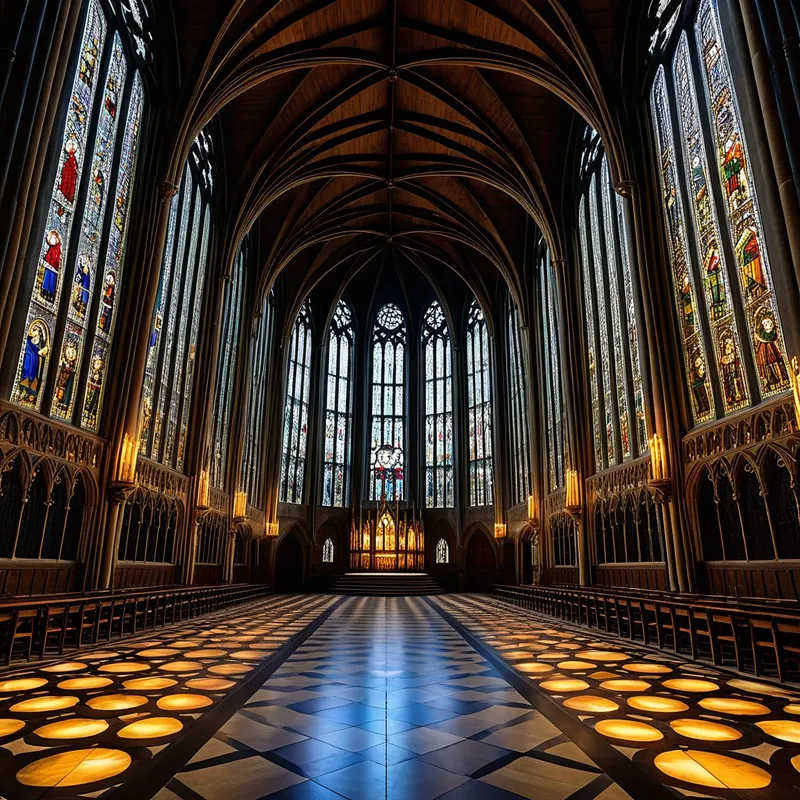
Rise with the sun and see it. Its towers pierce the morning fog like promises. Enter its vastness, where light does not merely fall but is born from walls of pale, luminous stone and windows that are frozen hymns of color—sapphire, ruby, and emerald, telling tales of virtue and valor. The air is cool, smelling of beeswax, polished oak, and the faint, clean scent of rain-washed banners. But your eye is drawn, inevitably, to the center. There, upon a floor of green and white tiles like a chequerboard of fate, rests the Table.
It is not a king’s table, high and separate. It is the Round Table, a circle of dark, gleaming wood, vast as a stilled whirlpool. No head, no foot. Around it stand high-backed chairs, each empty, yet each humming with a name not yet spoken, a destiny not yet claimed. This is the silence before the symphony. This is the hollow chamber waiting for the breath of the world.
Then, he enters. Arthur Pendragon, his crown a simple band of gold, his cloak the color of heart’s blood. He does not take a throne; he stands by the Table, his hand upon its rim. One by one, they come. The thunder of Lancelot's honor, the steadfast light of Gawain, the pure questing fire of Galahad. They fill the chairs, and the Hall breathes. Here, oaths are sworn not to a man, but to the space between them—the sacred circle. Here, grievances are settled with measured words, not swords. The Hall becomes a crucible of order, a living geometry of justice where the weak find a voice and the strong find a law greater than their arm.
For a season, the light within is brighter than the sun without. The Hall is a beacon, a living dream made manifest. But dreams are fragile vessels. Watch as the first shadow falls, not from the outside, but from within a human heart. A whispered doubt, a glance held too long, a love that breaks the circle’s perfect law. The harmony frays, note by note. The great windows seem to dim. The Table, once a symbol of unity, becomes a silent witness to secrets and silences.
When the final, terrible conflict comes, it does not begin on a battlefield. It begins in the Hall’s hushed emptiness. The chairs stand vacant. The perfect order is a memory. The light that remains is the cold, lonely light of a king who sees the dream crumbling, who touches the Table and feels not power, but the ghost of what was promised. The Hall does not fall to siege engines; it dissolves from within, like a sigh released at the end of the world, its ideal returning to the mist from whence it came, leaving behind only a story and an everlasting ache for that brief, shining moment.
Cultural Origins & Context
The myth of Camelot and its Great Hall is not a fossil from a single time, but a tapestry woven across centuries. Its threads begin in the fragmentary histories and heroic elegies of post-Roman Britain, a land besieged by chaos, yearning for a Dux Bellorum to restore order. The earliest chronicles hint at a warrior chieftain, but the Camelot we know—the citadel of civilizing light—is a flower of the High Middle Ages.
It was in the 12th and 13th centuries, through the works of poets like Chrétien de Troyes and the monumental compilation of Sir Thomas Malory, that the Great Hall ascended from fortress to symbol. Told in feudal courts, the story served a dual function. For the aristocracy, it was a mirror and a model: the Round Table presented a idealized vision of feudal fellowship, where loyalty to a code (chivalry) transcended mere loyalty to a lord. It was a mythic blueprint for a just society.
For the wider culture, transmitted through romances and oral recitation by bards, it was a profound national myth. In a world of political strife and petty warfare, Camelot represented a lost Golden Age, a benchmark of what Britain could be—united, lawful, and radiant. The Hall was the physical and spiritual center of that age. Its rise and fall spoke to a deep cultural understanding: that the highest human creations are breathtakingly beautiful and heartbreakingly transient. The myth was not just entertainment; it was a vessel for collective longing and a meditation on the tragic cost of sustaining paradise on earth.
Symbolic Architecture
The Great Hall is not merely a setting; it is the central psychic organ of the Arthurian world. Its architecture is a map of a specific consciousness.
The Round Table is its beating heart, the ultimate symbol of wholeness and equality. It negates hierarchy, creating a space where every voice, in theory, holds equal weight. It represents the ego’s attempt to create a perfectly integrated psyche, where all inner “knights”—our drives, virtues, and capacities—are organized in harmonious council.
The circle admits no head, for true sovereignty resides in the center, the empty space where the collective purpose lives.
The Hall itself is the vessel of this conscious order. Its high, vaulted space represents the aspiration of the spirit; its stone walls, the discipline and structure required to contain that aspiration. The stained-glass windows, filtering chaotic sunlight into structured narratives of virtue, symbolize how raw experience is transformed into meaningful ideology. Yet, this order is pristine, new, and ultimately naive. It is the persona of a kingdom—the brilliant, idealized face it presents to the world and to itself.
The tragedy is embedded in this very perfection. The Hall, for all its glory, has no room for the shadow. It cannot integrate the messy, passionate, betraying, and irrational aspects of human nature represented by the love of Lancelot and Guinevere, or the vengeful rage of Mordred. The shadow, denied a seat at the Round Table, festers in the corridors and courtyards outside until it storms the gates. The Hall’s flaw is its lack of a basement, a dungeon, a hidden chamber—it has no psychological depth. It is all conscious ideal, with no acknowledged unconscious.

The Dreamer's Resonance
When the image of Camelot’s Great Hall arises in a modern dream, it rarely appears in its full, sunlit glory. More often, it manifests in fragments and moods that point to a specific psychological process.
You may dream of standing in a vast, empty hall. The scale is awe-inspiring but chilling. You are alone. This somatic experience of spacious solitude often accompanies a moment in life where you have achieved a long-sought structure—a new career, a committed relationship, a hard-won personal philosophy. The “knights” (your energies, projects, social roles) have yet to arrive, or have departed. The dream captures the poignant, sometimes terrifying, responsibility of maintaining order and meaning in a space you have created. It is the quiet after the victory, asking, “What now?”
Alternatively, you may dream of the Hall in a state of decay or neglect. Dust sheets cover the furniture, or cracks web the stained glass. This is the psyche signaling that a once-vital personal ideal or life structure has become rigid, lifeless, or outgrown. The code you lived by no longer serves. The dream is an invitation to mourn the passing of an old self-organization, acknowledging its beauty and its necessary end.
Most powerfully, you might dream of witnessing a fracture at the Round Table—a violent argument, a betrayal, a chair splitting. This is a direct manifestation of inner conflict. A deeply held ideal (loyalty, purity, justice) is being challenged by a competing inner force (desire, ambition, envy). The dream stages the civil war within the psyche, showing the catastrophic feeling that occurs when the central myth of one’s life is proven incomplete or flawed.
Alchemical Translation
The myth of the Great Hall models the alchemical process of psychic transmutation, specifically the perilous journey from the nigredo (chaos) to the albedo, and the failure to proceed to the integrated rubedo.
Arthur’s act of establishing the Hall is the albedo—the brilliant whitening. He takes the raw, chaotic matter of a broken kingdom (the nigredo) and, through will, vision, and the sword Excalibur (discrimination), refines it into a pristine, ordered state. The Round Table is the vas (vessel) of this operation, and the resulting kingdom is a magnificent, purified substance. This is a necessary and glorious stage in individuation: the conscious ego constructs a coherent, ethical, and effective identity.
The creation of a perfect order is not the goal of the work, but its most seductive and dangerous intermediate stage.
The myth’s profound lesson is that this white stage is not the culmination. It is a plateau that mistakes itself for the peak. The alchemical process must continue into the rubedo, which requires the reintroduction of the rejected elements—the heat of passion, the color of sin, the weight of the flesh. This is the coniunctio oppositorum. Camelot fails because it cannot endure this marriage. It cannot get its hands dirty. Lancelot and Guinevere’s love is the red tincture that the white kingdom cannot assimilate; it is experienced only as a stain, not as a vitalizing force.
Thus, for the modern individual, the myth warns against the idolatry of the conscious ideal. The true alchemical work begins not when we build our shining hall, but when we must courageously invite the shadow to sit at our inner Round Table, to endure the conflict, and to seek a new, more resilient synthesis that is not pure white light, but the enduring, tempered gold of a wisdom that has integrated both its nobility and its flaw. The quest is not for an eternal Camelot, but for the grace to build, lose, and rebuild our halls with ever-deeper foundations.
Associated Symbols
Explore related symbols from the CaleaDream lexicon: