
Calypso Myth Meaning & Symbolism
The goddess-nymph Calypso offers Odysseus immortality and perfect love on her hidden island, a profound temptation he must ultimately refuse to fulfill his destiny.
The Tale of Calypso
Hear now the tale of the one who sings in shadows, the Concealer, she who hides men from their fate. After the great sack of Troy, the Odysseus, breaker of cities, was cast upon the mercy of the wine-dark sea. His fleet was shattered, his companions lost to the wrath of Poseidon. For nine days he clung to the wreckage of his raft, a plaything for the waves, until the tenth dawn broke upon an impossible shore.
It was the isle of Ogygia, a jewel set in the navel of the sea. Here, cliffs of fragrant cedar rose to catch the clouds, and meadows of violet and wild celery sloped down to coves of sand like powdered pearl. In its heart lay a cavern, wide and warm, where a fire of thyme and juniper burned with a sweet scent. Vines heavy with grapes clustered at the entrance, and four springs of clear water bubbled in intersecting runnels. This was the domain of Calypso, daughter of the Titan Atlas, who holds the pillars of heaven apart.
She found him, salt-crusted and half-drowned, and her immortal heart was stirred. With nectar and ambrosia she restored him. With soft words and softer glances, she wove a spell not of malice, but of profound, encompassing love. She offered him the unthinkable: ageless immortality, to be her husband and dwell forever in this perfected, timeless paradise. For seven long years, Odysseus remained. By day, he would sit on the rocky shore, staring across the endless, empty sea, his eyes scouring the horizon until they ached. His tears fell like the evening rain. By night, he lay in the arms of the goddess, who was both his sanctuary and his prison, his comfort and his chain.
His heart was a knot of longing, pulled taut between the immortal bliss of a goddess’s bed and the mortal memory of a rocky island, a faithful wife, a son grown to manhood in his absence. The loom in Calypso’s cave wove a tapestry of eternal spring, but his soul was woven from the threads of Ithaca’s seasons—planting, harvest, and the smoke of his own hearth.
The turning point came not from the sea, but from the vault of heaven. The other gods, assembled in the halls of Zeus, took note. All had returned from the war but Odysseus, held in the gentle thrall of the nymph. Athena, his fierce protector, spoke for his destiny. The will of Zeus was sent on the swift winds to Ogygia.
The messenger Hermes found the island, a flash of gold against the green. He delivered the unbreakable decree: the hero’s release must be forged. Calypso’s heart, which had beat with the slow rhythm of eternity, now felt the sharp pang of a mortal wound. She confronted Odysseus by the shore, her beauty a terrible, sorrowful force. “Go then,” she said, her voice the sound of the tide receding from a beloved shore. She offered him the tools of his departure—axe, adze, and auger—and showed him the tall trees. She would help him build a raft and stock it with wine, water, and rich provisions. She would set a fair wind. But her final gift was the cruelest truth of immortality: “If you only knew the full measure of misery you are fated to suffer, you would stay here with me and be immortal, for all your longing to see your wife.”
Odysseus built his craft. On the fifth day, he launched it. Calypso stood on the beach, her form growing smaller, a statue of grace and grief, as the wind caught his sail. He did not look back, his eyes fixed on the painful, necessary horizon. The paradise of Ogygia faded into the haze, a dream from which he had finally, agonizingly, awakened.

Cultural Origins & Context
The story of Calypso is a pivotal episode in the Odyssey, one of the foundational pillars of ancient Greek literature. Composed in the 8th or 7th century BCE, this epic was part of an oral tradition, performed by bards (rhapsodes) for aristocratic audiences. Its function was multifaceted: it was entertainment, a repository of cultural values, and a theological exploration.
Within this framework, Calypso’s episode serves a critical narrative and ethical purpose. It represents the ultimate test of nostos—the heroic, driving concept of homecoming. Earlier adventures challenged Odysseus with monsters and primal chaos (Scylla, Charybdis, the Cyclops). Ogygia presents a more insidious danger: perfected order, divine love, and the end of striving. For a society that valued fame (kleos) won through action and one’s place in the mortal community (oikos), Calypso’s offer of private, eternal bliss was a profound threat to the heroic code. The myth reaffirms that a meaningful human life is defined by its limits—by mortality, by duty, by the very struggles from which Calypso promises escape. Her forced release of Odysseus, decreed by Zeus, underscores a central Greek belief: even the gods are subject to a larger order, often interpreted as Fate or the proper allocation of human destiny (moira).
Symbolic Architecture
Calypso is not a villainess, but a goddess of profound ambivalence. Her name means “she who conceals,” and she represents the part of the psyche that seeks to conceal us from our own difficult, necessary becoming. Ogygia is the symbolic landscape of the unconscious itself—beautiful, self-contained, timeless, and ultimately isolating.
The greatest temptation is not toward evil, but toward a perfect stasis that masquerades as peace.
Odysseus’s seven-year stay signifies a period of psychic incubation or stagnation. He is not actively suffering, but he is in a state of profound melancholia, suspended between worlds. The shore where he weeps is the liminal space between the unconscious (the island) and consciousness (the sea leading home). Calypso’s loom, weaving an endless, perfect pattern, symbolizes the mesmerizing, repetitive nature of a complex that holds us captive—be it an addiction, a paralyzing comfort, or a relationship that soothes but does not challenge the soul to grow.
The conflict is not between love and hate, but between two kinds of love: the divine, possessive, eternal love of the goddess, and the mortal, imperfect, rooted love for Penelope and Ithaca. To choose mortality is to choose loss, change, and death, but also meaning, identity, and authentic connection.
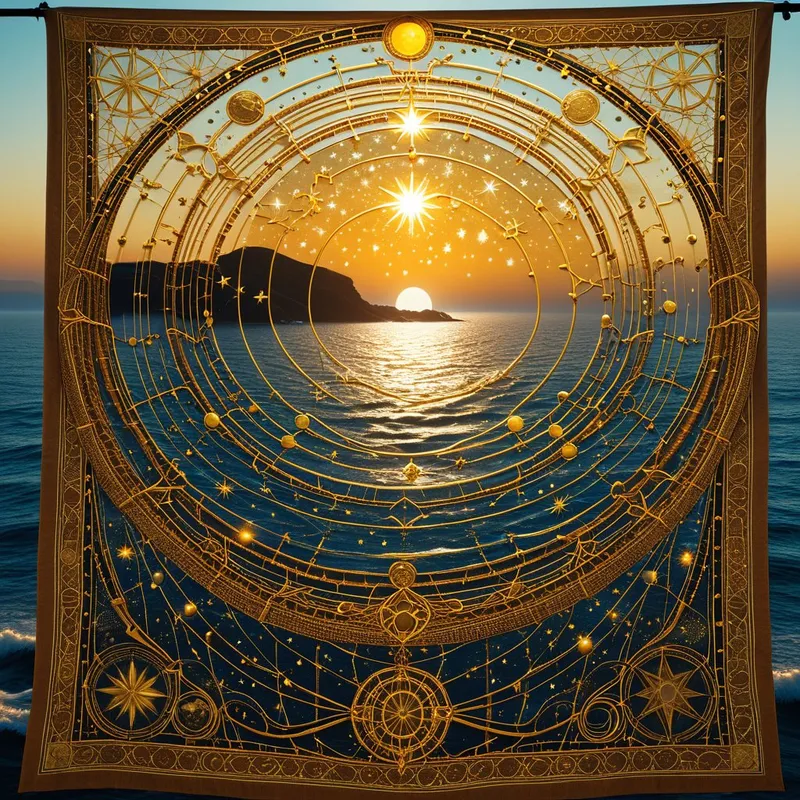
The Dreamer's Resonance
When the pattern of Calypso manifests in modern dreams, it rarely appears as a literal nymph on a beach. Instead, the dreamer may find themselves in an environment of stunning, serene beauty—a pristine apartment, a silent forest glade, a relationship that feels perfectly comfortable yet strangely airless. There is often a somatic feeling of being held or suspended, a luxurious weightlessness. Time feels distorted or absent.
The psychological process at work is the confrontation with a benevolent prison. The dreamer is encountering a part of their life or psyche that offers profound comfort but at the cost of growth, ambition, or true self-expression. It is the job that pays well but kills the spirit, the relationship that is secure but passionless, the creative project endlessly prepared for but never begun. The dream may feature a figure (a lover, a guide, a parent) who is both nurturing and subtly restraining. The critical moment in such a dream is the glimpse of a path out—a simple door, a map, a voice calling from beyond the beautiful enclosure—accompanied by a surge of both terror and exhilarating longing. The ensuing conflict is the heart of the work: the Self signaling that the time for incubation is over, and the painful, necessary journey toward consciousness must resume.

Alchemical Translation
In the alchemy of individuation—the process of becoming a whole, integrated Self—the Calypso myth models the stage known as the nigredo followed by a forced separatio. The lush, golden stagnation of Ogygia is the nigredo disguised as its opposite; it is a depression of the soul, a paralysis within paradise.
The raft one builds to leave paradise is crafted from the very trees that shaded one’s imprisonment.
Odysseus’s true heroism here is not in battle, but in accepting the divine command to leave, and in the humble, practical labor of building his own means of escape. Psychically, this translates to the individual gathering their own resources—memories of who they are, fragments of old skills, the dormant spark of desire—to construct a vessel of consciousness. The provisions Calypso gives are essential; we must take nourishment from the complex that held us to fuel the journey ahead.
The ultimate alchemical translation is the transmutation of longing from a symptom of captivity into the engine of liberation. Odysseus’s tears on the shore are the aqua permanens, the permanent water that dissolves the fixed state. His choice is the lapis philosophorum in nascent form: the realization that wholeness is not found in the removal of conflict (immortality), but in the conscious, willing engagement with one’s own finite, flawed, and destined human journey. We each have an Ithaca—a true, if imperfect, home in the world and in the self. The Calypso within us must be honored for her shelter, and then, with immense courage and grief, we must set her farewell upon our backs and sail toward the stormy, open sea.
Associated Symbols
Explore related symbols from the CaleaDream lexicon: