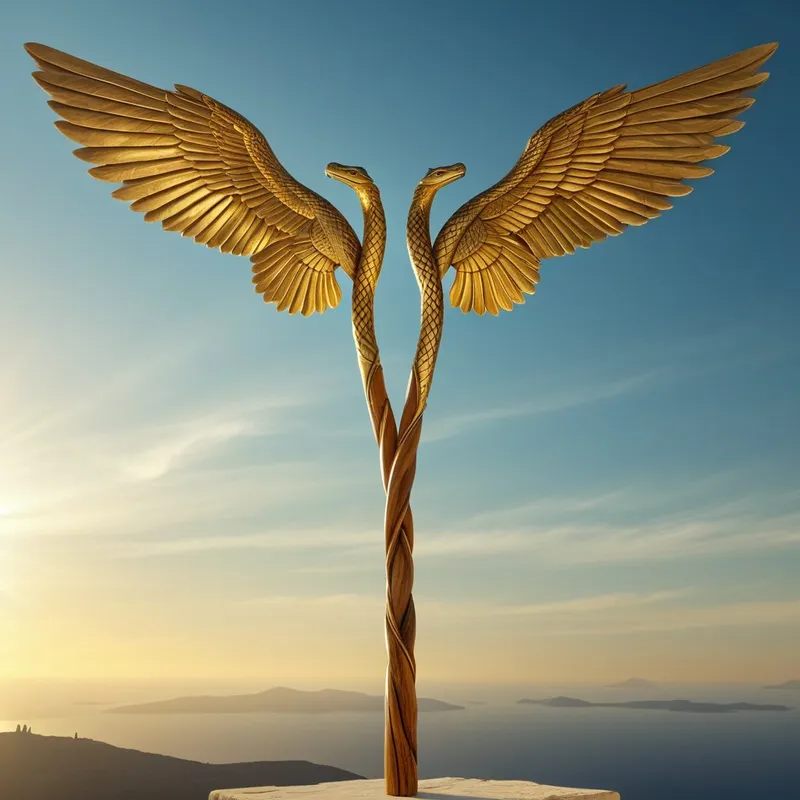
Caduceus Myth Meaning & Symbolism
A herald's staff, gifted by Apollo, becomes a symbol of divine negotiation, healing, and the reconciliation of opposing forces through the power of Hermes.
The Tale of Caduceus
Before it was a symbol, it was a story. Before it was a story, it was a sound.
Listen.
In the first light of his first day, the infant Hermes slipped from his cradle. His eyes, older than the hills, saw not a world of things, but a world of potential. The sun was a golden coin, the wind a whispered secret. And in a sun-dappled grove, he heard a new sound—a slow, scraping shuffle. There, armored in its own patience, was a tortoise.
With a laugh that held the spark of invention, the god-child saw not an animal, but an instrument. He hollowed the shell, stretched sinew across the void, and from his clever fingers drew the first music of string and resonance. He called it the lyre. Its notes were so beautiful they could stitch the sky to the earth.
His elder brother, Apollo, lord of melody and light, heard this new song. It pierced him, a sweetness he did not command. Enraged by the theft of his sacred cattle—a mischief Hermes had performed with infantile glee—Apollo descended, a tempest of golden wrath. He demanded restitution, his voice the crack of certainty.
But Hermes did not cower. He offered the lyre.
He placed the tortoise-shell instrument into Apollo’s hands. The god of light plucked a string. The note hung in the air, pure and reconciling. Apollo’s anger melted into awe. In that moment of exchanged gifts—cattle for song, transgression for beauty—a pact was forged. Not of victory, but of understanding.
In return, Apollo gave the herald his staff. Not just any rod, but a shaft of living olive wood, capable of stirring men from conflict into concord. Later, the poets would say, Hermes used this very staff to part two serpents locked in mortal combat. He did not slay them. He lowered the staff between their furious coils. Entranced, they ceased their strife and wound their bodies around the wood in a mirrored, eternal embrace. Wings, perhaps from the god’s own sandals, sprouted from its crown.
Thus, the Caduceus was born. Not from a forge of war, but from a negotiation of art. It became the sign carried before kings and between enemies, an emblem that whispered: Listen. There is a third way.

Cultural Origins & Context
The Caduceus is a symbol of syncretic and layered heritage, primarily rooted in the interconnected mythologies of the ancient Mediterranean. Its most famous bearer is the Greek Hermes, the divine messenger, psychopomp, and god of boundaries. The symbol likely has precursors in Mesopotamian iconography, where entwined serpents represented fertility and healing deities.
In Greek culture, the staff was the kerykeion, the badge of the herald. A herald was an inviolable figure; to harm him was to transgress against the gods themselves. He moved between warring states, between the human and divine realms, between the living and the dead (as psychopomp). The Caduceus was his passport and his tool of pacification. It was not a medical symbol in antiquity—that is a later, though profound, conflation with the Rod of Asclepius. Its function was diplomatic, hermeneutic, and magical. It was depicted on pottery, in sculpture, and carried in rituals, a tangible sign of protected communication and the resolution of duality through divine authority.
Symbolic Architecture
At its core, the Caduceus is a map of dynamic equilibrium. It is an axis mundi—a world axis—around which primal opposites perform their sacred dance.
The staff is the central pillar of consciousness, the spine of the individual, or the path of the mediating principle. It is the unwavering line of intent that must be present before opposites can be reconciled.
The two serpents are the twin currents of existence: light and dark, conscious and unconscious, life and death, poison and medicine, ascent and descent. They are not enemies, but partners in a necessary tension. Their entwining is a double helix, the very pattern of life (DNA) and the ascending path of kundalini. They represent the psychic energy that flows in pairs.
The wings at the apex signify the transcendence achieved through this reconciliation. They are the liberation, the swiftness of thought (hermeneusis), and the spiritual insight that arises when duality is not fought, but integrated.
The Caduceus does not choose a side; it is the space between the sides where meaning is generated.
Psychologically, Hermes with his Caduceus represents the transcendent function, the capacity of the psyche to generate a third, reconciling symbol from the clash of opposites (the warring serpents). He is the archetype of the connector, the trickster who bypasses rigid logic to create new pathways of understanding.
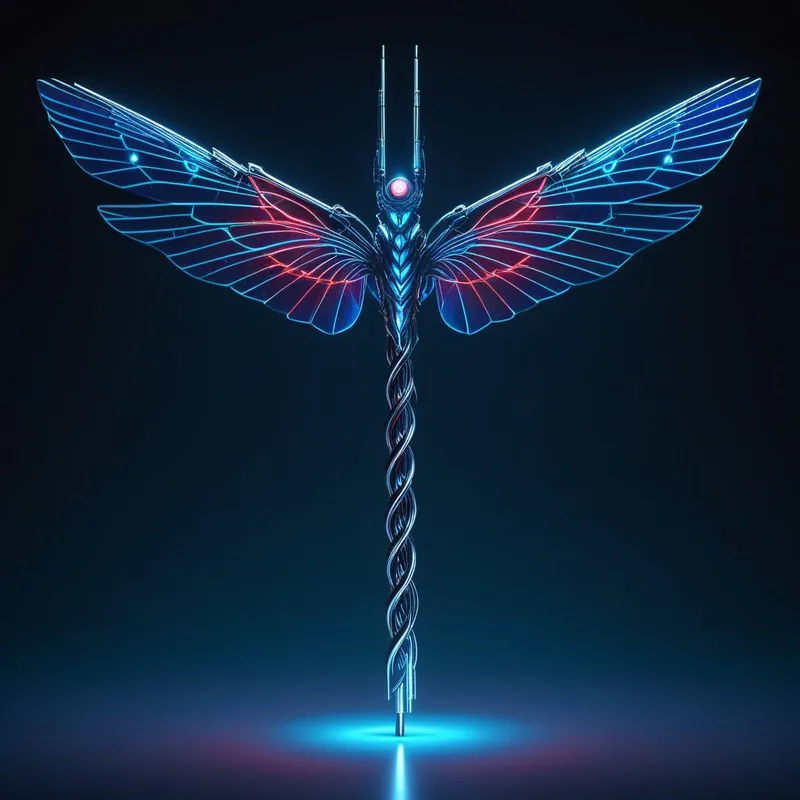
The Dreamer's Resonance
To dream of the Caduceus is to dream of a crucial negotiation within the self. The dreamer is often at an impasse, caught between two powerful, conflicting forces: a career versus a calling, logic versus intuition, attachment versus freedom.
The serpents may appear as actual snakes, as two people arguing, as twin roads, or as a feeling of being torn in half. The staff may be a tree, a ladder, a spine, or a beam of light. The dream’s somatic signature is often a tension in the body’s own central column—the spine—or a feeling of constriction followed by a sudden, winged release in the chest or mind.
This dream signals that the psyche is attempting its own hermetic magic. It is not asking the dreamer to defeat one side, but to find the mediating tool—the “staff”—that can separate the combatants without violence and allow them to reorganize into a cooperative, ascending pattern. The dream is an invitation to become the herald of one’s own inner states, to carry a message from the unconscious to the conscious, and to declare a truce in a civil war of values.
Alchemical Translation
The myth of the Caduceus is a precise allegory for the alchemical process of individuation—the journey toward psychic wholeness. The base matter, the prima materia, is the state of inner conflict (the fighting serpents).
Separation (The Staff): The first act is not fusion, but conscious separation. The individual must establish a firm, observing ego—the staff—that can step between compulsive identifications. “I am not only this anger, nor only this passivity. I am the one who holds the space for both.”
Conjunction (The Entwining): With the central principle established, the opposites are allowed to engage, not in destruction, but in a creative embrace. This is the coniunctio oppositorum. The conscious mind dialogues with the shadow; the masculine and feminine principles within commune. This stage is often turbulent, a “sacred marriage” that feels like chaos.
Sublimation (The Wings): The energy generated by this sacred marriage no longer leaks out as internal conflict. It is transmuted. It ascends the central staff (the integrated personality) and emerges as a new, transcendent function: creative insight, healing capability, or spiritual awareness. The wings are the symbol of this liberated energy.
The goal is not to become one snake, but to become the winged whole that holds the dance of both.
For the modern individual, the Caduceus teaches that healing and wholeness are born from negotiation, not annihilation. Our conflicts, our dualities, are not flaws to be eradicated but the very serpents whose reconciled dance gives rise to our highest, most winged potential. We are called not to be warriors on one side, but heralds carrying the staff of conscious mediation, speaking the language that turns strife into symphony.
Associated Symbols
Explore related symbols from the CaleaDream lexicon: