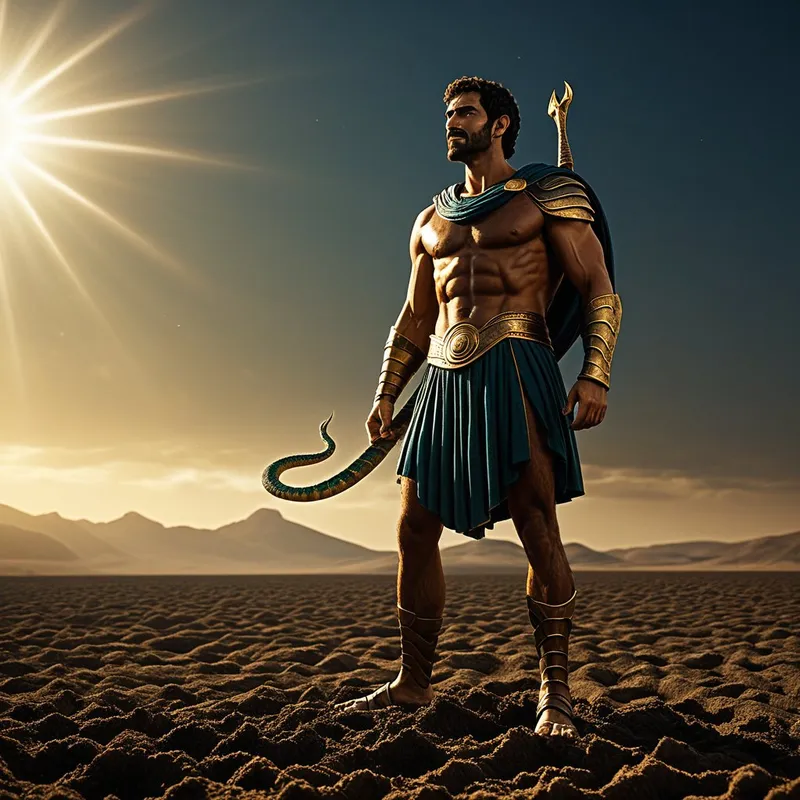
Cadmus Sowing Dragon's Teeth Myth Meaning & Symbolism
A hero slays a sacred dragon, sows its teeth, and harvests a brotherhood of warriors from the earth, founding a city from sacred violence.
The Tale of Cadmus Sowing Dragon’s Teeth
Hear now the tale of [Cadmus](/myths/cadmus “Myth from Greek culture.”/), son of Agenor, a prince cast upon the waves of fate. His sister, Europa, was stolen by a god in the guise of a bull, and his father’s command was a blade against his neck: “Find her, or never return.” Thus did [Cadmus](/myths/cadmus “Myth from Greek culture.”/) wander, a rootless man, until the voice of [Apollo](/myths/apollo “Myth from Global/Universal culture.”/) himself echoed from the stones of Delphi. “Abandon the search,” the god declared. “Follow a cow with a moon-mark on her flank. Where she lies down from weariness, there you shall found a city.”
And so he followed the sacred heifer across mountains and valleys, until her legs buckled on a grassy plain. Grateful, Cadmus sent his companions to a nearby spring to fetch [water](/myths/water “Myth from Chinese culture.”/) for a sacrifice of thanks to the gods. But this was no ordinary spring. It was the sacred pool of Ares, guarded by a serpentine [dragon](/myths/dragon “Myth from Chinese culture.”/), a child of the god, whose scales were like polished bronze and whose breath was a poisonous mist.
The men did not return. Cadmus, seeking them, found only silence and then a horror: [the dragon](/myths/the-dragon “Myth from Chinese culture.”/), coiled around the spring, its maw stained, his men slain. Grief and fury forged a single purpose in his heart. With a roar that matched the beast’s own, he fought. He drove his spear deep into the creature’s maw, pinning it to an oak tree, a sacrifice to [the earth](/myths/the-earth “Myth from Hindu culture.”/) for the sacrifice it had taken.
As the great beast bled out, a voice, perhaps [Athena](/myths/athena “Myth from Global/Universal culture.”/) herself, whispered on [the wind](/myths/the-wind “Myth from Various culture.”/). “Take the teeth of the vanquished. Sow them in the earth you have consecrated with its blood.” Bewildered but obedient, Cadmus pried the glistening teeth from the dragon’s jaw. He plowed a furrow in the rich, red earth and cast the teeth like seeds, each one a buried scream, a buried power.
For a moment, nothing. Then, the soil trembled. The earth cracked. From the furrow, points of bronze spears pierced the surface, followed by crested helmets, then grim faces, then entire bodies clad in full armor. The Spartoi, the “Sown Men,” stood before him, a fully armed host sprung from the ground, their eyes burning with a nascent, murderous light. They did not look to him as their creator, but at each other as rivals. A stone thrown by Cadmus—or by a watching god—struck one. In an instant, the field erupted. The Sown Men turned their weapons on each other, a storm of clashing bronze and guttural cries, until only five remained, their fury spent, their brotherhood forged in mutual violence. These five, Echion, Udaesus, Chthonius, Hyperenor, and Pelorus, laid down their arms. With them, Cadmus built [the acropolis](/myths/the-acropolis “Myth from Greek culture.”/) of a new city: Thebes. The dragon’s teeth had borne a strange, violent harvest, and from that harvest, civilization was born.

Cultural Origins & Context
This foundational myth comes to us primarily from the epic cycles and later sources like Ovid’s [Metamorphoses](/myths/metamorphoses “Myth from Greek culture.”/). It is a charter myth for the city-state of Thebes, explaining its origins not in peaceful settlement, but in an act of profound transgression and sacred violence. Cadmus, a Phoenician prince, represents the introduction of foreign (Near Eastern) knowledge, including the alphabet, to the Greek world, making the myth one of cultural synthesis born from conflict.
The tale was told not merely as history, but as a sacred narrative that explained the city’s fraught relationship with its patron deity, Ares (whose dragon was slain), and its inherently turbulent nature—Thebes would become a stage for some of mythology’s greatest tragedies. The act of sowing teeth functioned as an aition (a story explaining the origin of a custom or fact), justifying the warrior aristocracy of Thebes, who saw themselves as literally born from the land they defended. It served a societal function of connecting civic identity to the very soil, a soil fertilized by a primal, chthonic power.
Symbolic Architecture
The myth is a dense symbolic map of the [psyche](/myths/psyche “Myth from Greek culture.”/)’s [journey](/symbols/journey “Symbol: A journey in dreams typically signifies adventure, growth, or a significant life transition.”/) from [chaos](/symbols/chaos “Symbol: In Arts & Music, chaos represents raw creative potential, uncontrolled expression, and the breakdown of order to forge new artistic forms.”/) to order, and the terrible price of creation.
To found a city of the soul, one must first slay the guardian of the unconscious and sow the fragments of its power.
Cadmus begins as an [orphan](/symbols/orphan “Symbol: Represents spiritual abandonment, primal vulnerability, and the quest for belonging beyond biological ties. Often signifies a soul’s journey toward self-reliance.”/) of his old [life](/symbols/life “Symbol: The symbol of ‘Life’ represents a journey of growth, interconnectedness, and existential meaning, encompassing both the joys and challenges that define human experience.”/), severed from his [family](/symbols/family “Symbol: The symbol of ‘family’ represents foundational relationships and emotional connections that shape an individual’s identity and personal development.”/) and [mission](/symbols/mission “Symbol: A mission in dreams represents one’s aspirations and goals, often linked to a sense of purpose or commitment.”/). The [dragon](/symbols/dragon “Symbol: Dragons are potent symbols of power, wisdom, and transformation, often embodying the duality of creation and destruction.”/) is not mere [monster](/symbols/monster “Symbol: Monsters in dreams often symbolize fears, anxieties, or challenges that feel overwhelming.”/); it is the [guardian](/symbols/guardian “Symbol: A protector figure representing safety, authority, and guidance, often embodying parental, societal, or spiritual oversight.”/) of a sacred, unconscious [source](/symbols/source “Symbol: The origin point of something, often representing beginnings, nourishment, or the fundamental cause behind phenomena.”/) (the spring). It represents the instinctual, primal psyche—perhaps the raw, unintegrated power of Ares (aggression, drive) or the chthonic claim of the land itself. Slaying it is a necessary but sacrilegious act; one cannot access the creative waters without confronting and violating the old guard.
The [teeth](/symbols/teeth “Symbol: Teeth in dreams often symbolize personal power, self-image, and the fear of losing control or aging.”/) are potent symbols. They are the dragon’s weapons, its means of biting and consuming. To sow them is to take the tools of destruction and plant them as seeds. They represent latent, aggressive potential, the “seeds of conflict.” The [earth](/symbols/earth “Symbol: The symbol of Earth often represents grounding, stability, and the physical realm, embodying a connection to nature and the innate support it provides.”/) that receives them is the [fertile ground](/symbols/fertile-ground “Symbol: Fertile ground symbolizes potential, growth, and the promise of new beginnings, reflecting a state where life can thrive.”/) of the unconscious, now fertilized by the dragon’s [blood](/symbols/blood “Symbol: Blood often symbolizes life force, vitality, and deep emotional connections, but it can also evoke themes of sacrifice, trauma, and mortality.”/)—a sacrifice.
The Sown Men (Spartoi) are the archetypal result: autonomous complexes of martial [energy](/symbols/energy “Symbol: Energy symbolizes vitality, motivation, and the drive that fuels actions and ambitions.”/) that spring forth fully formed. Their immediate fratricide illustrates a core psychological [truth](/symbols/truth “Symbol: Truth represents authenticity, honesty, and the quest for knowledge beyond mere appearances.”/): raw, undifferentiated psychic energy, when summoned, first turns [inward](/symbols/inward “Symbol: A journey toward self-awareness, introspection, and the exploration of one’s inner world, thoughts, and unconscious mind.”/) in a civil war of competing impulses, drives, and potentials. Only through this internal conflict—this painful sorting—does a stable, functional [structure](/symbols/structure “Symbol: Structure in dreams often symbolizes stability, organization, and the framework of one’s life, reflecting how one perceives their environment and personal life.”/) (the five survivors, the [city](/symbols/city “Symbol: A city often symbolizes community, social connection, and the complexities of modern life, reflecting the dreamer’s relationships and societal integration.”/) walls) emerge.
The Dreamer’s Resonance
When this myth stirs in modern dreams, it signals a profound process of psychic integration. The dreamer may be at a point of necessary violation—having to “slay” an old pattern, addiction, or dependency (the dragon) to access a vital, life-giving resource (the spring). This act feels dangerous and morally fraught.
Dreaming of planting teeth, or of things growing from one’s mouth or body, speaks to the phase of “sowing the seeds of conflict.” The dreamer has taken a powerful but destructive element of their psyche and is attempting to cultivate it, to make it creative. The somatic feeling is often of tension in the jaw, throat, or gut—a holding of unspoken words or unleashed fury.
The emergence of armed figures, especially if they are fighting, directly mirrors the internal conflict that follows a major life decision or the awakening of a new, powerful aspect of [the self](/myths/the-self “Myth from Jungian culture.”/). The psyche is in a state of civil war, where new identities, ambitions, or responsibilities clash for dominance. The dream is not a warning of external attack, but a snapshot of the necessary, internal consolidation of power.
Alchemical Translation
The Cadmus myth is a perfect allegory for the alchemical and Jungian process of individuation—the forging of a coherent, conscious Self.
The [Nigredo](/myths/nigredo “Myth from Alchemical culture.”/), the initial blackening and dissolution, is Cadmus’s loss: the failure of his quest, the [death](/myths/death “Myth from Tarot culture.”/) of his men. He is reduced to his essential, desperate core. The slaying of the dragon is the confrontation with [the Shadow](/myths/the-shadow “Myth from Jungian culture.”/), the powerful, often terrifying contents of the personal and [collective unconscious](/myths/collective-unconscious “Myth from Jungian culture.”/). One must “kill” its autonomous, threatening form to access its energy.
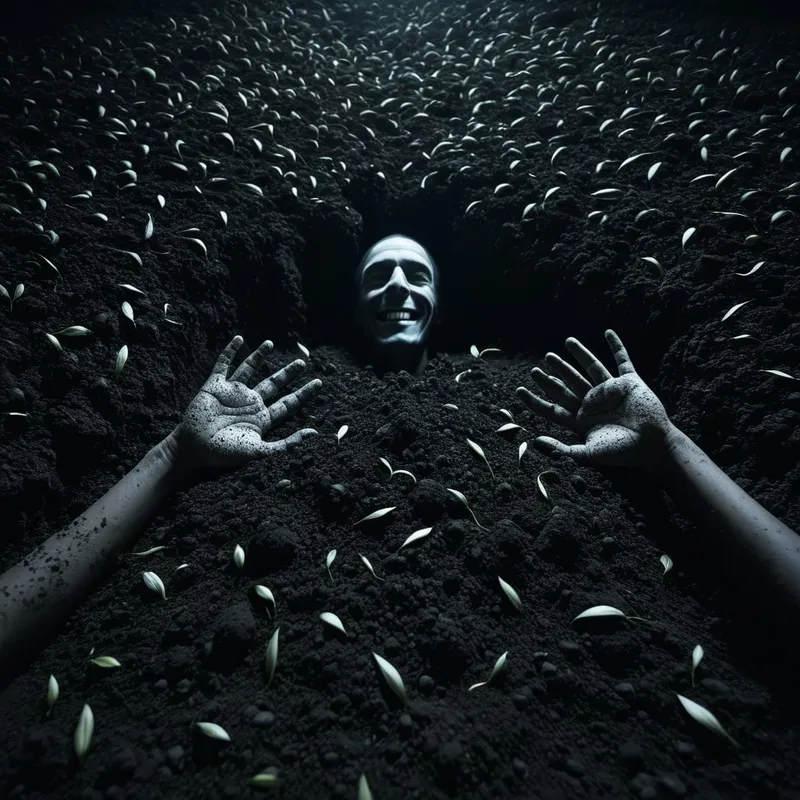
The sown field is the vas or temenos—the sacred vessel of the work. The teeth are the prima materia, the base matter of the soul, which is both poison and medicine.
Sowing the teeth is the conscious act of engaging with this shadow material, planting it in the fertile soil of attention and intention. The chaotic battle of the Spartoi is the [separatio](/myths/separatio “Myth from Alchemical culture.”/) and [coniunctio](/myths/coniunctio “Myth from Alchemical culture.”/) in violent form—the separation of elements through conflict and their eventual recombination into a stable, functional unity (the five survivors).
The five who remain represent the integrated, usable energies that can now serve [the ego](/myths/the-ego “Myth from Jungian culture.”/) in building the “city”—the coherent, resilient structure of the conscious personality. The founding of Thebes is the culmination: the establishment of a new, stable order within the psyche, a civitas Dei of the soul, built not on avoiding conflict, but on having passed through its fiery, self-consuming heart. The myth tells us that our greatest creations—our identities, our lives, our art—are not born from peaceful seeds, but from the planted, fragmented weapons of the dragons we were brave enough to slay.
Associated Symbols
Explore related symbols from the CaleaDream lexicon: