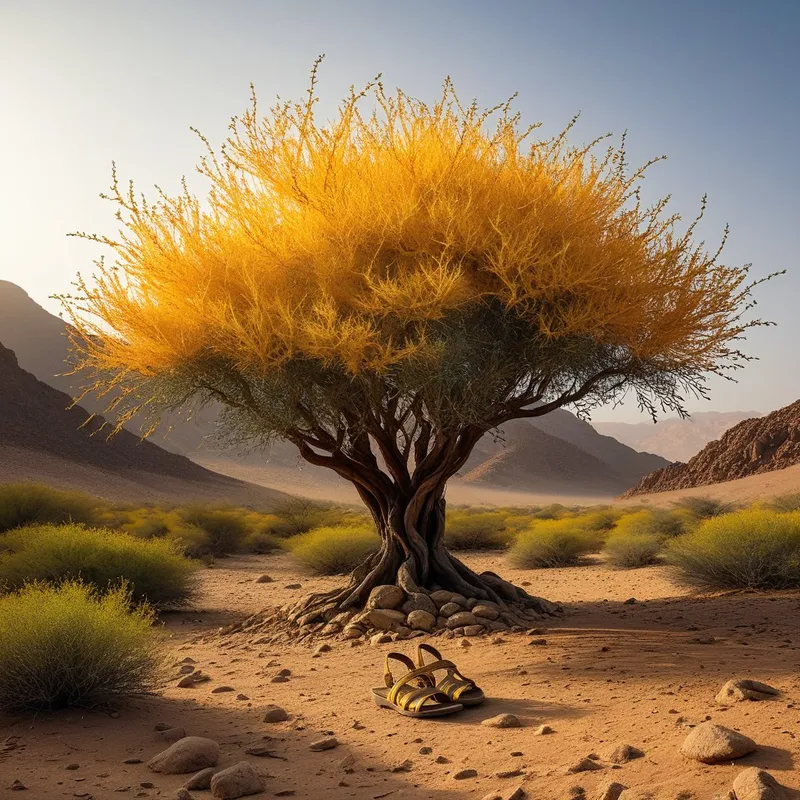
Burning Bush Myth Meaning & Symbolism
A shepherd encounters a bush ablaze yet unconsumed, hearing a voice that names the sacred and calls him to liberate a people.
The Tale of Burning Bush
The desert does not forgive. It is a place of bones and forgetting, where the sun bleaches memory from stone and the wind scours identity from the soul. Here, in the stark wilderness of Horeb, a man named Moses tended the flock of his father-in-law. He was a man of two worlds and none, a prince turned fugitive, a shepherd with blood on his hands and a people in his heart—a people enslaved far to the east, in the brick pits of Egypt.
The air shimmered with midday heat, a silent, heavy veil. Then, a flicker at the edge of vision. A thornbush, a common acacia, was on fire. But this was no desert blaze. The flames leaped and danced—a fierce, living gold, a white-hot heart—yet the leaves did not blacken. The branches did not crackle into ash. It burned, a contained sun, utterly and miraculously unconsumed.
Moses turned aside. “I must see this great sight,” he whispered to the scorching air, “why the bush is not burned.” As he drew near, a voice called from the very center of the flame. “Moses, Moses!”
“Here I am,” he replied, his own voice thin against the desert’s vastness.
“Do not come near,” the voice commanded, a sound that was not sound, vibrating in the marrow. “Remove your sandals from your feet, for the place on which you are standing is holy ground.” And Moses, trembling, obeyed, his bare feet meeting the earth that was now a threshold.
The voice declared itself: “I am the God of your father, the God of Abraham, the God of Isaac, and the God of Jacob.” Moses hid his face, for he was afraid to look upon the divine. The voice had seen the misery of his people in Egypt, heard their cry. “I have come down to deliver them… Come, I will send you to Pharaoh that you may bring my people, the children of Israel, out of Egypt.”
Moses, the shepherd, protested. “Who am I that I should go to Pharaoh?” The voice answered not with qualifications, but with a promise: “I will be with you.” And when Moses asked for a name to give to the people, the voice spoke a mystery that has echoed through millennia: “I AM WHO I AM.” Tell them, “I AM has sent me to you.”
The bush blazed on, a silent witness. The call had been issued. The ground was forever marked. The shepherd, barefoot on holy earth, would now walk into history, carrying a fire that does not consume.
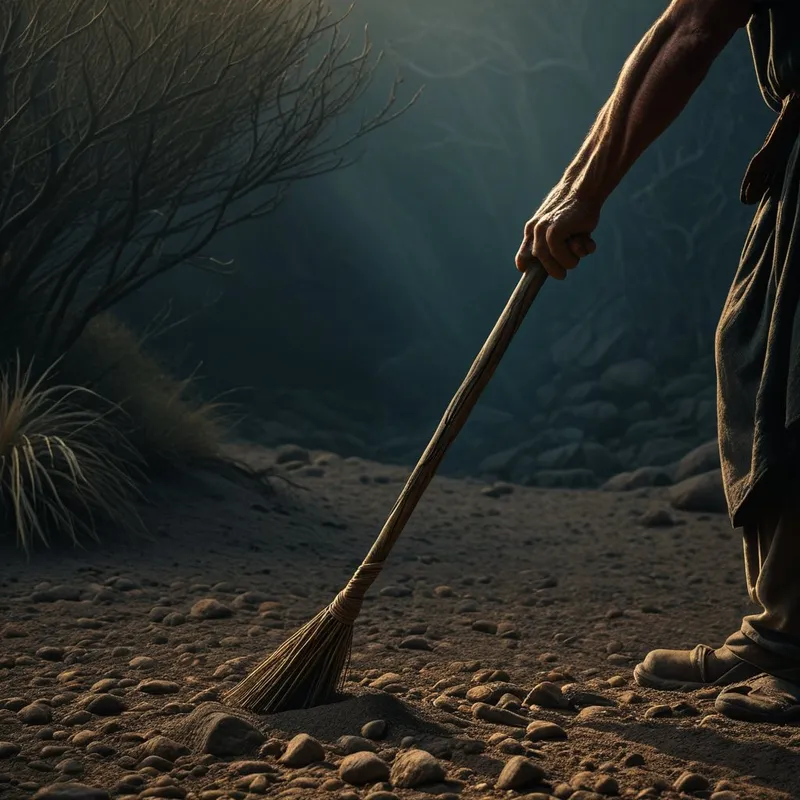
Cultural Origins & Context
This narrative is anchored in the Torah, specifically the Book of Exodus. It functions as the foundational theophany—the moment of divine self-revelation—for the prophetic tradition of ancient Israel. Historically, it is set against the backdrop of the Late Bronze Age, a time of imperial powers and displaced seminomadic tribes.
The story was not an isolated folktale but a core identity myth, passed down orally and later codified by priestly and prophetic circles. Its primary societal function was twofold. First, it established the legitimacy of Moses’s radical mission, grounding a political liberation movement in a direct, transcendent mandate. Second, and more profoundly, it defined the nature of the deity worshipped by the Israelites: a God who is fundamentally active in history, who hears the cry of the oppressed, and who is mysteriously present (I AM) yet utterly distinct from nature (the unconsumed bush). This stood in stark contrast to the static, idolatrous nature deities of surrounding Canaanite and Egyptian cultures. The myth served as the bedrock for a covenant relationship, marking the moment a tribal god became a God of ethical purpose and historical action.
Symbolic Architecture
The symbolism here is not decorative; it is the very architecture of a psychological event.
The Bush itself is humble, thorny, a thing of the desert margins. It represents the ordinary, the overlooked, the seemingly insignificant vessel. The Fire is the archetypal symbol of spirit, purification, revelation, and terrifying presence. Their union—fire that does not consume—is the central paradox. It symbolizes a sacred energy that illuminates and transforms without annihilating the vessel it inhabits. It is the ultimate image of sustainable revelation, of a divine principle that respects the integrity of the form it engages.
The holy is not found by escaping the world, but by perceiving the world itself, in its most ordinary guise, ablaze with a meaning that does not destroy it.
Holy Ground is not a geographically special place, but any place where this numinous encounter occurs. The command to remove sandals is a ritual of shedding the mundane, the cultural accumulations, the “dirt” of everyday travel, to make direct, humble contact with the foundational reality of the moment.
The divine name, Yahweh, is perhaps the most potent symbol. It is a verb, not a noun. It denotes pure, dynamic, unconditioned being. It is the voice of the ground of existence itself speaking from within the phenomenal world. Psychologically, it represents the call of the Self (in Jungian terms), the central, organizing principle of the psyche that is both the source and the goal of individuation.
The Dreamer's Resonance
When this myth pattern erupts in the modern dreamscape, it signals a profound crisis of calling. The dreamer is often in a personal “desert”—a period of stagnation, exile, or feeling lost in the mundane routines of life (the shepherd’s daily grind).
To dream of a burning yet unconsumed object—a tree, a book, a piece of furniture in one’s own home—suggests the somatic awakening of a dormant potential or a truth that is demanding recognition. The psyche is highlighting a part of the dreamer’s own life or personality that is secretly “on fire” with meaning, purpose, or creative energy, even if it appears ordinary or thorny (problematic).
The experience of hearing a voice from the flame correlates with the emergence of an authoritative inner voice, distinct from the chatter of the ego or the internalized voices of parents and society. It can be terrifying, as it often calls for a drastic reorientation of life’s direction. The somatic process is one of both awe and dread: a quickening of the pulse, a feeling of being “addressed” by something vast. The dreamer is being summoned to acknowledge their own “holy ground”—the often-repressed or ignored core of their authentic being—and to prepare for a journey they feel ill-equipped to make.

Alchemical Translation
The alchemy here is the transmutation of a fugitive identity into a prophetic vessel. Moses begins as an “orphan” archetype (exiled from both Egyptian and Hebrew homes) and is forged into a “sage” and a “leader.”
The first stage (nigredo) is the desert itself: the depression, the aimlessness, the tending of another’s flock. It is the necessary dissolution of the old, princely ego.
The encounter with the bush is the albedo, the washing pure. The shocking, illuminating vision whitens the perception. The command to remove sandals is the active participation in this purification—a conscious surrender of one’s defensive layers and acquired identities to stand naked before the truth.
The call does not ask if you are ready. It announces that the ground of your being is ready for you.
The divine dialogue is the citrinitas, the yellowing, the dawning of intellectual and spiritual understanding. The protest (“Who am I?”) meets the assurance of presence (“I will be with you”). The request for a name is met with the revelation of essential being (“I AM”). This is the illumination of the connection between the personal mission and the transpersonal source.
Finally, the acceptance of the call is the beginning of the rubedo, the red work, the enduring labor in the world. The fire that did not consume the bush must now be carried within the person into the court of Pharaoh (the resistant outer world) and through the wilderness of implementation. For the modern individual, this is the process of individuation: hearing the call of the Self from within the seemingly ordinary confines of one’s life, acknowledging the sacredness of one’s own path (holy ground), and undertaking the often-daunting task of bringing that inner fire into concrete reality, transforming both oneself and one’s corner of the world. The bush burns on, an eternal symbol that the vessel can contain the infinite.
Associated Symbols
Explore related symbols from the CaleaDream lexicon: