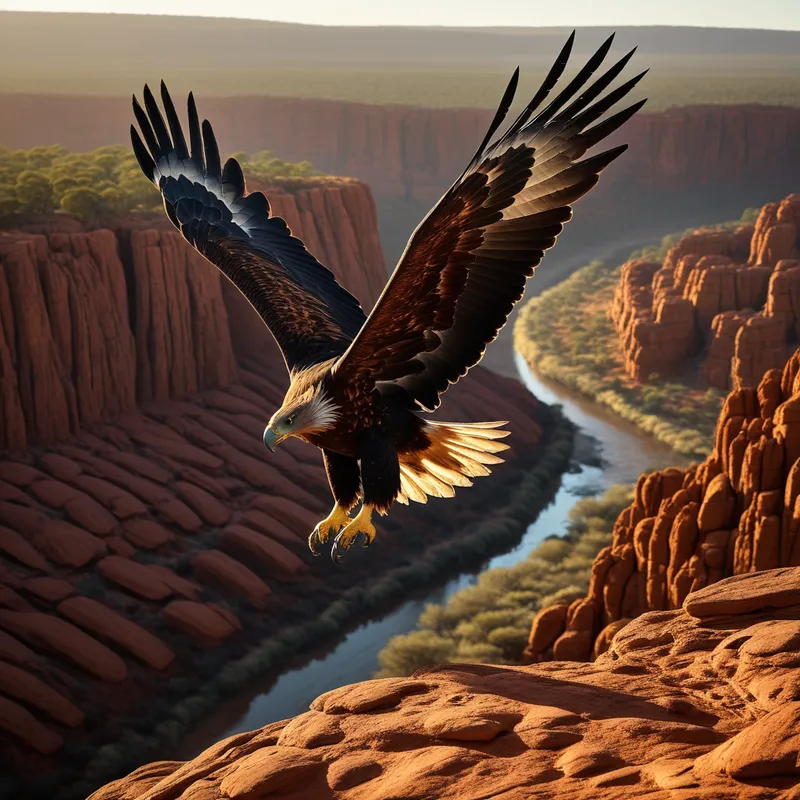
Bunjil the Wedge Tailed Eagle Myth Meaning & Symbolism
The story of Bunjil, the Wedge Tailed Eagle creator spirit who shaped the world, gave law, and ascended to the sky, watching over all creation.
The Tale of Bunjil the Wedge Tailed Eagle
In the time before time, when the world was soft and formless, there was only the great, silent plain beneath a starless sky. Then, from the vast and dreaming Dreaming, a presence stirred. It was not a sound, but a pressure in the air, a gathering of intention. With a rush of wind that was the first breath of the world, Bunjil descended. His wings, vast as storm clouds, were the colour of sun-baked clay and shadow. His eyes held the cold, clear light of the first dawn.
He found the earth a flat, featureless thing. With his powerful talons, he scooped out great valleys where rivers would later run. He piled up earth into mountains that scraped the underbelly of the sky. He breathed upon the clay, and from it rose the first people—his children. He gave them shape, but they were silent, moving without purpose. So Bunjil took from the sky the fire of the sun and struck it against stone, gifting them warmth and spirit. He showed them which plants to eat, where to find water in the whispering roots of the gum tree, and how to sing the songs that would call the kangaroo from the scrub.
Yet, a deep unease settled. The people began to quarrel. Without law, their world threatened to unravel back into the formless dream from which it came. Bunjil watched, his heart heavy. He called his brother, Waang, the Crow, but Waang only cackled and sowed more discord. Bunjil knew then that creation was not enough. Order was needed. A covenant.
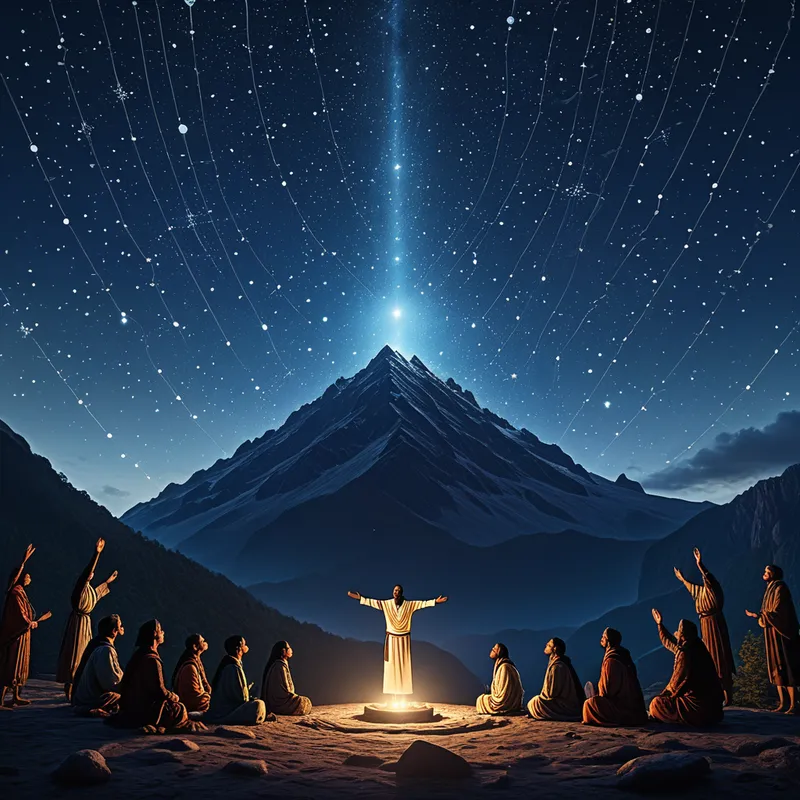
He gathered all the people and the animals at a sacred place. There, standing tall, his human form crowned with eagle feathers, he spoke not with a voice, but with a truth that vibrated in the bones of the land itself. He gave them the Law: how to marry, how to share, how to care for country, and the sacred rituals to honour the ancestors. He painted the stories of this Law across the night sky, forming the constellations—a celestial map of morality for all time.
His work complete, a profound weariness touched him. The earth-bound form could no longer contain him. With a final, loving look at his creation, Bunjil began to climb a mountain that reached into the heavens. At the summit, he transformed once more into the mighty Wedge Tailed Eagle. With one last, powerful downstroke that stirred the winds for generations, he ascended. He did not vanish. He became the star in the sky, watching eternally from the Seven Sisters. From his perch in the celestial realm, he watches still, his shadow a blessing, his distant cry a reminder of the Law that holds the world together.
Cultural Origins & Context
The myth of Bunjil belongs primarily to the Kulin nation of what is now known as south-central Victoria, though creator beings with eagle attributes are found in other Aboriginal groups. This is not a story from a book; it is a living narrative etched into the landscape itself—in the shape of a mountain, the course of a river, the flight path of an eagle. It was and is transmitted through ceremony, song, dance, and art, with Elders serving as the custodians of this profound knowledge.
Its societal function was multifaceted. It was a cosmological map, explaining the origin of the physical and moral world. It was a legal constitution, encoding the Lore that structured kinship, reciprocity, and ecological stewardship. Most importantly, it was an ontological anchor, connecting every individual and community directly to the sacred time of the Dreaming, affirming that they were not separate from creation but active participants in a story that began with Bunjil’s first flight.
Symbolic Architecture
Bunjil represents the archetypal principle of the cosmocrator—the world-fashioner. He is not a distant, detached god, but a hands-on creator who shapes, breathes life, teaches, and ultimately transcends. His symbolism is a profound triad: Creator, Law-Giver, Watcher.
The eagle does not create the sky, but by flying, he defines it. So too does the creator spirit, by imposing form and law, make the world real and meaningful.
The Wedge Tailed Eagle itself is a perfect symbol of this totality. It is of the earth (hunter, carrion-eater) yet masters the sky (soaring, visionary). Its keen sight represents the overview consciousness necessary for creation and governance. Bunjil’s ascent to the stars is not an abandonment, but an apotheosis into a permanent, overseeing consciousness. The conflict with Waang introduces the necessary shadow—the chaos that makes order not just a gift, but a vital, conscious act of imposition. Law, in this myth, is not repression; it is the sacred structure that prevents a return to primordial chaos.

The Dreamer's Resonance
When Bunjil enters the modern dream, it often signals a profound shift in the dreamer’s psychological architecture. To dream of the eagle soaring high above may reflect a nascent capacity for a detached, objective perspective on one’s life—the "view from 10,000 feet." To dream of being given a law or a sacred object by an eagle-faced figure can point to the emergence of a deep, internal ethical compass, a personal "Lore" rising from the unconscious to guide conscious choices.
Conversely, dreams of a wounded or grounded eagle, or of chaotic, lawless landscapes, may speak to a crisis of this principle. The dreamer may feel their inner world—or their outer life—lacking structure, meaning, or creative direction. The somatic sensation is often one of weightlessness or disorientation seeking grounding, or a tightness in the chest seeking the expansive breath of the high air. The psyche is grappling with its own need to create order from inner chaos, to move from passive existence to conscious, responsible world-building.

Alchemical Translation
The myth of Bunjil is a masterful allegory for the Jungian process of individuation, specifically the stage where the ego aligns with the Self. The initial, formless dream state mirrors the undifferentiated psyche. Bunjil’s creative acts symbolize the ego’s first, often messy, attempts to shape an identity—scooping out valleys of emotion, piling up mountains of ambition.
The true alchemy begins not with the first act of creation, but with the courageous imposition of inner law upon the chaos of one's own nature.
The critical turn is the giving of the Law. Psychologically, this is the moment when the individual moves beyond impulsive creation and begins to establish a consistent, ethical framework for the psyche—integrating values, setting boundaries, acknowledging responsibilities (to self, others, and the "country" of one’s own soul). This is the transmutation of raw potential into mature character. The final ascent is the culmination: the ego, having served its purpose as the instrument of the Self in shaping a life, learns to relinquish total control. It achieves a transcendent perspective, becoming a watcher or witness aligned with a greater, enduring order. The individual no longer just lives their life; they observe its pattern as part of a larger, meaningful story. They become, in a sense, the star that guides themselves.
Associated Symbols
Explore related symbols from the CaleaDream lexicon:
- Eagle — The primary form of Bunjil, symbolizing visionary consciousness, the union of earth and sky, and the overseeing, creative spirit.
- Sky — The realm of Bunjil’s mastery and final abode, representing transcendence, overview, and the domain of law and order.
- Mountain — The sacred meeting place where law is given and the point of ascent, representing the arduous climb toward higher consciousness and perspective.
- Star — Bunjil as the eternal watcher in the heavens, symbolizing guidance, destiny, and the permanent imprint of sacred law upon the cosmos.
- Creator — The foundational archetype embodied by Bunjil, representing the psychic force that brings form, meaning, and structure into being from chaos.
- Order — The essential gift of Bunjil’s Law, representing the internal psychological structures of ethics, ritual, and meaning that prevent a collapse into chaos.
- Dream — The state of the Dreaming from which Bunjil emerges, representing the fertile, formless unconscious from which all creative acts originate.
- Journey — Bunjil’s arc from creator to law-giver to celestial being, modeling the soul’s journey from formation, through ethical consolidation, to transcendent awareness.
- Stone — The material of the mountains he shapes and the tool for striking the first fire, representing the raw, foundational substance of reality and the spark of spirit.
- Light — The fire given to the first people and the light of the stars, representing consciousness, spirit, enlightenment, and the illuminating power of law.
- Spirit — The breath Bunjil gives to the clay figures, representing the animating life force and the connection to the sacred that distinguishes mere existence from being.
- Original — Referring to the first, foundational acts of creation and law-giving, representing the archetypal, timeless pattern that underpins all authentic psychological development.