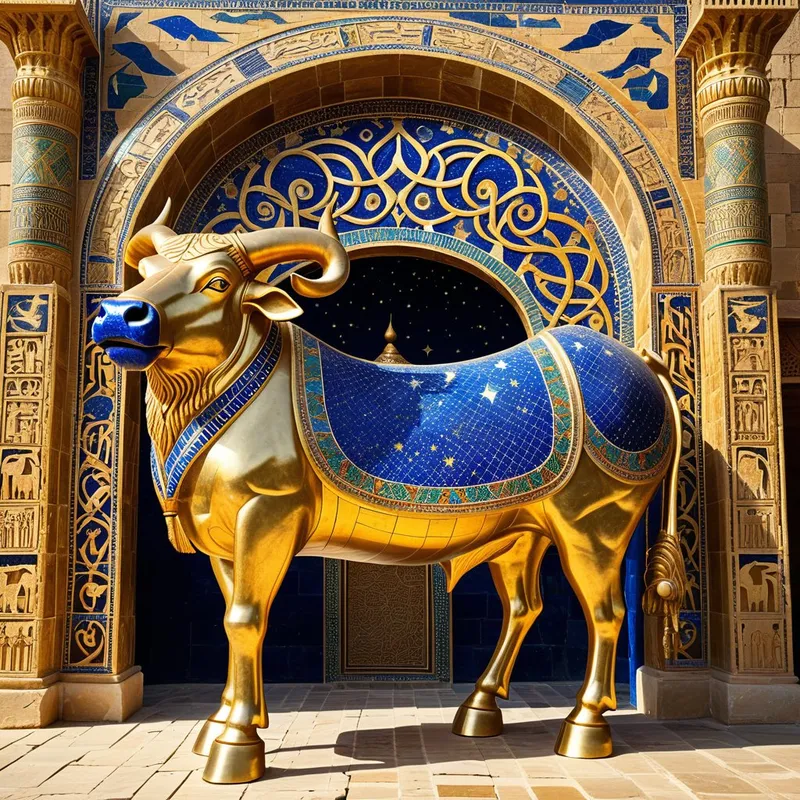
Bull Lyre of Ur Myth Meaning & Symbolism
A sacred lyre, crafted from a celestial bull, channels divine music to bridge the heavens and earth, taming chaos and ordering the human soul.
The Tale of Bull Lyre of Ur
Hear now, and let the silence between the stars fill your ears. In the time when the great rivers, Idiglat and Buranun, first learned their courses from the gods, there existed a sound before all songs. It was the low, tectonic groan of the earth dreaming, the rumble in the belly of the primordial bull of heaven.
This bull was no ordinary beast. Its hide was the vault of the night sky, speckled with the silver nails of the stars. Its breath was the hot wind from the southern desert, and its voice was the thunder that Ishkur kept locked in his clouds. It roamed the Edin, the high steppe, and where it trod, the ground trembled. Where it bellowed, men dropped their tools and covered their ears, for its cry was pure, undiluted power—beautiful and terrifying, the raw noise of creation itself.
In the gleaming city of Ur, a king, whose name is lost to all but the clay, had a vision. He saw in a dream, sent by Enki in the sweet waters of the abyss, a instrument that could catch this divine noise and weave it into patterns the human heart could bear. He summoned his most gifted artisan, a man whose fingers were taught by the gods themselves. "You will not build a lyre," the king commanded, his voice hushed with awe. "You will invite one. You will coax it from the boundary between the wild and the civilized."
The artisan journeyed to the Edin with nothing but reverence and a vial of sacred cedar oil. For seven days and nights, he did not hunt or trap. He sang. He sang the songs of the city—the chants of the brick-makers, the lullabies of mothers, the precise, measured hymns to Anu and Nanna. He sang order into the chaos. On the seventh night, the Celestial Bull emerged from a stand of tamarisks, not charging, but listening, its great head lowered. It understood the bargain in the song.
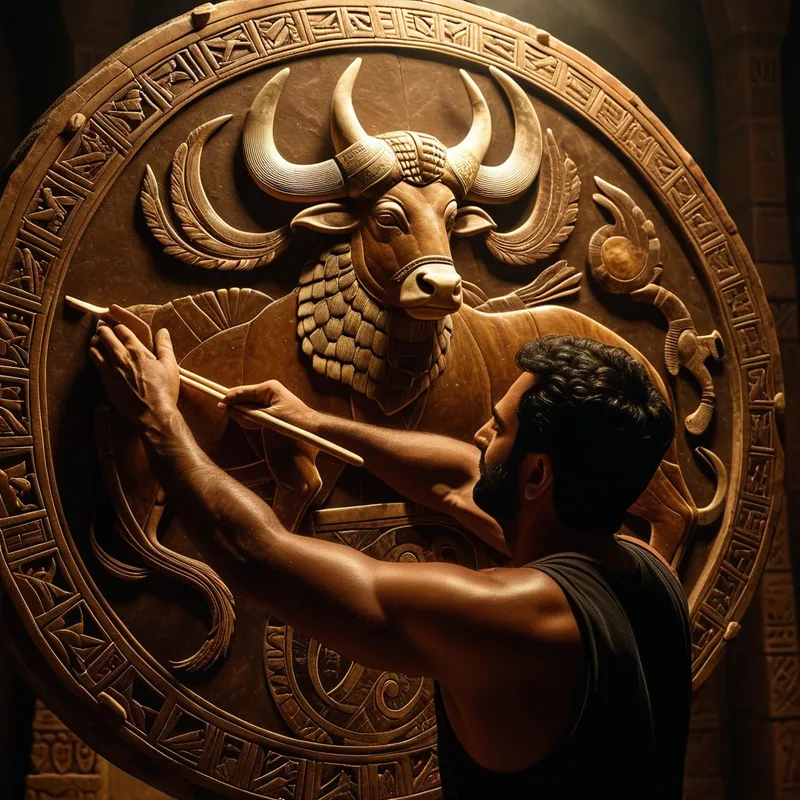
In a ritual that was part sacrifice and part metamorphosis, the bull laid down its massive form. The artisan, with tools of copper and gold, did not break the beast; he translated it. The powerful neck and shoulders became the sturdy soundbox, resonating with the memory of the bull's mighty heart. The bones of its legs, strong and true, became the arms of the lyre. Its magnificent, sweeping horns became the very frame that would hold the heavens of sound. The hide, stretched tight, became the drumhead, waiting for the touch that would make it speak not with a roar, but with a melody.
The first time the strings—spun from the guts of a sacred ram—were plucked in the courtyard of the palace, a hush fell deeper than silence. It was not the bull's roar, but its soul. The music that flowed forth was the sound of the steppe gentled, the thunder made rhythmic, the chaos given a name and a scale. It was the voice of the Me, the cosmic principles of civilization: kingship, truth, music, and carpentry, all vibrating in a single, golden chord. The lyre did not play for entertainment; it performed a sacred function. Its music was a rope, a Dur, tying the high, wild heavens to the ordered, human earth, ensuring that one would never forget the other.
Cultural Origins & Context
The Bull Lyre of Ur is not a myth from a single tablet or epic poem, but a mythos born from an artifact. The actual lyres, discovered in the Royal Tombs of Ur (c. 2600-2500 BCE), are the silent, physical seeds from which the story grows. They were found in the graves of kings and queens, placed there to accompany and perhaps protect or entertain the soul in the afterlife. Their construction—gold, lapis lazuli, shell mosaic—speaks of immense wealth and divine patronage.
The myth was not "told" in a linear narrative but was performed and enacted. It lived in the hands of the court musician, the gala or nar priest-singer. When they played the bull-headed lyre during rituals for Inanna or funerary ceremonies, they were channeling the story. The instrument itself was the myth. The inlaid panels on the soundbox, showing scenes of a hero wrestling beasts and animals playing music, were a visual liturgy. They depicted the central theme: the taming of wild, natural power (the bull, the lion, the scorpion-man) into the service of culture, celebration, and communion with the gods. This mythos served a critical societal function: it legitimized kingship (the king as the one who commissions the taming of chaos), sanctified the arts, and provided a sonic model of the cosmos—a harmony achieved not by eliminating powerful forces, but by integrating them into a sacred structure.
Symbolic Architecture
The bull is the paramount symbol of unbridled, potent life force, fertility, and raw celestial power. It is the thundercloud, the earthquake, the terrifying and awesome fecundity of nature. The lyre represents the human impulse—and capacity—for order, pattern, and meaning. The myth, therefore, is not a conquest but a sacred marriage.
The transformation of bull into lyre is the alchemy of nature into culture, instinct into art, noise into music. It is the founding act of consciousness, which does not destroy the unconscious but gives it a voice.
The hero depicted on the lyre's panels, often grappling hybrid creatures, symbolizes the ego or the conscious self undertaking this essential, perpetual task. He does not slay the bull-man; he engages with it, wrestles it into a form that can be understood and utilized. The resulting music is the symbol of the integrated psyche—a harmony that includes the deep, resonant bass of the instinctual world (the bull's body as the soundbox) and the high, clear notes of spirit and intellect (the strings stretched toward the heavens). The lyre becomes a model of the Self, a microcosm where opposing forces are held in creative, vibrating tension.
The Dreamer's Resonance
When this myth stirs in the modern unconscious, it may manifest in dreams of powerful, often intimidating animals—bulls, bison, or other great beasts—that are not threatening, but waiting. The dreamer may find themselves in a workshop, tasked with building something vital from strange, organic materials. There may be a profound, somatic experience of a deep, resonant sound or vibration that is felt in the bones more than heard, a frequency that seems to rearrange things internally.
Psychologically, this signals a process of containment and translation. The "bull" represents a surge of raw, undifferentiated psychic energy: a potent but chaotic emotion (like rage or desire), a burst of creative impulse that feels overwhelming, or a foundational instinct rising from the depths. The dream-ego is being called to become the artisan. The struggle is not to repress this force, but to "invite" it, to listen to its nature, and to find the sacred structure—the "lyre"—within one's own life that can hold this power and translate its raw noise into a purposeful melody. It is the dream of moving from being overwhelmed by one's own depth to becoming a vessel for its expression.

Alchemical Translation
The individuation process modeled here is the crafting of the personal instrument. We all contain within us the "Celestial Bull"—the totality of our innate, instinctual, and spiritual potential. In its raw state, it is magnificent but unusable; its power can be destructive or simply lost as background noise. The first stage of the alchemy is the "king's vision": the emergence of a conscious intention from the Self (Enki's dream) to create meaning from this material.
The long, patient work in the "workshop" is the analysis, reflection, and discipline of life—the ego's effort to engage with the unconscious material. We "sing to the bull" through active imagination, journaling, art, or therapy, not to subdue it, but to communicate our intent to integrate. The transformation itself is the opus, the great work. It requires us to deconstruct our old, rigid forms to provide "bones" and "hide" for the new structure.
The finished lyre is the individuated personality. Its music is not a single, perfect note, but a complex harmony that includes dissonance and resonance. To play it is to live authentically, where one's deepest, most powerful nature is not a hidden secret but the very source of one's unique voice in the world.
The final, crucial step is to play the instrument. The alchemy is incomplete if the transformed power remains static. We must pluck the strings in our relationships, our work, and our creative acts. The music that flows out is our contribution to the human chorus, our own unique frequency that helps tie the chaotic, wondrous earth to the starry, ordered heavens within and around us.
Associated Symbols
Explore related symbols from the CaleaDream lexicon: