Buga the Creator Evenki Myth Meaning & Symbolism
The story of Buga, who dove into the primordial ocean with the help of a water-bird to bring forth the land and create the world from chaos.
The Tale of Buga the Creator Evenki
In the time before time, there was only the endless, dark water. No sun pierced its depths, no wind stirred its surface. It was a dreaming, formless Chaos, a great, silent ocean beneath an empty sky. And in this nothingness, there was a presence. Not a being as we know it, but a potential. A thought. This was Buga.
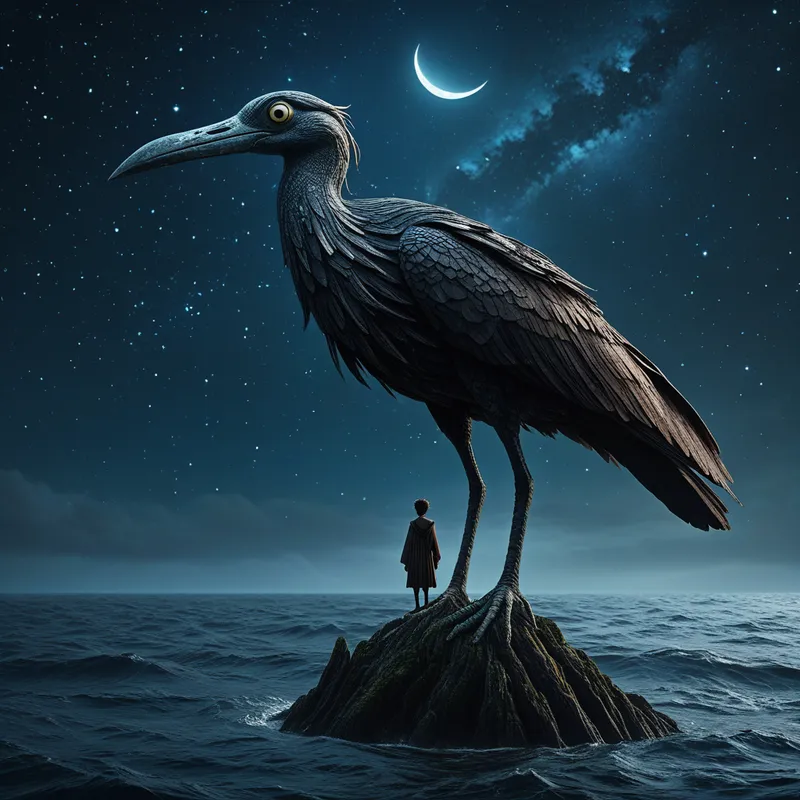
Buga dreamed of solidity, of shape, of a place to stand. But the water was everywhere, deep and cold and featureless. The longing grew into a need, a painful yearning for earth. For a foundation. From the formless mist above the waters, a great bird appeared—a loon or a goldeneye, its feathers slick with the damp of creation. It saw the longing in the presence of Buga and spoke not with voice, but with spirit. “I will dive,” the bird’s essence said. “I will seek the bottom of this endless sea and bring you what you seek. But you must give me a place to rest when I return, for the dive is long and the darkness is heavy.”
And so the pact was made. The water-bird gathered its courage, its small body a spear of intent against the infinite. It plunged. The dark waters swallowed it whole. Time, unmeasured, flowed. Buga waited on the breath of the world. The bird did not return. Again, the bird dove, and again, it failed, surfacing exhausted and empty-beaked. The darkness below was absolute, a belly with no floor.
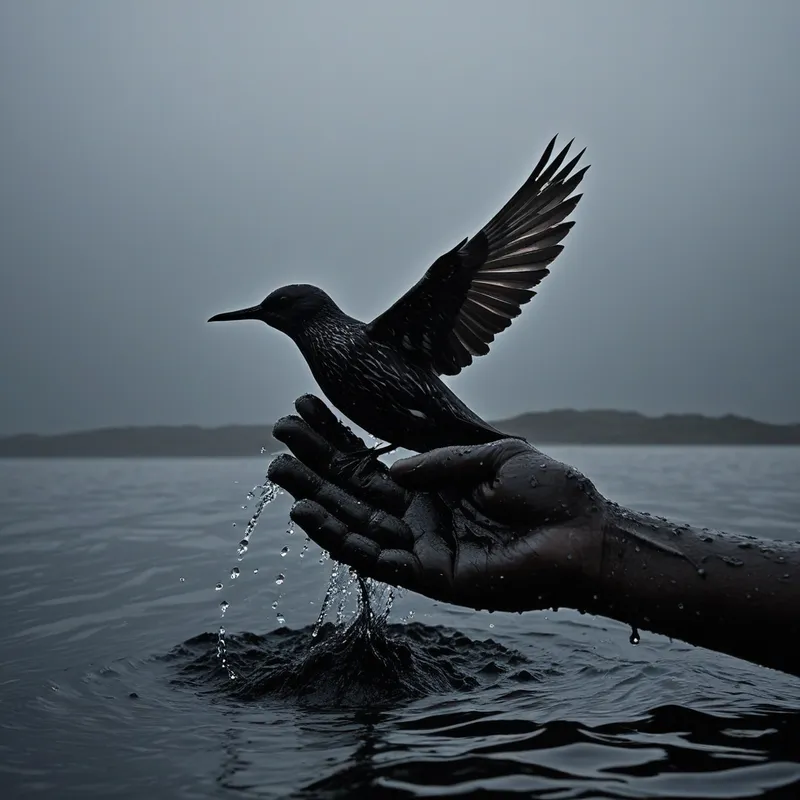
On the third dive, the bird pushed beyond its own endurance, driven by the shared dream of Buga. Its lungs burned, its wings ached, and the pressure of the deep sought to crush its spirit. Just as it was to be lost forever, its foot brushed not water, but something grainy, something solid. With the last of its strength, it clutched a tiny piece of this substance in its claw and fought its way back toward the faint memory of light.
It broke the surface, gasping, dying, and placed into Buga’s waiting hands a single, precious clump of primal earth. Then, its Spirit spent, it sank. But Buga acted. Holding the tiny seed of the world, Buga breathed upon it the warmth of intention. He placed it carefully upon the broad, floating back of the noble bird, who now rested, giving its form as the first altar.
And the earth grew. It spread from that single point, multiplying, expanding across the bird’s back, becoming an island, then a vast plain, then mountains that pushed their heads toward the sky. Buga walked upon it, and where Buga’s feet touched, rivers flowed and forests sprang up. The world was born not from a command, but from a collaboration—a desperate dive, a willing sacrifice, and a nurturing breath upon a gift wrested from the abyss.
Cultural Origins & Context
This creation narrative belongs to the Evenki people, whose traditional homelands span the vast taiga and tundra of Siberia. For nomadic hunters living in intimate dialogue with an immense and often harsh landscape, the myth of Buga was not mere entertainment; it was a foundational cosmology. It was told not from books, but from memory, passed down through generations by shamans and elders around crackling fires, the scent of pine smoke and drying hides in the air.
The story served multiple vital functions. Firstly, it answered the primary human question: “Where did all this come from?” It rooted the people’s existence in a specific, sacred act of procurement and growth. Secondly, it established a fundamental ethical and ecological relationship. The world is not a given, but a gift, born from the sacrifice of another creature (the water-bird). This instills a profound respect for the animal world and the very earth itself, framing humanity not as conquerors but as beneficiaries of a sacred trust. The shaman, the community’s intermediary with the spirit world, would invoke this myth to maintain balance, seeing in their own spiritual “dives” for healing knowledge a reflection of the bird’s primordial quest.
Symbolic Architecture
At its heart, this is a myth about the emergence of Order from Chaos. The endless water represents the unconscious, the unformed potential of the psyche and the universe. Buga represents the first stirring of consciousness—a desire for distinction, for a Self that can stand apart and observe.
The first act of creation is not making, but wanting. A longing in the void for something to hold.
The Bird is the instinctual force, the animal spirit that can navigate the depths where conscious intention cannot yet go. Its repeated dives symbolize the persistent, often failing, efforts required to bring a fragment of latent potential (the Earth) into the light of awareness. The fact that the earth is found not by Buga, but for Buga by another, is crucial. It signifies that the foundational elements of our being—our instincts, our bodily wisdom—are not created by the ego, but retrieved from the deep unconscious through a mediated, often perilous process.
The bird’s near-death and its transformation into the foundation of the world is the ultimate Sacrifice. The instinctual, mobile creature becomes the stable ground of being. This is the alchemical price of creation: one state must die for another to be born.
The Dreamer's Resonance
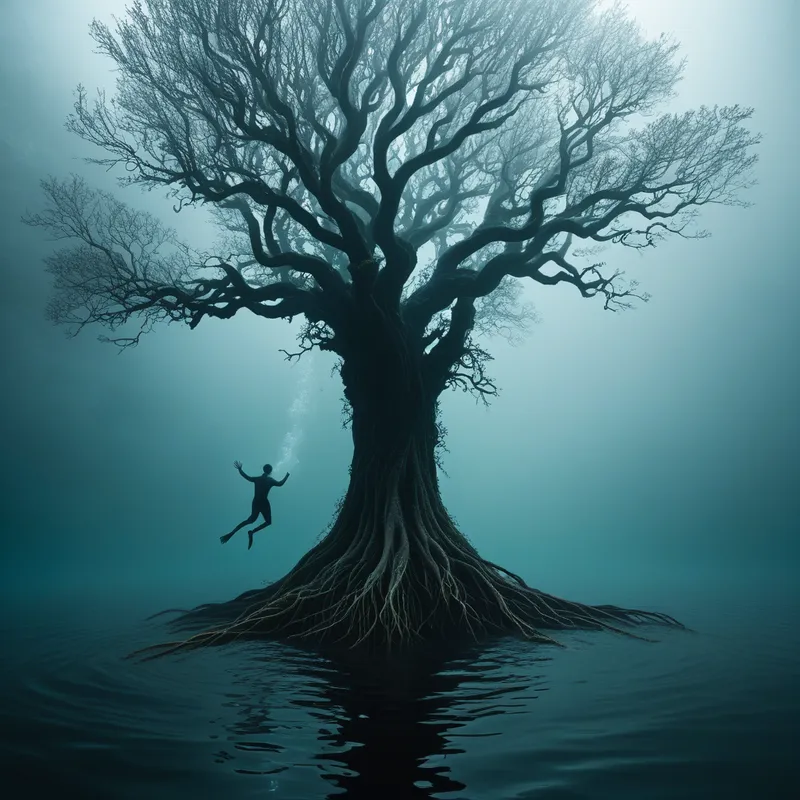
When this mythic pattern stirs in the modern Dream</abrand, it often signals a profound inner process of foundation-building. You may dream of diving into dark Water, of searching the murky bottom of a lake or ocean for a lost object. There is a somatic quality of pressure, of breath being held, of a desperate need to find something.
This is the psyche’s depiction of a “soul dive.” The dreamer is, like the water-bird, attempting to retrieve a piece of their own primal “earth”—a core truth, a buried talent, a forgotten trauma, or a foundational identity—from the chaotic depths of the personal or collective unconscious. The feeling upon waking is often one of exhaustion mixed with determination. The dream is a rehearsal, showing that the process is arduous and requires multiple attempts, but that the sought-after substance does exist below the surface of daily consciousness. Failure in the dream is not a sign to stop, but a mythic echo of the necessary perseverance.
Alchemical Translation
For the individual, the myth of Buga maps the early, crucial stages of Individuation. We all begin in a state of psychic chaos—the blended influences of family, culture, and unconscious drives. The conscious ego (Buga) feels a restless longing for solid ground, for a distinct and authentic Self.
The psyche’s first land is always built on the back of a sacrificed instinct.
The “dive” is the courageous descent into self-analysis, therapy, or creative exploration. It is the hard, often discouraging work of sifting through the murky waters of memory, habit, and shadow. The retrieved “earth” is that first, solid insight: “This is who I am at my core.” It might be a reclaimed passion, an acknowledged wound, or a fundamental value.
But the process doesn’t end with retrieval. The alchemical work is in the “breathing upon” this insight—nurturing it, expanding it, and finally, building a stable life upon it. The sacrificed “bird” represents the old, unconscious ways of being that must be transformed to serve as the foundation for the new, conscious structure. The ego does not create the Self from nothing; it midwifes its birth from materials offered up by the deeper, instinctual layers of the psyche, in a sacred pact that forever ties our consciousness to the animal and elemental world from which it arose.
Associated Symbols
Explore related symbols from the CaleaDream lexicon:
- Water — The primordial, chaotic unconscious from which all form must be retrieved, representing both the source of life and the abyss of the unknown.
- Bird — The instinctual helper and diver, symbolizing the aspect of the psyche that can navigate the unconscious depths to retrieve foundational truths.
- Earth — The foundational substance of reality and self, representing stability, form, and the material born from chaotic potential.
- Chaos — The undifferentiated state before creation, the formless void that contains all possibilities but no distinctions.
- Order — The principle of structure and consciousness that emerges from chaos, represented by the spreading land and the act of creation itself.
- Sacrifice — The essential act of giving up one state of being (the bird's freedom) to enable the birth of another (the solid world).
- Spirit — The animating presence of Buga and the driving force behind the creative longing and the collaborative pact.
- Journey — The perilous, repeated dive into the depths, symbolizing the difficult inner quest required for any act of true creation or self-discovery.
- Dream — The initial state of potential from which Buga's longing emerges, mirroring the creative power of the dreaming psyche.
- Creator — The archetypal force of Buga, representing the conscious will that seeks to give form to the formless and manifest a world.