Buffalo Trails Myth Meaning & Symbolism
A myth of sacrifice and renewal where the Buffalo People offer themselves, creating the sacred trails of life and teaching humanity the law of reciprocity.
The Tale of Buffalo Trails
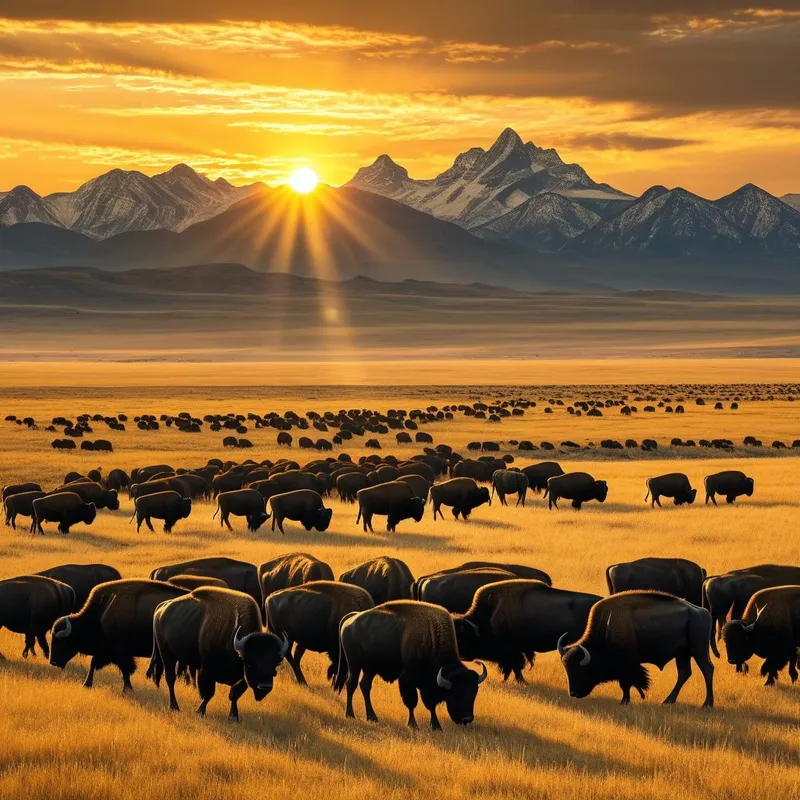
In the time before time, when the earth was new and the people were few, the world was a vast, silent plain. The people were hungry, and their spirits were thin as winter grass. They looked to the horizon, where the great Pte Oyate lived—the Buffalo People. These were not mere animals; they were a nation of immense power and spirit, their dark shoulders holding up the sky, their thunderous breath the wind itself. They moved as one great, living shadow across the land, and the people could only watch from afar, their stomachs hollow, their prayers rising like smoke.
One winter, when the cold bit to the bone and the last berries were memory, a young hunter, his heart heavy with the cries of the children, ventured further than any had dared. For seven days and seven nights, he walked, following not tracks, but a feeling—a deep, resonant hum in the earth. On the eighth morning, as dawn painted the sky in blood and gold, he crested a hill and saw her.
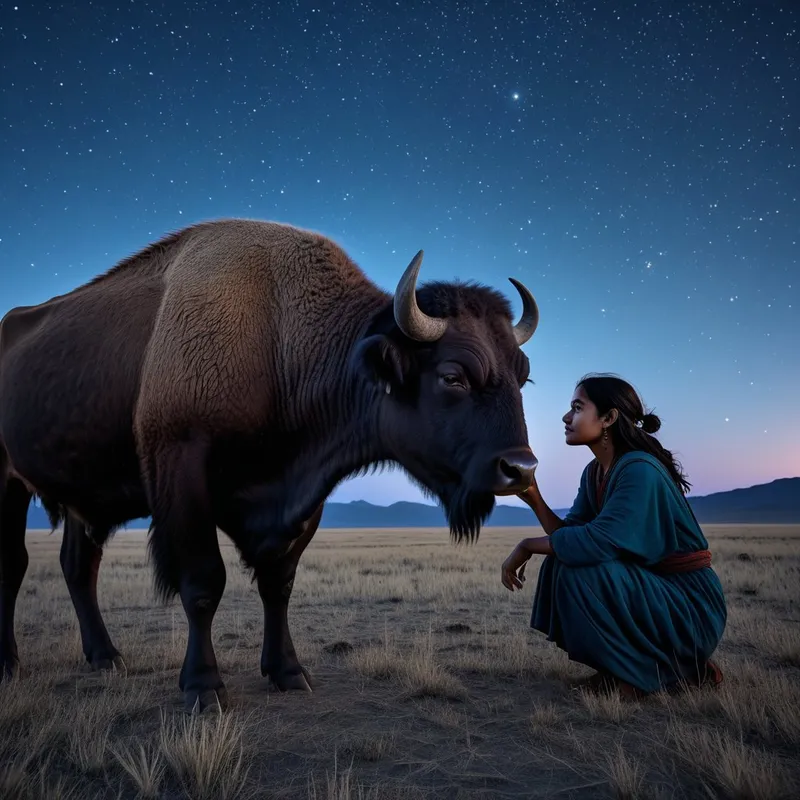
She stood apart from the distant herd, a great matriarch, her horns curving like the bow of the moon, her eyes holding the patience of stone and the wisdom of deep springs. She did not flee. She lowered her massive head and looked at him, and in that look, he saw not an animal to be hunted, but a sovereign being offering a council.
“You have followed the longing in your heart,” her silence seemed to say. “It has led you to me. My people see your hunger. We hear the songs of your grandmothers. The earth is our mother, as she is yours. But life cannot be taken; it must be given.”
The hunter fell to his knees, not in triumph, but in awe. The great buffalo cow knelt before him, her breath warm and sweet with sage. “We will give ourselves to you,” the understanding flowed into him, not as words, but as a truth etched into his spirit. “But you must give yourself to us. You must promise to honor the gift, to use all that we provide, to sing our spirits back to the grass, and to follow the trails we make, for they are the sacred paths of life itself.”
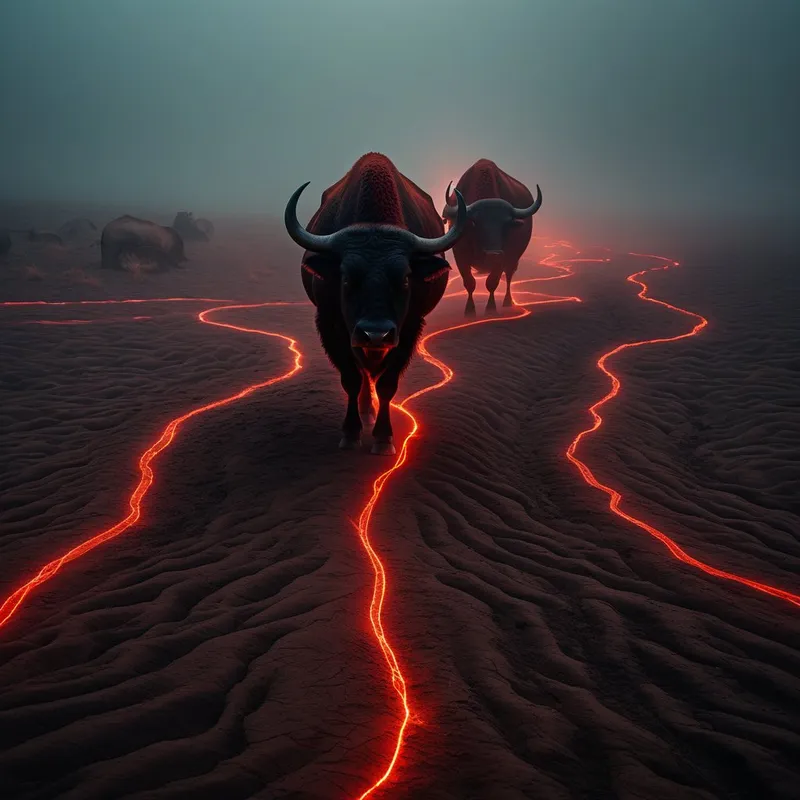
As the sun climbed, the great cow laid herself down upon the earth. With a final, deep sigh that stirred the dust into tiny whirlwinds, her spirit departed. But as it did, a miraculous thing began to happen. From where her body lay, a soft, glowing path began to etch itself into the prairie, a trail of shimmering light. Then another, and another, radiating out from the herd across the plains, over the hills, becoming rivers, becoming valleys, becoming the very migratory routes of life. The Buffalo People began to move, and where their hooves touched, the trails shone brighter, mapping a vast, pulsing network of reciprocity between all beings. The hunter understood. The gift was not just the flesh, but the path. The sustenance was not just the body, but the way.
Cultural Origins & Context
The stories of the Tatanka and the origins of the buffalo trails are foundational to many Plains Indigenous nations, including the Lakota, Nakota, Dakota, Blackfoot, and Crow. These narratives were not mere folklore but sacred ohunkakan, told during specific times, often in winter, by respected storytellers and elders. The telling was a ceremonial act, a way of transmitting law, ecology, and spiritual understanding.
The myth functioned as the bedrock of a complex relational worldview. It established the sacred covenant of the hunt, which was governed by elaborate protocols of prayer, gratitude, and meticulous use of every part of the animal. It explained the physical landscape—the very trails and migration routes that were the continent’s highways. Most importantly, it encoded the principle of Mitakuye Oyasin. The buffalo were elder brothers, sovereign nations who engaged in a conscious, reciprocal relationship with humanity. The trails were the visible manifestation of that relationship, a contract written on the land itself.
Symbolic Architecture
At its heart, the myth of Buffalo Trails is a profound map of a conscious universe built on the principle of sacred exchange. The Pte Oyate symbolize the ultimate Caregiver archetype, but one that demands conscious participation from the recipient.
The gift is never free; its price is the responsibility of right relationship. The trail is both a blessing and a binding treaty.
The Trails themselves are the central symbol. They are the paths of destiny, the routes of migration (both physical and spiritual), and the neural pathways of a living, sentient landscape. They represent law, order, and the predetermined yet sacred way of life. To stray from the trail is not just to get lost; it is to break the covenant, to fall into the chaos of taking without giving.
The Hunter’s Journey represents the human quest for sustenance, meaning, and connection with the greater powers of the world. His successful approach is not through force or cunning, but through humility, perseverance, and an open heart—a readiness to receive instruction. The moment of meeting is a hierophany, a rupture in ordinary reality where the divine law is communicated.
The Dreamer's Resonance
When this myth stirs in the modern dreamer, it often surfaces during periods of profound lack—not just material, but spiritual, emotional, or creative. To dream of following a buffalo trail is to dream of seeking a sacred contract with one’s own sustenance.
You may dream of walking a faint, glowing path across an endless plain, feeling a deep, somatic pull in your feet, a knowing that you are on a "right" path ordained by a larger intelligence. Conversely, to dream of being lost, of seeing the trails but being unable to find their beginning, speaks to a disconnect from one’s own inner covenant, a feeling of taking life without giving back to it. The buffalo in the dream may appear as a looming, silent presence—not threatening, but immensely demanding. Its gaze asks the critical, somatic question: What are you willing to give in exchange for what you need to live? The dream process is one of re-negotiating one’s fundamental relationship with the source of one’s life, moving from a mindset of consumption to one of conscious, sacred reciprocity.
Alchemical Translation
Psychologically, the myth models the alchemical process of solve et coagula—dissolving the old, isolated ego and coagulating a new, relational self. The modern individual often operates under the illusion of the self-made person, taking resources, energy, and opportunities from the world (the herd) without a conscious practice of return. This leads to a spiritual famine, a hollowing out.
Individuation is not about becoming a sovereign island, but about discovering the sacred trails that connect your sovereignty to the sovereignty of all other beings.
The Dissolution (Solve) is embodied by the hunter’s hungry, desperate journey. His old way of being—passive waiting, disconnected longing—breaks down. He is stripped bare on the plain.
The Conjunction is the miraculous meeting. This is the critical moment of psychic transmutation where the ego (the hunter) consciously encounters the Self (the buffalo matriarch), the archetypal source of life and nourishment. It is not a battle but a solemn agreement. The ego does not conquer the source; it enters into a treaty with it.
The Coagulation (Coagula) is the creation of the trails. This is the new, enduring structure of the psyche. The gift of life (energy, creativity, vitality) is received, but with it comes the enduring responsibility—the trail. The integrated individual no longer wanders aimlessly. They walk a conscious path, knowing that for every step taken, for every resource drawn upon, a song of gratitude must be sung, a portion must be given back to the earth of the soul, to the spirit of the endeavor. The trail is the individuated life path, now understood as part of a vast, reciprocal network. To walk it is to be both sustained and sustainer, forever bound in the sacred, giving circle of Mitakuye Oyasin.
Associated Symbols
Explore related symbols from the CaleaDream lexicon: