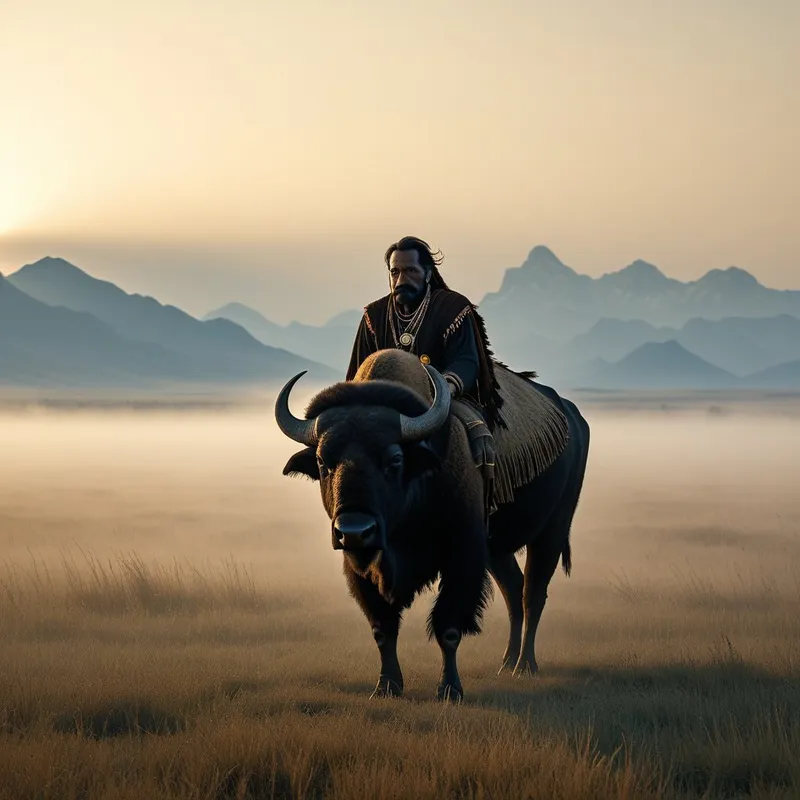
Buffalo Hunt Myth Meaning & Symbolism
A sacred story of a visionary hunter who learns the ritual of reciprocity, ensuring the buffalo return and life continues in a sacred cycle.
The Tale of Buffalo Hunt
Listen. The world was hungry.
The People moved across the great plains, their bellies tight as dried hides. The buffalo, the great Pte Oyate, the Buffalo Nation, had vanished. They were not hiding behind the hills. They were gone from the world itself, as if the earth had swallowed them whole. The hunters returned each day with empty hands and emptier eyes. The children grew quiet. The elders’ prayers seemed to rise and scatter like smoke in a high wind.
Among them was a hunter, known more for the depth of his heart than the strength of his arm. He watched his people diminish. One morning, as a cold sun bled into the sky, he took his bow, his last arrow, and a resolve that felt like a stone in his chest. He did not tell his family he was leaving. He simply walked west, toward the place where the land meets the sky, following a thread of desperation that felt like a calling.
For four days he walked, drinking from scarce streams, eating nothing. His body became a light, aching shell. On the fourth day, he climbed a high, solitary butte. The wind there was a constant voice. He lay down on the stone, offering his weakness to the vastness. He did not ask for a hunt. He asked for a vision. He asked to understand.
Exhaustion pulled him into a space between waking and dreaming. The sky darkened, then swirled with colors that had no name. From this vortex, a being descended. It was a great Buffalo Spirit, but vaster than any herd. Its coat was the night sky, its eyes were pools of dark, liquid wisdom, and its breath was the warm wind of creation. It stood over the hunter, not with threat, but with immense, patient presence.
“You seek my people,” the spirit’s voice echoed not in the air, but in the hunter’s bones. “You seek to take. But do you know how to give? Do you know the sacred hoop?”
The hunter, in his dream-state, had no words. He offered only his open, empty hands.
The Buffalo Spirit showed him. It showed the great herds moving like a single, breathing entity across the plains. It showed the grass growing from the soil enriched by their droppings. It showed the People taking a buffalo—the meat for food, the hide for shelter, the sinew for thread, the bones for tools. And then it showed the critical, missing piece: the songs of gratitude sung to the spirit of the slain animal. The careful placement of the heart or the skull on a scaffold of respect. The understanding that the buffalo’s life was not taken, but asked for, and given in a covenant of reciprocity. The spirit’s life-force would return to the Pte Oyate, ensuring the cycle would continue.
“We give ourselves so that you may live,” the spirit intoned. “And you must give your honor, your ceremony, so that we may return. This is the law. This is the hunt.”
The vision faded. The hunter awoke on the cold stone, but the knowledge was fire in his veins. He was weak, but he was full. Staggering back to his people, he gathered the elders and the holy men. He taught them the songs, the prayers, the rituals of profound respect he had been shown. Skepticism turned to awe as they performed the first ceremony with true understanding.
The next morning, a scout’s cry echoed through the camp. On the horizon, a dark, moving line appeared. It thickened, it rumbled, it became a tide of life. The buffalo had returned. The hunt that followed was not a slaughter; it was a sacred dialogue. The first animal taken was honored with every step of the ritual. The people were fed, clothed, and saved. The hunter had not brought back mere meat; he had brought back the covenant itself, the sacred hoop of giving and receiving, mended and made whole.

Cultural Origins & Context
The myth of the visionary Buffalo Hunt is not a single, fixed story but a profound narrative pattern found across many Plains tribes, including the Lakota, Cheyenne, Blackfoot, and others. For cultures whose physical and spiritual existence was inextricably linked to the American bison, the sudden, unexplained disappearance of the herds was an existential crisis of the highest order. This myth provided the theological and practical framework for that crisis.
It was not merely a story of “how we got food.” It was a foundational charter for an entire ecological and spiritual worldview. The myth was typically transmitted by spiritual leaders, storytellers, and elders during ceremonies, winter counts, and initiatory teachings. Its function was multifaceted: it encoded critical survival ethics (conservation, using every part of the animal), established the proper protocols for hunting (ritual purity, prayer), and, most importantly, it instilled the core cultural value of reciprocity. The myth taught that survival was not an act of dominance, but of participation in a sacred, living system. The hunter’s quest was less about conquest and more about attaining the wisdom necessary to fulfill his side of a cosmic bargain.
Symbolic Architecture
At its heart, this myth is a blueprint for a conscious relationship with the Source of life. The vanished buffalo represent not just physical scarcity, but a spiritual disconnection. The life-force of the world has withdrawn because the proper relationship—one of honor, gratitude, and conscious exchange—has been broken.
The hunter is the archetypal human consciousness confronted with this barrenness. His journey is an askesis, a purposeful stripping away. His physical hunger on the butte is the necessary emptiness that makes room for revelation. He does not force a solution; he makes himself a vessel for it.
The true hunt is always an inward journey to find the sacred law that restores the flow between the self and the nourishing world.
The Buffalo Spirit is the numinous aspect of the natural world itself, the anima mundi or world-soul, which is willing to engage in relationship but demands conscious participation. The ritual it imparts is the symbolic act that transforms taking into receiving, and slaughter into sacred sacrifice. The returned herd symbolizes the bounty that flows naturally when the psyche (and by extension, the culture) aligns itself with the principles of reciprocity and respect.

The Dreamer's Resonance
When this myth stirs in the modern dreamer, it often signals a profound psychological famine. One may dream of searching endlessly in a barren landscape, of a workplace or home that is devoid of sustenance, or of a crucial resource—energy, love, creativity—that has mysteriously vanished. The somatic feeling is one of hollow yearning and depletion.
The dream-ego’s subsequent journey mirrors the hunter’s: a movement away from collective despair toward a solitary, elevated space of introspection (the butte). The appearance of a powerful, guiding animal spirit—be it a buffalo, a whale, a wolf, or another majestic creature—marks the moment the unconscious is ready to impart the missing “law.” This is often a dream of instruction, where the dreamer is shown a simple but profound ritual or understanding. The psychological process is the unconscious compensating for a one-sided conscious attitude of endless consumption (of time, resources, energy) without the counter-balance of gratitude, honoring, or giving back. The dream calls for the establishment of an inner ceremony to restore balance.

Alchemical Translation
For the individual on the path of individuation, the Buffalo Hunt myth models the alchemical opus of psychic transmutation. The initial state is the nigredo: the darkening, the famine of meaning, where the vital energies of the soul (the buffalo) have retreated.
The hero’s lonely quest represents the necessary separatio—withdrawing from the collective panic to confront the Self. The visionary encounter on the butte is the coniunctio, the sacred marriage between the desperate human ego and the transpersonal, nourishing spirit of the deep psyche (the Self symbolized by the Buffalo Spirit). The ritual knowledge granted is the alchemical formula, the precise inner action required to transform leaden scarcity into golden sustenance.
Individuation is not about acquiring more of the self, but about learning the sacred ritual of exchange with the Self.
The final stage, the return and enactment of the ritual leading to the herd’s return, is the rubedo: the reddening, the return of vitality and fullness to life, now operating under a new, conscious law. The modern individual completes this cycle not by hunting physical buffalo, but by identifying what in their life they “take” without honor—their time, their relationships, their own talents—and instituting a personal “ritual” of gratitude and conscious reciprocation. In doing so, they no longer exploit their own inner world or the outer world; they engage with it. They restore the sacred hoop within their own psyche, and the buffalo—in the form of renewed energy, purpose, and creativity—always return.
Associated Symbols
Explore related symbols from the CaleaDream lexicon: