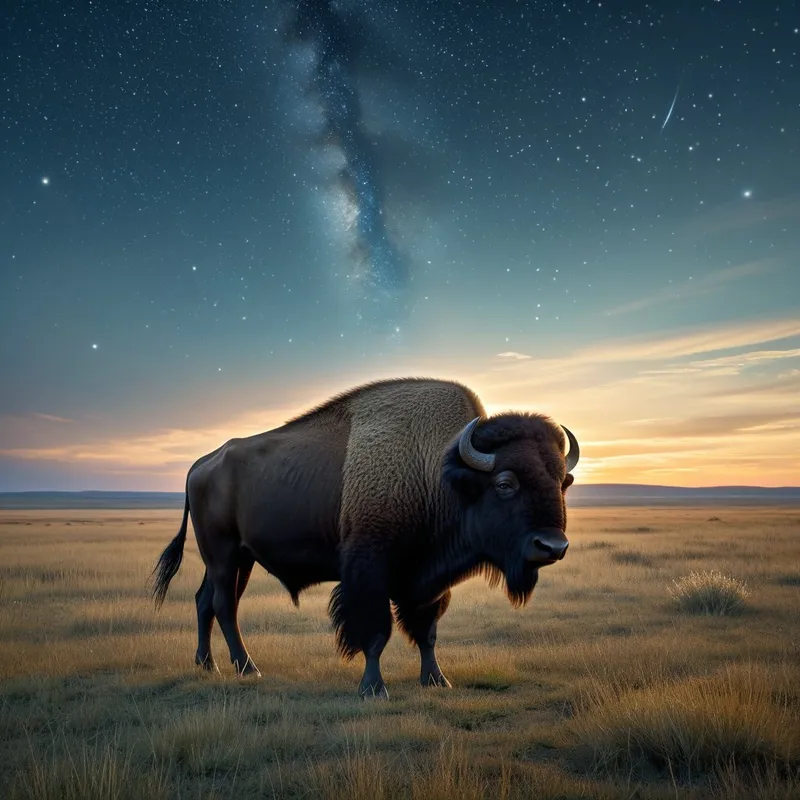
Buffalo Hide Myth Meaning & Symbolism
A myth where a great hunter's sacrifice and a buffalo's gift forge a sacred covenant of life, death, and renewal for the people.
The Tale of Buffalo Hide
Listen. The wind on the high plains does not just blow; it carries memory. It carries the time when the People were new to the earth, and their bellies were hollow with a hunger that was more than physical. It was a hunger of the spirit, a longing for the right way to live. The great herds of the Buffalo were like a distant storm cloud on the horizon—present, powerful, but untouchable. The hunters would return empty-handed, their arrows finding only grass. Despair, cold and sharp as flint, began to chip away at the heart of the camp.
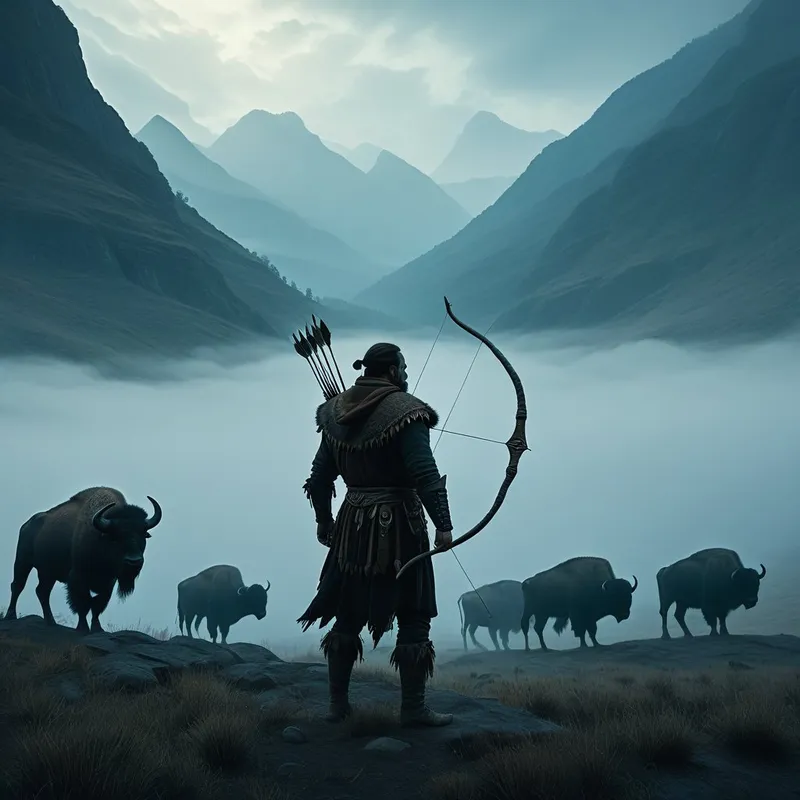
Among them was a man known for his strength and his silence. He was a hunter whose eyes missed nothing, yet now he saw only absence. One evening, as the fire spat weak sparks into a vast, uncaring sky, he stood. His face was carved from the same worry that lined every face, but in his eyes was a terrible resolve. “I will go,” he said, his voice the sound of dry stones rubbing together. “I will not return until I have found an answer for the People, or I will become part of the silence.”
He walked. He walked until the circle of the world seemed to close behind him. He walked until his moccasins were dust and his body was a rack of bones held together by will alone. He fasted, and prayed, and offered his suffering to the four directions. In his weakness, the veil between the worlds grew thin.
On the fourth day, as a purple dusk bled into the land, the earth itself seemed to shift. From a fold in the prairie emerged not one buffalo, but a council of them. They were not mere animals; they were Spirit-Buffalo, immense and shimmering with a light that came from within. Their breath was the mist of creation, and their eyes held the patience of mountains. The greatest among them, a bull whose horns scraped the belly of the sky, stepped forward.
The hunter had no strength for fear. He had nothing left to offer but his own emptiness. He laid down his last arrow, his bow, and himself upon the ground. “I have come with nothing,” he whispered to the earth. “I ask for nothing for myself. But my people are dying. Show us the way.”
The great Spirit-Buffalo lowered its head. There was no anger in its gaze, only a deep, appraising sorrow. It spoke, not with a voice, but directly into the hunter’s spirit. “You have offered your life. You have shown respect. You understand that to take, one must first give. Now, see.”
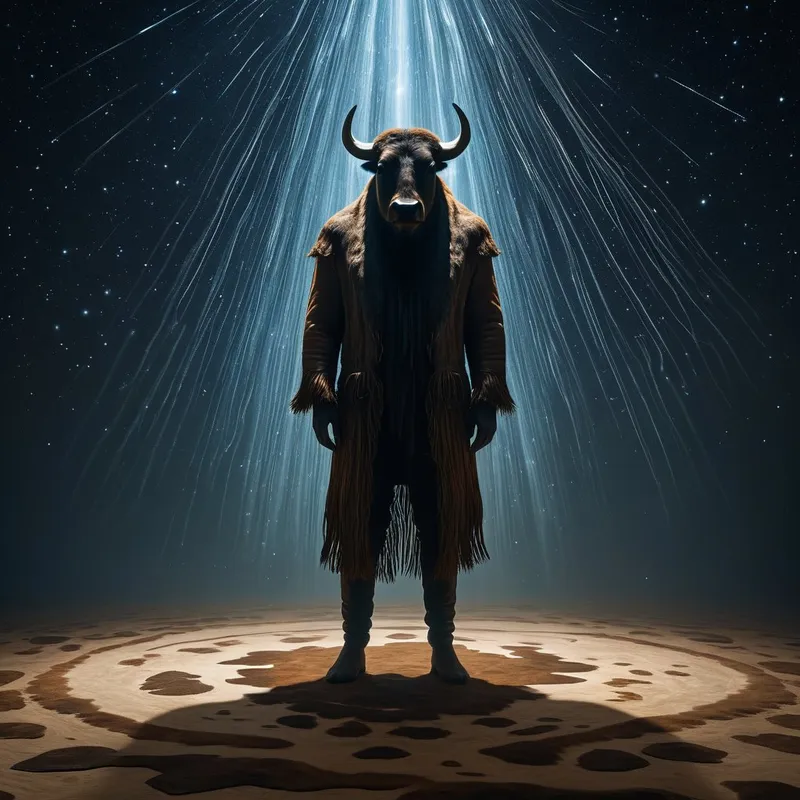
The bull knelt. And then it began to change. Its mighty form softened, blurred, and flowed like water. Its great hide peeled away, not in a gory spectacle, but in a sacred transformation. The hide spread upon the ground, vast as a landscape. Upon its inner surface glowed a map—not of places, but of truth. It showed the dance of the hunt, the prayer of gratitude, the use of every part from hoof to horn, so that nothing was wasted and death was not an end but a return. It showed the covenant: the Buffalo would give its body so the People might live, and the People, in turn, would honor that gift with ceremony, song, and stewardship.
The hunter wept. He understood. When the vision faded, he was alone on the prairie, but he was not empty. Before him lay a tangible gift: a perfect buffalo hide. Carried by a strength that was not his own, he returned to his people. He showed them the hide and taught them the sacred ways inscribed upon his heart. The next hunt was different. It was a prayer in motion. The buffalo came, and they gave themselves. The people ate, and they gave thanks. The circle, broken by hunger, was mended by sacrifice and reciprocity. The hide became their first altar, the tangible proof of the bond that would sustain them forever.
Cultural Origins & Context
The myth of Buffalo Hide finds its deepest roots among the many Plains Nations, including the Lakota, Cheyenne, Blackfoot, and others, for whom the American Bison was not merely a resource but the cornerstone of existence. This story is a cosmogonic myth, explaining the origin of the sacred relationship between humans and buffalo. It was not a tale for casual entertainment but a core teaching narrative, passed down through generations by elders and storytellers, often during winter camps or important ceremonies.
Its societal function was multifaceted. Primarily, it encoded the ethics of the hunt and the imperative of conservation long before the term existed. It taught that survival was a spiritual contract, not a right of conquest. The myth also served as a model for visionary quests, illustrating the proper attitude—humility, sacrifice, perseverance—required to receive spiritual guidance. It grounded the people’s identity, reminding them that their way of life, their food, shelter, and tools, were gifts born from a sacred pact, making them responsible partners in the web of life.
Symbolic Architecture
At its heart, the myth is a profound blueprint for the relationship between consciousness (the human) and the deep, instinctual life of the body and earth (the buffalo). The hunter’s desperate journey represents the ego’s confrontation with its own limits and its ultimate insufficiency.
The ego must be stripped bare, offered up, and dissolved before the Self—the greater, transpersonal spirit—can be encountered.
The Buffalo is the archetypal symbol of abundant, unconditional life force and the nourishing power of the instinctual world. Its initial absence signifies a psychic state where the conscious mind is cut off from its vital, sustaining roots, leading to spiritual famine. The transformation of the buffalo’s hide into a map is the critical symbol. The hide represents the interface—the sacred boundary where spirit becomes manifest, where the formless wisdom of the unconscious is translated into a tangible pattern for conscious life.
The covenant established is the myth’s central psychological truth: wholeness requires a reciprocal relationship between our conscious intentions and the autonomous, powerful energies of the psyche. We cannot simply plunder our inner depths for inspiration or energy; we must approach with respect, make offerings of our attention and sincerity, and agree to honor what we receive.
The Dreamer's Resonance
When this myth stirs in the modern dreamscape, it often surfaces during periods of profound lack—not necessarily material, but emotional, creative, or spiritual. To dream of a barren landscape where a sought-after animal (a bull, a bison, a powerful beast) is elusive mirrors the hunter’s initial quest. The dreamer may feel they are expending great effort in life but receiving no sustenance, no “meat” for their soul.
The transformative moment in such dreams might appear as encountering a powerful animal that does not flee, or finding a skin, pelt, or blanket with strange markings. This signals that the psyche is ready to offer its wisdom if the dreamer adopts the correct posture: one of surrender and sacred petition. The somatic experience can be one of immense relief, a feeling of being “filled” after a long emptiness, or a visceral understanding of a “deal” or “agreement” being struck at a level deeper than words. It is the dream-ego learning the law of reciprocity with the Self.
Alchemical Translation
The alchemical process modeled here is the nigredo followed by the albedo. The hunter’s starvation and despair are the nigredo—the blackening, the utter dissolution of the old, prideful way of seeking (the failed hunt). His offering of himself is the crucial surrender of egoic will.
The Spirit-Buffalo’s transformation is the albedo—the whitening, the illumination. The raw, massive power of instinct (the buffalo) is transmuted into a structured, intelligible guide (the mapped hide). This is the moment of revelation, where the unconscious ceases to be a frightening, chaotic force and reveals itself as an ordered, purposeful partner.
Individuation is not about conquering the inner wilderness, but about receiving its constitution and agreeing to its laws.
For the modern individual, the “Buffalo Hide” process asks: Where am I spiritually hungry because I am only taking, not giving? What part of my instinctual, creative, or emotional self have I treated as a mere resource to be exploited? The alchemical work is to embark on a deliberate “fast” from our habitual demands on ourselves and the world—to stop, to listen, and to make an offering of our sincere need. The transformed “hide” we receive might be a new creative practice, a healed relationship with the body, or a simple, clear knowing of the next right step. It is the psyche’s gift of a sustainable pattern for life, granted only after we acknowledge the sacredness of the source.
Associated Symbols
Explore related symbols from the CaleaDream lexicon: