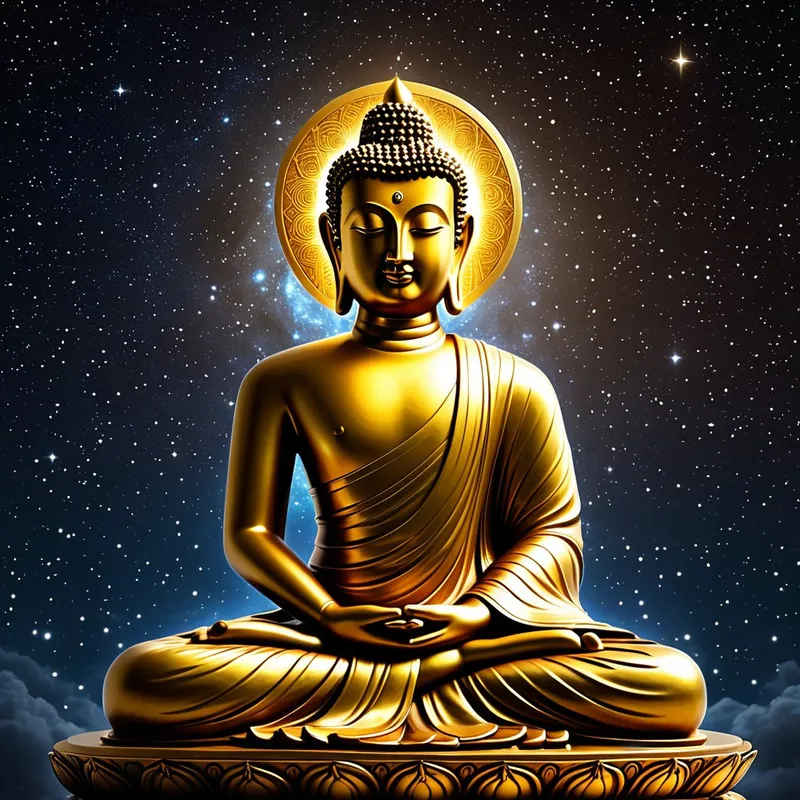
Buddha's Ushnisha Myth Meaning & Symbolism
The story of the Buddha's Ushnisha, a sacred cranial mound representing the full flowering of enlightened awareness beyond all dualistic thought.
The Tale of Buddha's Ushnisha
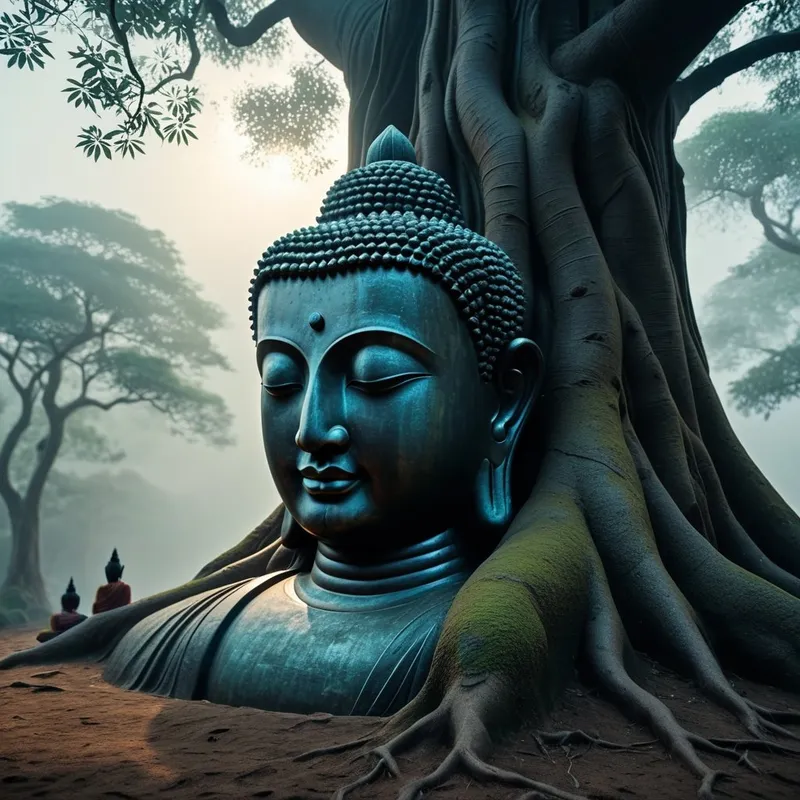
Beneath the ancient, sprawling limbs of the Bodhi tree, a man sat upon the unyielding earth. His name was Siddhartha, but the world he was about to shatter would soon know him by another. The air was thick, not with moisture, but with the weight of all existence. He had vowed not to rise until he had pierced the final veil, until he understood the root of suffering itself.
As dusk bled into night, the shadows around him began to stir. Not the shadows of branches, but of the mind. From the depths of ignorance and fear, Mara, the tempter, arose. He did not come as a monster, but as a symphony of distraction—a chorus of whispered doubts, the seductive ghosts of past pleasures, the terrifying specters of future pains. "By what right do you seek this knowledge?" Mara thundered, his voice the sound of a thousand crumbling worlds. "Who will bear witness to your claim?"
The seated man did not flinch. His hand moved, a gesture slow as continents shifting, and touched the ground beneath him. "This earth," he whispered, and his voice was the bedrock of reality, "is my witness." At that touch, the earth herself roared in affirmation. Mara and his legions of illusion shattered like glass against that silent, immovable truth.
Then, in the profound stillness that followed the tempest’s retreat, something began to unfold. It was not a sound, nor a light, but a deepening. The seeker’s consciousness, having turned inward through lifetimes of practice, now turned upon the very instrument of turning. He saw the ceaseless chain of cause and effect, the endless wheel of Samsara, not as a philosopher, but as one who had walked every mile of its dusty road. He saw his own countless births and deaths, and in seeing them, he saw they were not his own. The knot of selfhood loosened.
And as this supreme, unconditioned wisdom dawned—not as an idea, but as the very fabric of his being—his form underwent a subtle, sacred transformation. The crown of his head, the seat of the highest spiritual center, the Sahasrara, could no longer be contained by ordinary human shape. It swelled, not with flesh, but with the palpable substance of realization. A mound arose, smooth and firm like a perfected Cintamani. This was the Ushnisha. It was not an adornment, but an emanation. The vessel had become perfectly shaped to hold the ocean of Dharma. Where once sat a seeker, now sat the Buddha, his silent form crowned by the very wisdom that had set him free.
Cultural Origins & Context
The Ushnisha is one of the thirty-two major and eighty minor Lakshanas, or "marks of a great man," described in ancient Buddhist texts like the Lakkhana Sutta. These marks were not invented by the early Buddhist community but were drawn from a pan-Indian physiognomic tradition that associated specific physical traits with supreme spiritual and temporal potency—a Chakravartin or a Buddha.
The mythic narrative of its manifestation is inextricably woven into the core story of the Buddha’s enlightenment. It was passed down orally by the Sangha and later codified in sutras and Abhidharma texts. Its primary function was not merely descriptive but devotional and pedagogical. For devotees, the Ushnisha on statues and paintings served as an immediate, visual testament to the Buddha’s transcendent state, a symbol so integral that to represent the Buddha without it became unthinkable. It anchored the abstract concept of enlightenment in a tangible, iconic form, making the inconceivable slightly more accessible to the reverent eye.
Symbolic Architecture
The Ushnisha is the ultimate symbol of psychic integration and the triumph of consciousness over fragmentation. It represents the culmination of the spiritual journey, where all dualities—self and other, sacred and profane, wisdom and ignorance—are resolved into a seamless, unified whole.
The Ushnisha is not an addition, but a revelation. It is the hidden shape of the mind, made visible only when every inner conflict has been resolved into silent, potent wholeness.
Psychologically, it signifies the full activation and integration of the highest faculties of the mind. It is the physical metaphor for the "crowning" achievement of individuation, where the personal ego is not destroyed but subsumed into a vaster, transpersonal awareness. The head, the seat of intellect and identity, transforms to accommodate a knowledge that is not intellectual but existential. It symbolizes containment—the ability to hold the boundless within a defined form, the infinite within the finite. It is the stable, calm apex that results when the chaotic energies of the psyche (Kleshas) have been completely purified and transmuted into luminous awareness (Vijnana).
The Dreamer's Resonance
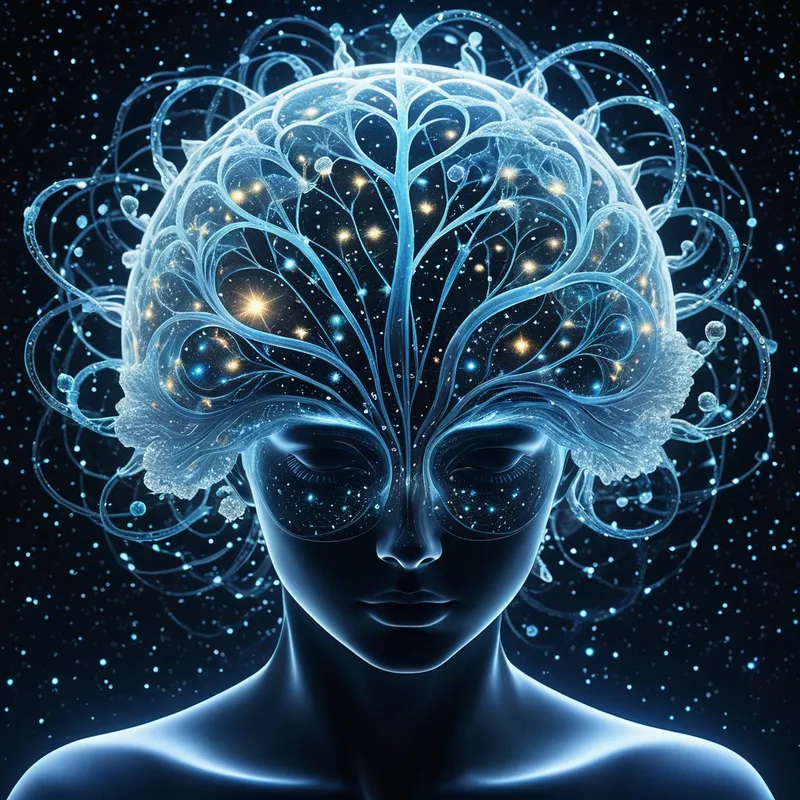
When this mythic pattern stirs in the modern dreamer, it often signals a profound process of cognitive and spiritual restructuring. One might not dream of a literal Ushnisha, but of its symbolic equivalents: the head feeling heavy with insight, a crown of light or crystal forming at the crown, the skull becoming transparent or expanding, or a sense of immense pressure and then release at the top of the head.
Somatically, this can correlate with sensations often reported in deep meditation or during psychic breakthroughs—tingling at the crown, a feeling of "opening," or a headache that resolves into clarity. Psychologically, the dreamer is assimilating a level of understanding or experience that their ordinary identity struggles to contain. It is the psyche's way of depicting the birth of a new, more capacious "vessel" for consciousness. The conflict in such dreams is often between this expansive pressure and the old, familiar limits of the self. The resolution is the peaceful, awe-inspiring emergence of a new form—a symbol of the ego successfully making room for the Self.
Alchemical Translation
The alchemical process mirrored in this myth is the sublimatio—the distillation and elevation of base matter into its highest, most refined state. The "base matter" is the totality of our lived experience: our suffering, our joys, our confusions, and our fleeting insights. The long ascetic journey of the Buddha represents the arduous, repetitive work of introspection and discipline (Samadhi) that heats and refines this raw material.
Enlightenment is not the destruction of the person, but its perfect, diamond-like crystallization around a central void of pure awareness.
The moment under the Bodhi tree is the critical juncture where this refined substance, under the extreme pressure of ultimate inquiry, undergoes a phase change. The Ushnisha is the tangible evidence of that transmutation. For the modern individual, this models the process of psychic transmutation wherein we are called to not just acquire knowledge, but to be reconfigured by it. It is not enough to have insights; we must allow those insights to reshape the very architecture of our identity. The "struggle" is the ego's resistance to this reconstitution. The "triumph" is the emergence of a consciousness that can hold paradox, endure ambiguity, and remain undisturbed at its center, having integrated all aspects of its journey into a single, indivisible, and radiant point of being. The Ushnisha teaches that true wisdom does not just fill us; it ultimately changes our form.
Associated Symbols
Explore related symbols from the CaleaDream lexicon: