Buddha Myth Meaning & Symbolism
A prince abandons luxury, confronts suffering, and attains enlightenment under a tree, founding a path of wisdom and liberation for all beings.
The Tale of Buddha
Listen. In a time when the world was heavy with longing, in the foothills of the snow-crowned mountains, there was a kingdom called Kapilavastu. Here, a prophecy echoed through the halls: a son would be born to King Shuddhodana who would become either a great king of the earth, or a great sage who would renounce it all. The king, gripped by fear of loss, built a palace of sublime distraction. Walls of perfumed sandalwood enclosed gardens where eternal spring reigned. The prince, Siddhartha Gautama, knew only beauty, pleasure, and the love of his wife Yasodhara. He was swaddled in silk, shielded from the scent of decay, the sight of age, the very whisper of sorrow.
But the gods of destiny are not so easily thwarted. A deep restlessness, like a forgotten melody, stirred in the prince’s heart. He commanded his charioteer, Channa, to take him beyond the gilded gates. On this journey, the veils were torn away. First, he saw an old man, body bent, skin like parchment, leaning on a staff—a sight unknown to him. “What is this, Channa?” he asked. “This is age, my lord, which comes to all,” came the hushed reply. Next, a man consumed by fever, writhing in the dust. “This is sickness.” Then, a funeral procession, a corpse borne by wailing kin. “This is death.” The world of his father, built on the denial of these truths, cracked like thin ice. Finally, he saw a wandering ascetic, his face calm, his eyes holding a peace that no palace could offer. “This is one who seeks the end of suffering.”
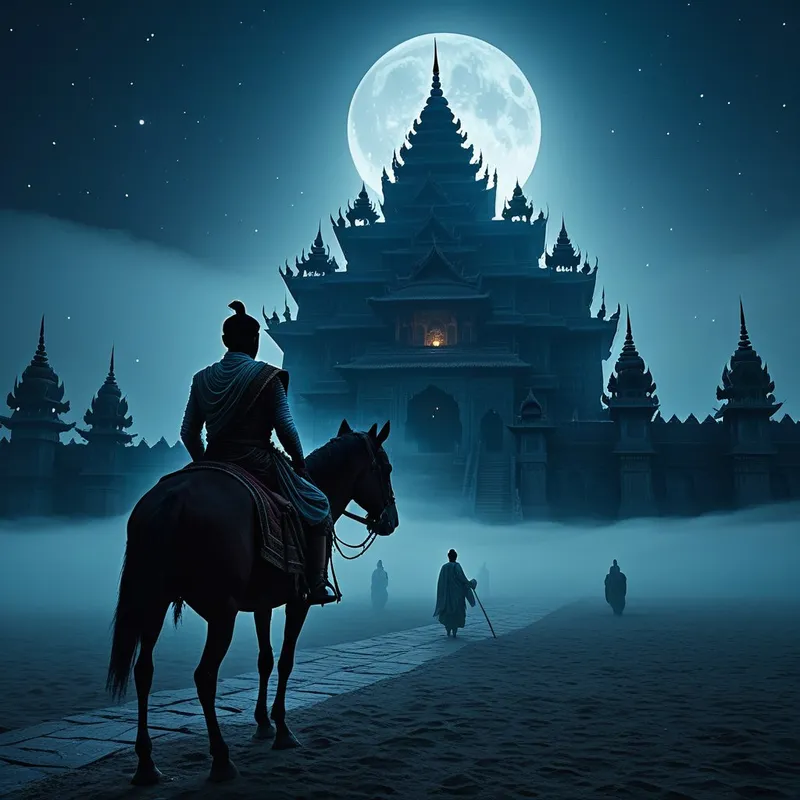
That night, the perfume of the palace gardens smelled of imprisonment. The laughter of the dancers sounded like echoes in a tomb. Gazing upon his sleeping wife and newborn son, Rahula, with a love so sharp it was a kind of agony, he made his choice. In the silent heart of midnight, he mounted his horse Kanthaka, and with Channa, slipped into the enveloping dark. He cut his princely hair, exchanged silks for the rough cloth of a seeker, and sent his weeping companion back with his horse. Alone, he began the great search.
For years, he walked the dusty roads, sitting at the feet of famed teachers, mastering states of profound meditation. Still, the core question burned: what is the cause of this universal suffering? He joined five ascetics and pursued the path of extreme self-denial, starving his body to near dissolution, believing freedom lay in crushing the flesh. But enlightenment did not come; only weakness and delusion. Realizing this too was an extreme, a bondage of its own, he accepted a simple bowl of milk-rice from a village woman named Sujata. His companions, seeing him break his fast, left in disgust.
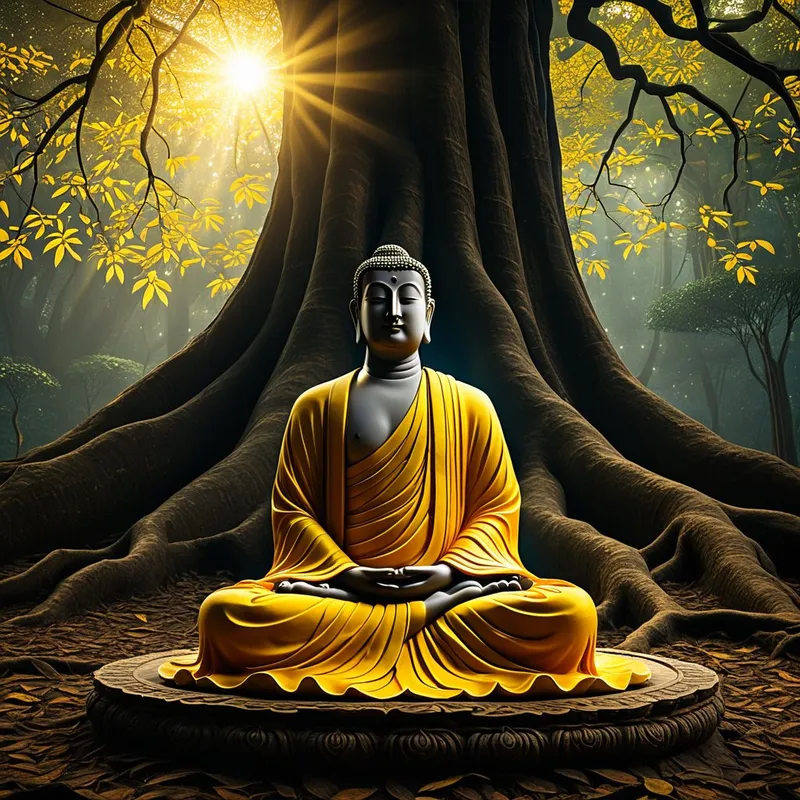
Alone again, but with a body restored to balance, he walked to a place near the town of Gaya. A magnificent Bodhi tree stood sentinel. He spread a mat of kusha grass at its roots, vowing not to rise until he had found the answer. As he sat, the demon Mara, lord of illusion and desire, unleashed his army. Fearsome warriors shot arrows that turned to flowers. Mara’s beautiful daughters danced with seductive promise. Mara himself challenged Siddhartha’s right to sit on the seat of enlightenment. “Who bears witness for you?” he thundered. In response, Siddhartha touched the earth with his right hand. The earth itself roared, “I bear witness!” and Mara fled.
In the deep silence that followed, through the watches of the night, his mind pierced the final veils. He saw the endless cycle of his own past lives, the law of karma, and the chain of causation that binds beings to suffering: the Four Noble Truths and the Noble Eightfold Path became clear. As the morning star glittered in the pre-dawn sky, the last trace of ignorance fell away. The seeker was no more. The Buddha, the one who is awake, sat in the unshakable peace of Nirvana. The long night of the world had found its dawn.
Cultural Origins & Context
This is not a myth of distant gods, but the sacred biography of a historical figure, Siddhartha Gautama, who lived in the 5th century BCE in the northeastern region of the Indian subcontinent. The stories were not initially written down but were preserved and elaborated within the oral tradition of the monastic community, the Sangha. They were recounted to inspire renunciants, to provide a template for the spiritual journey, and to offer lay followers a relatable, human figure who achieved the ultimate goal. Texts like the Pali Canon and later Sanskrit works like the Jataka tales (stories of the Buddha’s past lives) served as the primary vessels. The tale functioned as a societal mirror, challenging the rigid hierarchies of Brahmanical ritualism and the materialism of merchant kingdoms, proposing instead that liberation was an internal conquest available to anyone, regardless of birth, who walked the path with diligence.
Symbolic Architecture
The myth is a perfect map of the psyche’s journey from identification with the persona to the realization of the Self. The palace represents the constructed self, the persona—the life built on conditioned desires, societal expectations, and the avoidance of pain. It is comfortable, but ultimately a gilded prison of ignorance (avidya).
The Great Departure is not an abandonment of the world, but the soul’s necessary rebellion against a life lived inauthentically, a breaking of the parental and cultural complex that defines our identity for us.
The Four Sights—Old Age, Sickness, Death, and the Ascetic—are the unavoidable eruptions of the unconscious, the shadow realities that the conscious ego has walled out. They force a confrontation with life’s most profound truths: impermanence (anicca) and inherent unsatisfactoriness (dukkha). The ascetic represents the first conscious pull of the Self, the archetype of wholeness, calling the ego to a greater destiny.
The years of austerity symbolize the ego’s mistaken attempt to achieve wholeness through negation, by defeating the “base” instincts of the body and world. This is the inflation of the spiritual ego, which must also be surrendered. Accepting Sujata’s offering is the critical integration of the middle way, rejecting both hedonism and self-punishment, embracing a conscious relationship with the physical and instinctual.
The final battle with Mara under the Bodhi tree is the ultimate confrontation with the personal and collective unconscious. Mara’s armies are our own neuroses, fears, and addictive desires; his daughters, our projected fantasies of fulfillment; his challenge, our deepest insecurity about our own worthiness. The Earth-Touching gesture (Bhumisparsha Mudra) is the profound moment of grounding. It symbolizes the ego’s alignment with reality itself, with the solid, undeniable truth of one’s own experience and being, which alone can dispel illusion.
The Dreamer's Resonance
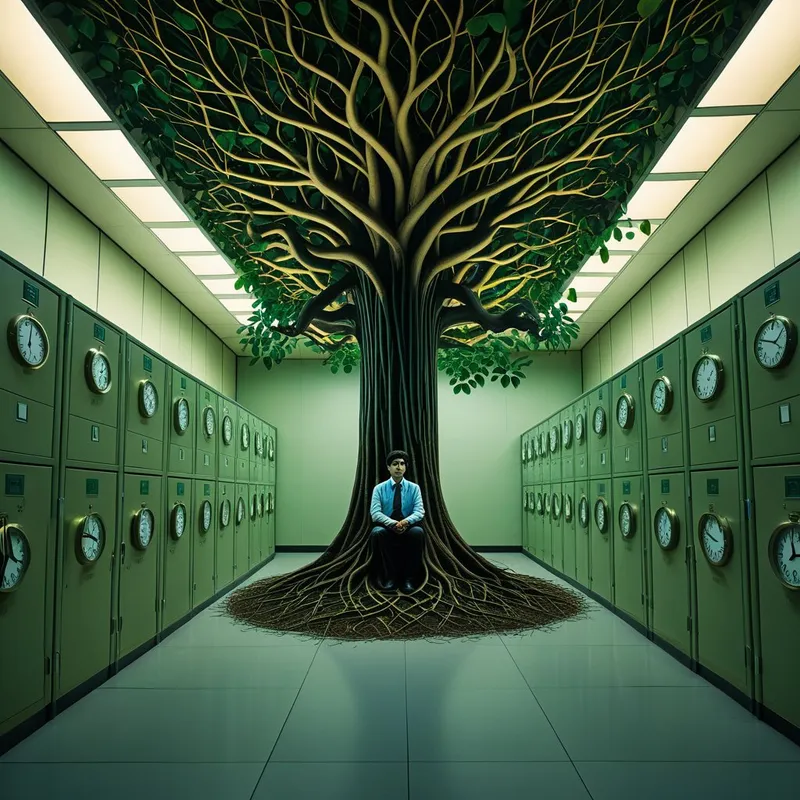
When this mythic pattern stirs in modern dreams, it signals a profound crisis of meaning and a call to individuation. One might dream of being trapped in a beautiful but sterile modern “palace”—a corner office, a perfect home, a prestigious career—that suddenly feels suffocating. Dreams of encountering a sick, aged, or dying figure, or of a calm, silent guide, often precede a life transition, forcing the dreamer to confront mortality, limitation, or the emptiness of their current pursuits.
A dream of cutting one’s hair, changing clothes, or walking away from a familiar city into darkness reflects the active, often terrifying, initiation of the ego into a deeper process. Somatic sensations may accompany these dreams: a tightness in the chest (the palace walls), a profound fatigue (the futile asceticism), or, at the moment of breakthrough, a sensation of immense lightness and solidity simultaneously—the somatic signature of the Earth-Touching, of coming home to one’s own embodied truth.
Alchemical Translation
The alchemy modeled here is the transmutation of suffering (dukkha) into wisdom (prajna) and compassion (metta). For the modern individual, the palace is any identity complex we are fused with—the successful professional, the perfect parent, the eternal youth. The alchemical process begins with the “sight,” the shock that disrupts the fantasy. This is often a personal loss, failure, illness, or simply a deep, inarticulate yearning that material success cannot soothe.
The journey is not about finding a new belief system, but about developing the capacity to sit in the fire of uncertainty, at the root of your own Bodhi tree, and not move until you have seen through the illusion of a separate, suffering self.
The “ascetic phase” is our modern obsession with self-optimization, extreme diets, spiritual bypassing, or intellectual cynicism—all attempts to think or discipline our way out of the human condition. The “Sujata moment” is the grace of accepting our humanness, our needs, our vulnerabilities, and finding the Middle Way in our actual, messy lives.
The confrontation with Mara happens in our meditation cushion, in therapy, or in the quiet moments of despair. It is facing the chorus of inner critics, the seductive pull of old habits, the fundamental doubt: “Who am I to seek wholeness?” The alchemical victory is the Earth-Touching: the moment we stop seeking outside validation or escape, and instead, fully inhabit our present, embodied experience—our breath, our feelings, the ground beneath us. This is the Nirvanic moment within the psyche, where the conflict between ego and Self dissolves, not into nothingness, but into a luminous, compassionate engagement with all that is. The Buddha does not leave the world; he returns to it, transformed, to teach. So too, the individuated psyche does not abandon life, but returns to it, able to hold its joy and its sorrow with an awakened heart.
Associated Symbols
Explore related symbols from the CaleaDream lexicon: